Grade 3 Ontario Math: Spatial Sense
Twenty-six printable pages for the whole Grade 3 Spatial Sense strand: 3D objects and their faces, edges and vertices, structures, congruence, turns and directions, metric length and perimeter, capacity and mass with non-standard units, telling time to the second, and comparing and measuring area. Teacher notes, a two-part assessment and full answer keys included.
26 printable pages · teacher notes and answer key · Ontario · Common Core (US)
This pack isn't on your account yet. Buy it below, or sign in with the email you bought it with.
Yours to keep, with free updates. Pay by card in Canadian or US dollars:
Also in the Grade 3 Ontario Math: The Whole Year bundle (C$39 / US$29).
Included in every school licence: one purchase order covers every pack for your whole staff.
Already bought it? Download the PDF (sign in with the email you bought it with).
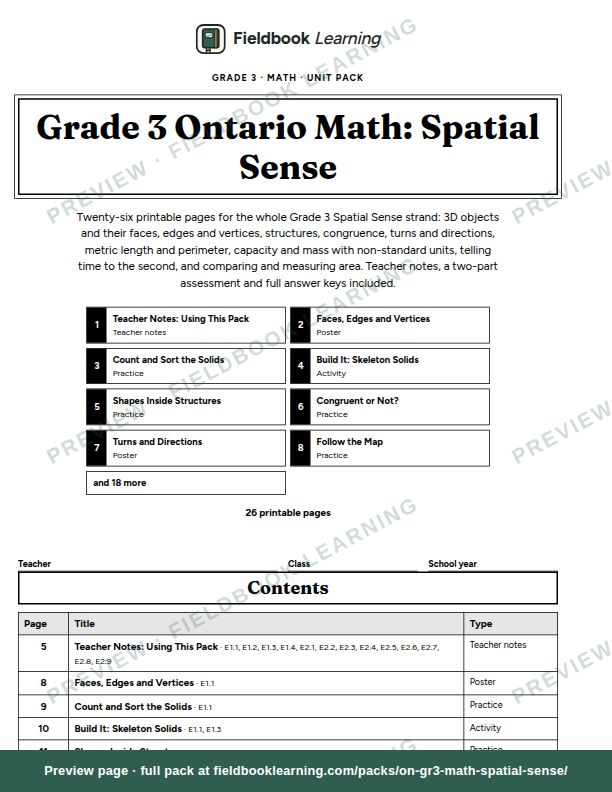
This pack covers every specific expectation in the Grade 3 Spatial Sense strand of the 2020 Ontario math curriculum, E1.1 to E2.9. Geometry comes first: faces, edges and vertices of cubes, prisms, pyramids, cylinders and cones, the shapes hiding inside real structures, congruent objects, and directions with quarter-turns and half-turns. Then comes measurement: millimetres to kilometres, perimeter, capacity and mass with non-standard units, telling time to the second, and area, first by comparing and then in square centimetres and square metres.
Each topic opens with a short teaching page or poster with a worked example in plain words, and then hands-on work and practice. Grids, maps and area shapes are drawn in black and white, so they photocopy cleanly and nothing depends on colour. Students build skeleton solids from straws and clay, follow and write directions on a town map, program a partner like a robot, pour and weigh with scoops and cubes on a pan balance, and cover shapes with sticky notes before they count square centimetres. The page on length relationships is generated, so every answer is computed and checked.
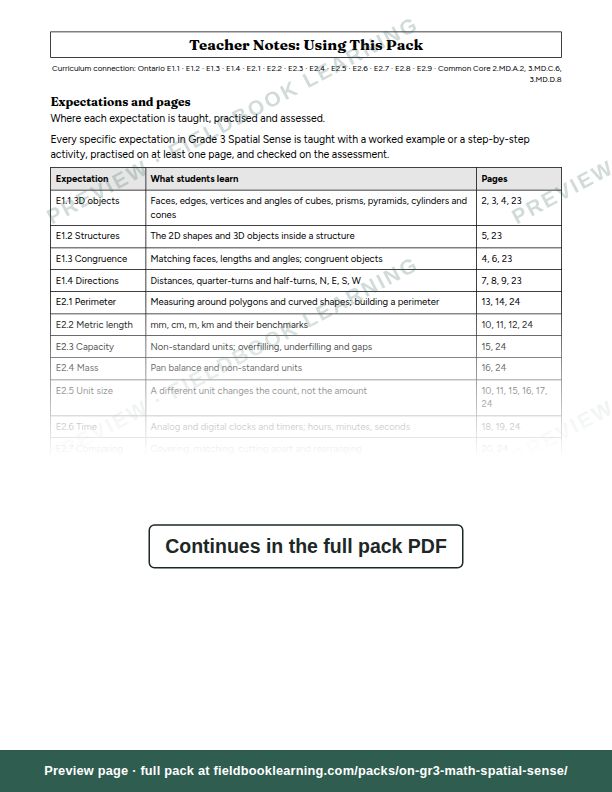
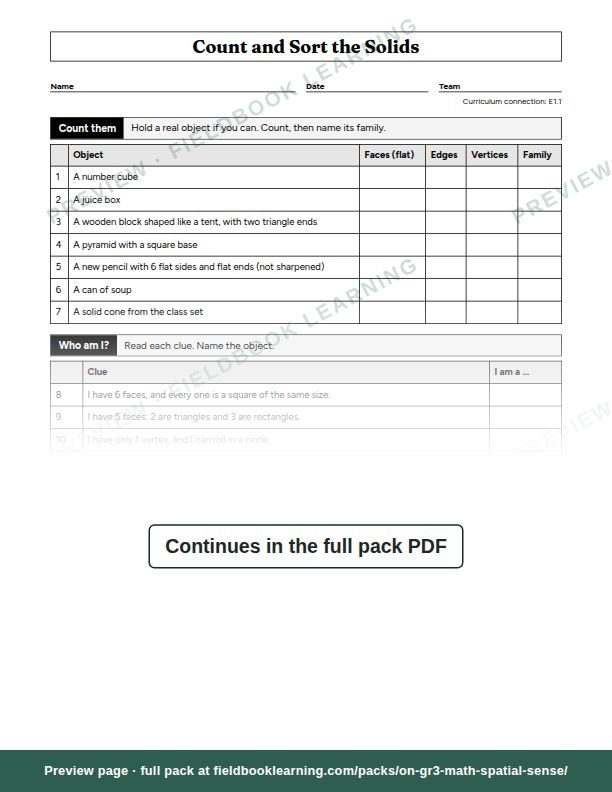
Inside: teacher notes with a teaching order, timing, materials, differentiation, the common misconceptions for each expectation and a map of expectations to pages; four teaching posters; five hands-on activities; eleven practice pages, two of them opening with a worked example; a partner game; a two-part end-of-strand assessment (part 1 also works as a mid-strand check); and answer keys with the working shown. The free sample is the teacher notes and the page on counting faces, edges and vertices.
Sample pages
What's inside
- 01Teacher Notes: Using This PackTeacher notes
- 02Faces, Edges and VerticesPoster
- 03Count and Sort the SolidsPractice
- 04Build It: Skeleton SolidsActivity
- 05Shapes Inside StructuresPractice
- 06Congruent or Not?Practice
- 07Turns and DirectionsPoster
- 08Follow the MapPractice
- 09Robot Moves: A Partner GameGame
- 10Millimetres to KilometresPoster
- 11Estimate, Then MeasureActivity
- 12Length RelationshipsPractice
- 13Around the Edge: PerimeterPractice
- 14Build a PerimeterPractice
- 15Fill It Up: CapacityActivity
- 16Balance It: MassActivity
- 17Same Thing, Different UnitsPractice
- 18Hours, Minutes and SecondsPoster
- 19What Time Is It?Practice
- 20Comparing AreasPractice
- 21Cover It: Units of AreaActivity
- 22Square Centimetres and Square MetresPractice
- 23Assessment Part 1: Geometry and DirectionsAssessment
- 24Assessment Part 2: MeasurementAssessment
- 25Answer Key: Generated PageAnswer key
- 26Answer Key: Hand-Written PagesAnswer key