Grade 5 Ontario Math: Spatial Sense
Twenty-six printable pages for the whole Grade 5 Spatial Sense strand: measuring angles with wedges and protractors, sorting and constructing triangles, congruent shapes, top, front and side views, coordinates on grids with different scales, metric units and conversions, the area of parallelograms and triangles, and same area with different perimeters. Teacher notes, a check-in, a two-part assessment and full answer keys included.
26 printable pages · teacher notes and answer key · Ontario · Common Core (US)
This pack isn't on your account yet. Buy it below, or sign in with the email you bought it with.
Yours to keep, with free updates. Pay by card in Canadian or US dollars:
Also in the Grade 5 Ontario Math: The Whole Year bundle (C$39 / US$29).
Included in every school licence: one purchase order covers every pack for your whole staff.
Already bought it? Download the PDF (sign in with the email you bought it with).
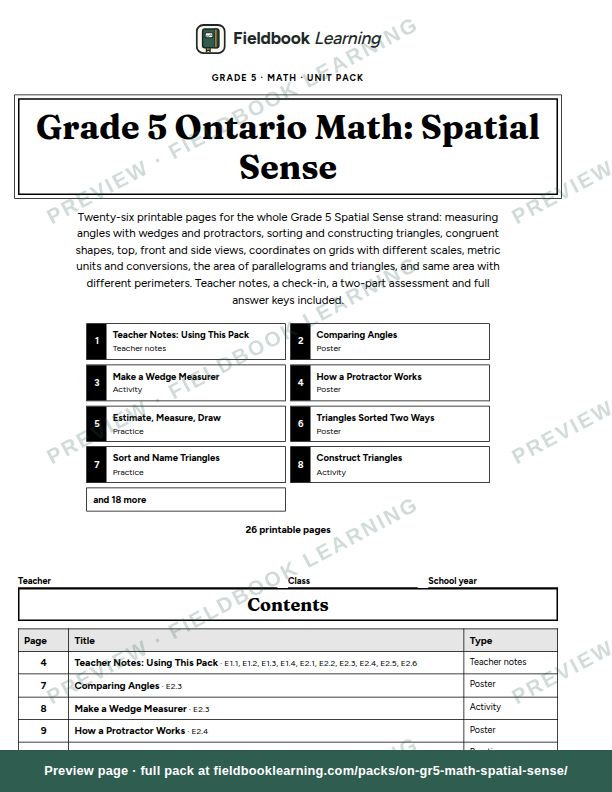
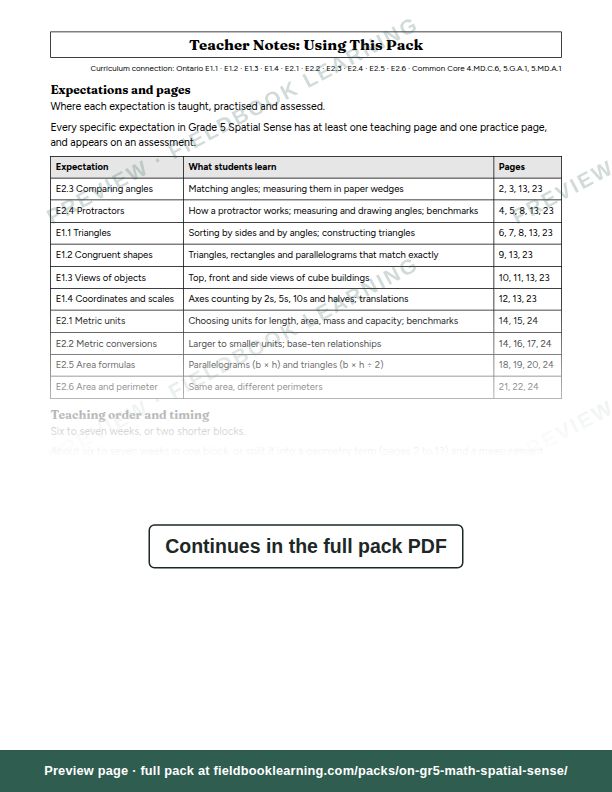
This pack covers every specific expectation in the Grade 5 Spatial Sense strand of the 2020 Ontario math curriculum, E1.1 to E2.6, in the order that makes the most sense to teach them. Angles come first: students compare angles with paper wedges, then learn how a protractor works and why. With a protractor in hand they sort and construct triangles, build congruent shapes, draw top, front and side views of cube buildings, and read coordinate grids that count by 2s, 5s, 10s and halves. The measurement half covers choosing metric units, converting between them, the area of parallelograms and triangles, and shapes with the same area but different perimeters.
Each topic opens with a short teaching page or poster with a worked example in plain words, and then practice. Grids, angles and shapes are drawn in black and white, so they photocopy cleanly and nothing depends on colour. Students fold a paper circle into a wedge measurer, construct triangles with a compass, build cube buildings from a plan, measure real objects against benchmarks, and cut a parallelogram into a rectangle to see where its area formula comes from. The conversion page and the area and perimeter page are generated, so every answer is computed and checked.
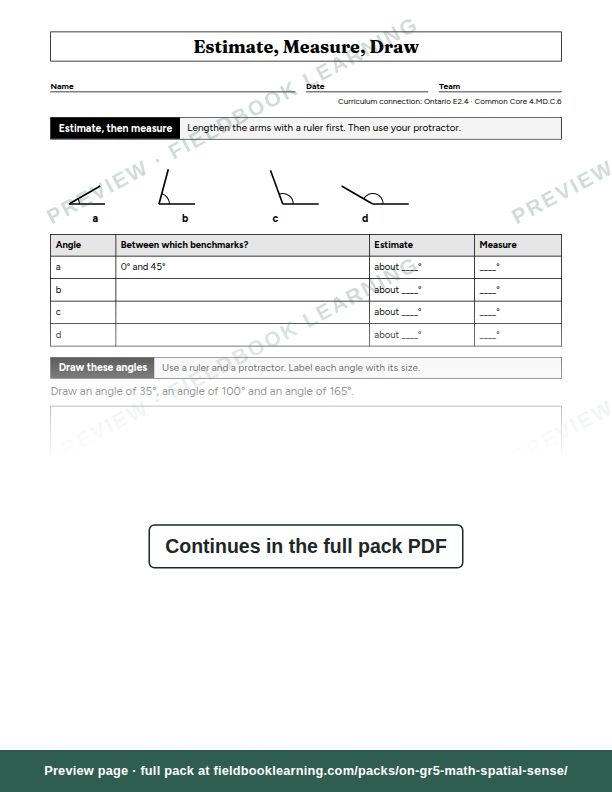
Inside: teacher notes with a teaching order, timing, materials, differentiation, the common misconceptions for each expectation and a map of expectations to pages; six teaching posters; five hands-on activity pages; nine practice pages; a mid-strand check-in; a two-part end-of-strand assessment; and answer keys with the working shown. The free sample is the teacher notes and the protractor practice page.
Sample pages
What's inside
- 01Teacher Notes: Using This PackTeacher notes
- 02Comparing AnglesPoster
- 03Make a Wedge MeasurerActivity
- 04How a Protractor WorksPoster
- 05Estimate, Measure, DrawPractice
- 06Triangles Sorted Two WaysPoster
- 07Sort and Name TrianglesPractice
- 08Construct TrianglesActivity
- 09Congruent ShapesPractice
- 10Top, Front and Side ViewsPoster
- 11Build It, Draw ItActivity
- 12Grids with Different ScalesPractice
- 13Check-In: Angles, Shapes and GridsAssessment
- 14Choosing Metric UnitsPoster
- 15Estimate, Then MeasureActivity
- 16Metric ConversionsPractice
- 17Mixed-Unit ProblemsPractice
- 18From Rectangles to Parallelograms and TrianglesPoster
- 19Find the AreaPractice
- 20Area ProblemsPractice
- 21Rectangles: Area and PerimeterPractice
- 22Same Area, Different PerimeterActivity
- 23Assessment Part 1: Angles, Shapes and GridsAssessment
- 24Assessment Part 2: MeasurementAssessment
- 25Answer Key: Generated PagesAnswer key
- 26Answer Key: Hand-Written PagesAnswer key