Years 4–5 in England and Wales · Cambridge Primary Stages 4–5 · IB PYP, ages 8–10
Fair Shares: Fractions and Decimals
Is half always the same size? Where does three-quarters stand? Why is 3/4 + 2/4 not 5/8? Who jumped further, 1.4 m or 1.35 m? Four hands-on lessons where students fold, stand on a giant number line, measure recipes and measure their own jumps to make sense of fractions and decimals.
Or try any 3 lessons free with an account. Prices in US dollars.
Already bought it? Download the whole unit as one printable workbook (61 pages): cover, contents, curriculum connections, every lesson, readings, practice pages, a unit test and an answer key, in black and white. Want to change the wording? Get every student page as one editable Word file.
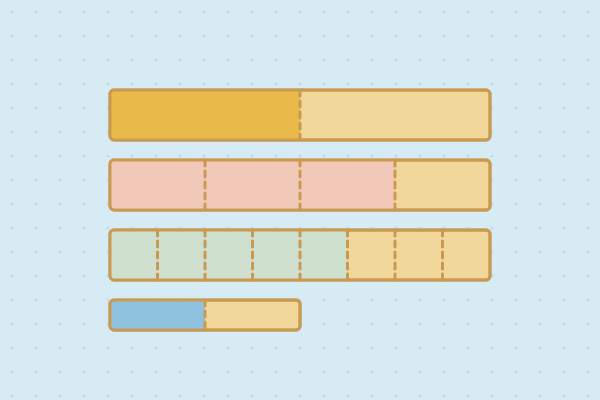
4 lessons in this unit
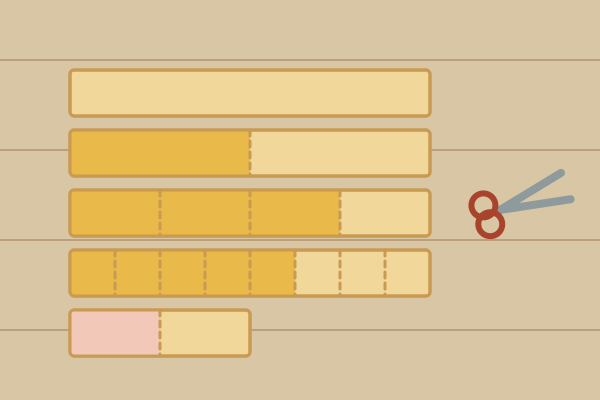 Lesson 1 · 50–60 min · 7 pagesIs half always the same size?Teams fold and cut paper granola bars into halves, quarters, eighths, thirds and sixths, and discover that a quarter of a long bar is exactly as long as a half of a short one. Students explain that a fraction names equal parts of a whole, and that the same fraction of a different whole can be a different amount.
 Lesson 2 · 50–60 min · 8 pagesWhere does three-quarters stand?The class builds a giant number line from 0 to 2 on the playground, and each student stands where their fraction card belongs. Students discover that 1/2, 2/4 and 4/8 all stand on the same spot, and explain fractions as numbers with a place on the line, equivalent fractions and how to compare fractions with benchmarks.
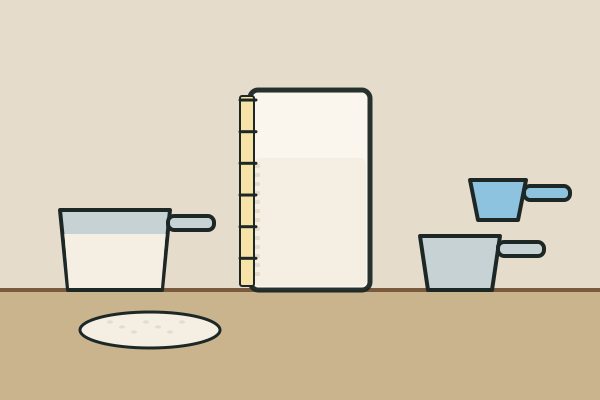 Lesson 3 · 50–60 min · 8 pagesWhich recipe makes more?Teams measure three trail-mix recipes with fraction cups and dry rice, and find that 3/4 cup plus 2/4 cup overflows the 1-cup mark. Students add and decompose fractions with the same denominator, catch the 'add the bottoms too' mistake with real evidence, and compare totals greater than one.
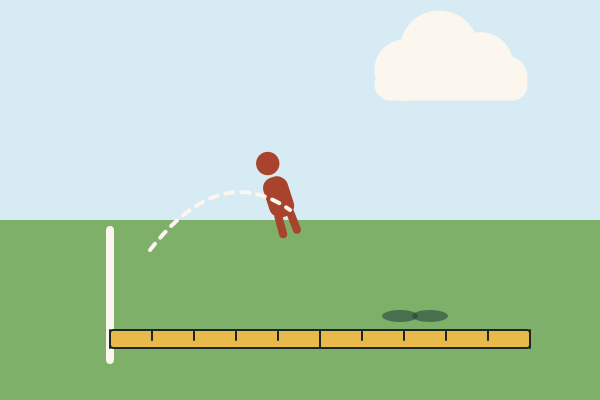 Lesson 4 · 50–60 min · 7 pagesWho jumped further, 1.4 m or 1.35 m?Students do standing long jumps, measure them to the centimetre and write them as decimals of a metre, then settle an argument: is 1.35 m further than 1.4 m because 35 is bigger than 4? Students explain tenths and hundredths with a metre stick, write them as fractions and decimals, and compare decimals correctly.
Materials for the whole unit · one list, lesson by lesson
Lesson 1: Is half always the same size?
- Paper strips 24 cm by 4 cm (the long bars)6 per team
- Paper strips 12 cm by 4 cm (the short bars)2 per team
- 30 cm (12 in) ruler1 per team
- Scissors and a pencil1 per student
Free: paper, rulers and scissors you already have
Lesson 2: Where does three-quarters stand?
- Sidewalk chalk or masking tape2 pieces or 1 roll
- Metre stick or 3 m measuring tape1 per team
- Fraction cards (from the Worksheet)1 set for the class
Free with chalk or tape you already have
Lesson 3: Which recipe makes more?
- Measuring cups: 1 cup, 1/2 cup, 1/3 cup and 1/4 cup1 set per team
- Clear straight-sided container, about 500 mL (2 cups)1 per team
- Dry rice or dried lentilsAbout 2 cups (500 mL) per team
- Tray, masking tape and a marker1 each per team
About $10 for rice and a few cup sets if the school has none
Lesson 4: Who jumped further, 1.4 m or 1.35 m?
- Metre stick or 3 m measuring tape marked in centimetres1 per team
- Chalk or masking tape for the take-off line1 per team
- Beanbag (for the indoor or no-jump version)1 per team
Free with metre sticks and chalk or tape you already have
Students begin by folding paper granola bars into halves, quarters, eighths, thirds and sixths, and find that a quarter of a long bar is exactly as long as half of a short one: a fraction always depends on its whole. On the playground they stand on a giant number line from 0 to 2, where 1/2, 2/4, 3/6 and 4/8 crowd onto one spot. With measuring cups and dry rice they find that 3/4 cup plus 2/4 cup overflows the 1-cup mark, which ends the “add the bottoms” mistake for good. They finish by measuring their own standing long jumps to the centimetre and settling whether 1.35 m beats 1.4 m.
By the end of the unit, students can explain what the numerator and denominator mean, place fractions on a number line, find equivalent fractions, compare fractions with benchmarks, add fractions with the same denominator including totals greater than one, and read, write and compare decimals to hundredths as fractions of a metre. Everything uses paper, chalk, measuring cups, rice and metre sticks.