Stone, Bamboo and Storms: Building in Vietnam
Science and English together, for English learners (CEFR B1). Three investigations from Vietnam: how rain carved the limestone islands of Hạ Long Bay, why builders trust hollow bamboo, and how a roof can survive a typhoon.
Or try any 3 lessons free with an account.
Already bought it? Download the whole unit as one printable workbook: cover, contents, curriculum connections, every lesson, readings, practice pages, a unit test and an answer key, in black and white.
3 lessons in this unit
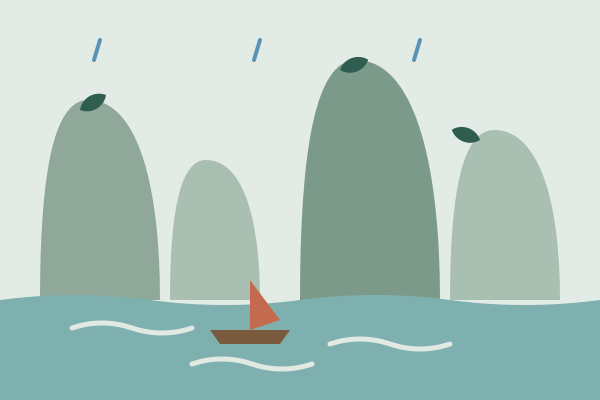 Lesson 1 · 60 min, plus 15 minutes the next dayHow did rain carve the islands of Hạ Long Bay?Science and English together, for English learners at CEFR B1. Teams drop limestone and shells into vinegar, water and soda water, watch for bubbles and weigh what is left the next day. Then they use the evidence to explain to a tour boat guide how weak acid in rain carved the towers and caves of Hạ Long Bay.
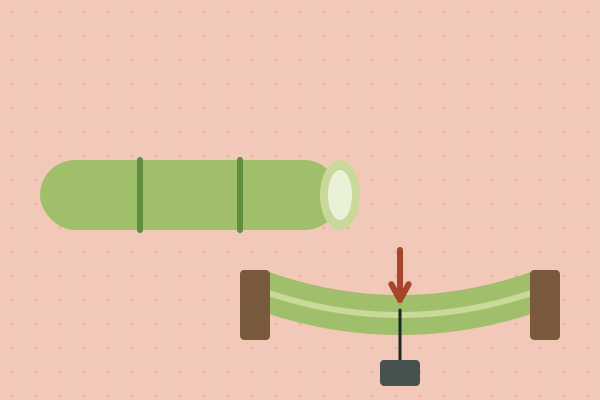 Lesson 2 · 60 min, or two 35-minute periodsWhy do builders in Vietnam trust bamboo?Science and English together, for English learners at CEFR B1. Teams make four beams from identical sheets of paper (a flat sheet, a solid rod, a hollow tube and a tube with 'nodes'), load each one with water until it bends, and work out strength per gram. Then they use the evidence to explain why bamboo is shaped the way it is, and design a bamboo footbridge.
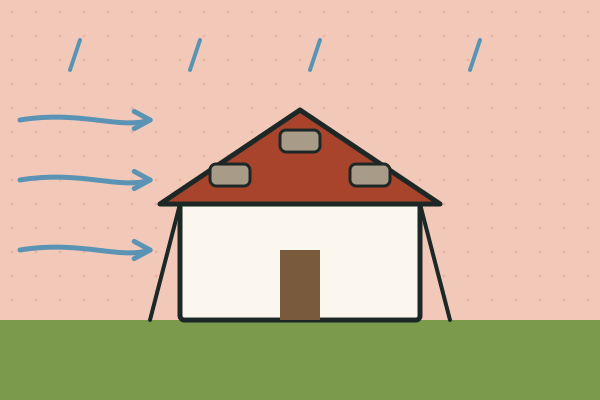 Lesson 3 · 60 min, or two 35-minute periodsHow can a roof survive a typhoon?Science and English together, for English learners at CEFR B1. Teams build a card house, then test roofs in the wind from a fan: loose, long overhang, short overhang, weighted and tied down. They use the results to explain why wind lifts roofs and to advise a family in Đà Nẵng before a typhoon.
Materials for the whole unit · one list, lesson by lesson
Lesson 1: How did rain carve the islands of Hạ Long Bay?
- Marble or limestone chips (garden or aquarium shop), or clean seashells or eggshells; all are calcium carbonateAbout 50 g per team
- White vinegar (the ordinary 4–5% kind)About 250 mL per team
- Unflavoured soda water (sparkling water)About 100 mL per team
- Tap waterAbout 150 mL per team
- Clear plastic cups, about 250 mL5 per team
- Kitchen scale that reads to 1 g (0.1 g is better)1 for the class, or 1 per two teams
- Paper towels1 roll for the class
- Safety glasses1 per student
- Magnifying glass1 per team, if you have them
- Masking tape and a marker for labels1 per team
About $15 for a class of 30, plus about $15 for a kitchen scale if you don't have one
Lesson 2: Why do builders in Vietnam trust bamboo?
- A4 paper, 80 g/m² (ordinary printer paper)5 sheets per team (one spare)
- Sticky tape1 roll per team
- Thick marker pen or glue stick, about 2.5 cm across, to roll tubes around1 per team
- Thin card discs about 2.5 cm across, cut from a cereal box (the 'nodes')3 per team
- Small plastic bottle with the top cut off and a string handle (the 'bucket')1 per team
- Measuring jug and a jug of water1 each per team
- Two stacks of books the same height, or two desks, with a 20 cm gap1 set per team
- Rulers, 30 cm2 per team
- Kitchen scale (optional), to weigh the beams and the bucket1 for the class
- Old towel or tray under the gap, for spills1 per team
About $8 for a class of 30, mostly paper, tape and recycled bottles
Lesson 3: How can a roof survive a typhoon?
- Small cardboard box, such as a shoebox or tissue box, for the house walls1 per team
- Thin card, A4, for roofs4 sheets per team
- Desk fan with a high setting, or a hair dryer on the COOL setting1 for the class (or 1 per 4 teams)
- Small zip bags with 20 g of rice (the 'sandbags')2 per team
- String1 m per team
- Masking tape30 cm per team
- Ruler, 30 cm, and a protractor1 each per team
- Scissors and a hole punch1 each per team
- Heavy book or a bag of 500 g of rice, to stop the house walls sliding1 per team
About $10 for a class of 30 if you have a fan; about $25 if you need to buy one
Vietnam is a country of stone, bamboo and storms. In Hạ Long Bay, about 1,600 limestone islands and islets rise straight out of the sea, shaped by rainwater over millions of years. In towns and villages, builders still tie bamboo into scaffolding and bridges. And every year, typhoons from the South China Sea (the East Sea, Biển Đông) test every roof on the coast.
Students investigate all three. They drop limestone and shells into weak acid and weigh what dissolves, test paper tubes, rods and sheets to find out why a hollow stem is so strong for its weight, and blow wind at model roofs to see which ones stay on. They come away able to explain how slow chemical weathering shapes landscapes, why shape matters as much as material, and how engineers use test data to make a design better.
Every lesson teaches English alongside the science: key words in English and Vietnamese, sentence frames for explaining, comparing and recommending, a speaking role-play, and readings at two levels.