 Preview · the opening mission
This lesson teaches science and English together (CLIL: content and language integrated learning). It is written for students learning English at about CEFR B1.
| Students will… | |
|---|---|
| Science | Show that limestone dissolves in acid and gives off a gas, that a stronger acid and more surface work faster, and explain how weak acid in rain shaped Hạ Long Bay over millions of years. |
| Language: words | Use the key words: limestone, rain, acid, carbon dioxide, dissolve, crack, cave, island, weathering, bubble. |
| Language: speaking | Describe a reaction: When we put the limestone in vinegar, bubbles appeared. Compare with numbers: The chips in vinegar lost 3 g, but the chips in water lost almost nothing. |
| Language: writing | Explain a process in order using first, then, after that, finally, and the passive: The rock is dissolved by the acid. |
Before the lesson: teach the key words with real things: a piece of limestone, a bottle of vinegar, a bottle of soda water, a photo of Hạ Long Bay. Open the soda water and ask, What are the bubbles? (A gas: carbon dioxide.) The Key words worksheet has English and Vietnamese, with a space for students' own language and a drawing.
Look inside the PDF
Sample pages, stamped “preview”. The download is the clean, full lesson.
In the full lesson PDF
- Mission (5 min)
- Predict (5 min)
- Hunt (25 min, plus 15 minutes tomorrow)
- Reveal (10–15 min)
- Act (10 min)
- Background for the teacher
- Assessment
- Student sheet
- Worksheet: Key words
- Worksheet: Talk about it
- Worksheet: Label the limestone
- Worksheet: Try it at home
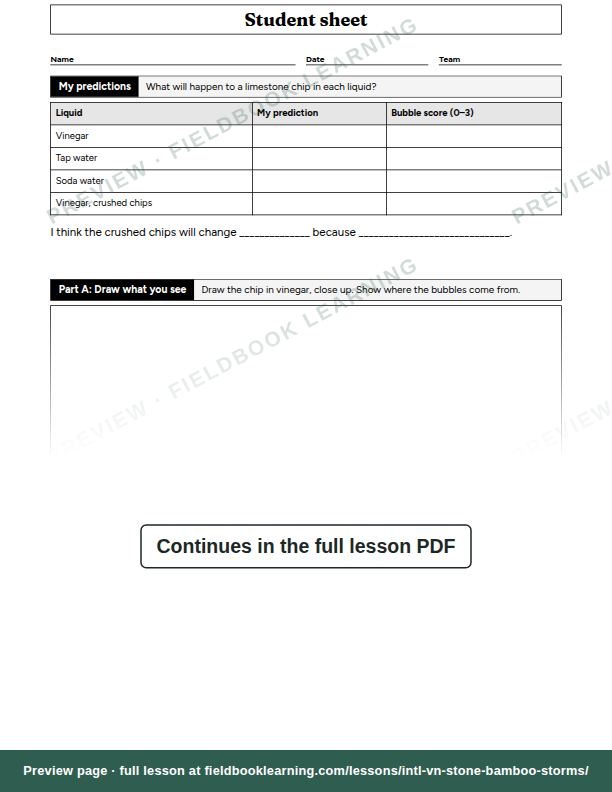
On the student sheet
- My predictions
- Part A: Draw what you see
- Part B: Our results
- Class results
- Graph it
- My explanation for the tourist boat
- Exit ticket
- Key words
- Talk about it
- Label the limestone
- Try it at home
US Letter, prints cleanly in black and white. The student sheet is on its own page, ready to photocopy.
Free with an account (any 3 lessons), or US$19 / C$25 for all 3 lessons in this unit.
What students show by the end
- Collects fair data
- Explains chemical weathering
- Uses evidence to explain the landscape
From the lesson’s rubric, which scores each one as not yet, getting there or got it.
Questions teachers ask
How long does “How did rain carve the islands of Hạ Long Bay?” take?
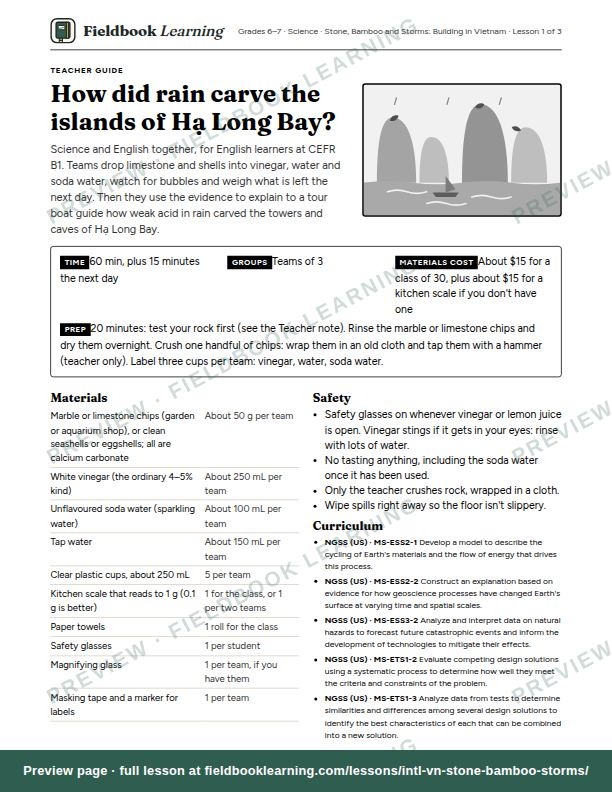
60 min, plus 15 minutes the next day. Group size: teams of 3.
How much prep does it need?
20 minutes: test your rock first (see the Teacher note). Rinse the marble or limestone chips and dry them overnight. Crush one handful of chips: wrap them in an old cloth and tap them with a hammer (teacher only). Label three cups per team: vinegar, water, soda water.
What materials do I need?
Marble or limestone chips (garden or aquarium shop), or clean seashells or eggshells; all are calcium carbonate; white vinegar (the ordinary 4–5% kind); unflavoured soda water (sparkling water); tap water; clear plastic cups, about 250 mL; kitchen scale that reads to 1 g (0.1 g is better); and 4 more. Cost: about $15 for a class of 30, plus about $15 for a kitchen scale if you don't have one.
Which curriculum standards does it cover?
NGSS (US): MS-ESS2-1, MS-ESS2-2, MS-ESS3-2, MS-ETS1-2 and MS-ETS1-3.
What’s in the lesson PDF?
A teacher guide that walks you through mission, predict, hunt, reveal, act, background for the teacher and assessment, then a student sheet (“My predictions”, “Part A: Draw what you see”, “Part B: Our results”, “Class results”, “Graph it”, “My explanation for the tourist boat”, “Exit ticket”, “Key words”, “Talk about it”, “Label the limestone” and “Try it at home”) on its own page, ready to photocopy. It’s US Letter and prints cleanly in black and white.
Can I try it for free?
Yes. A free account includes any 3 full lessons of your choice, and this can be one of them. After that, this unit is US$19 (C$25) for all 3 lessons, yours to keep, or every lesson is US$79 (C$109) a year.