Calendar and Leap Year Math
Grades 3 to 5 use the calendar as a math tool: days in the months, weeks and days with remainders, elapsed time, calendar patterns, the leap year rule, counting leap years and puzzles about February 29 birthdays. Includes a check-up and answer key.
12 printable pages · teacher notes and answer key · United States (Common Core)
This pack isn't on your account yet. Buy it below, or sign in with the email you bought it with.
Email me this sample
Editable student pages (Word): change the wording, add lines or cut a question. Opens in Word or Google Docs.
Yours to keep, with free updates. Pay by card in US dollars.
Included in every school licence: one purchase order covers every pack for your whole staff.
Already bought it? Download the PDF (sign in with the email you bought it with).
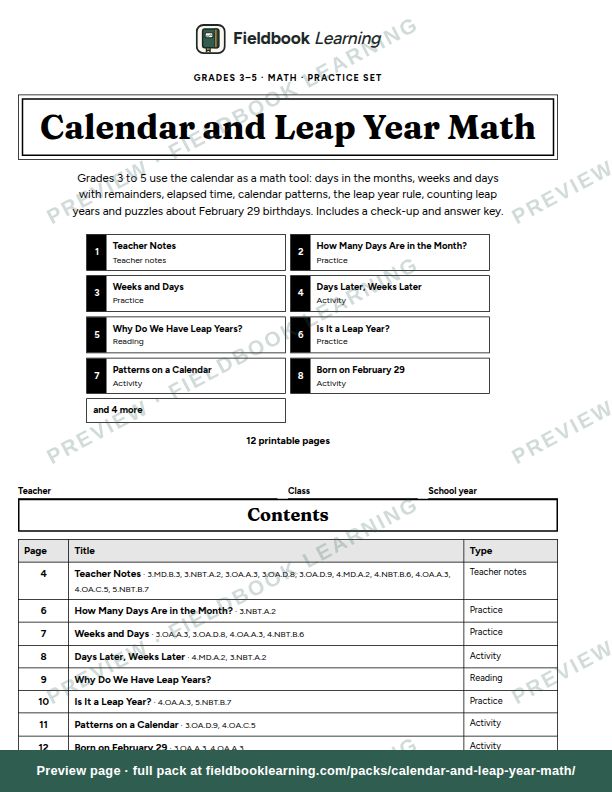
A calendar is a table, a clock for the year and a math tool all at once. This pack gives children in Grades 3 to 5 ten pages that use it: the knuckle trick for the days in each month, word problems with weeks and days, elapsed time that crosses the end of a month, patterns in a calendar grid, and a data page with a tally and a scaled bar graph.
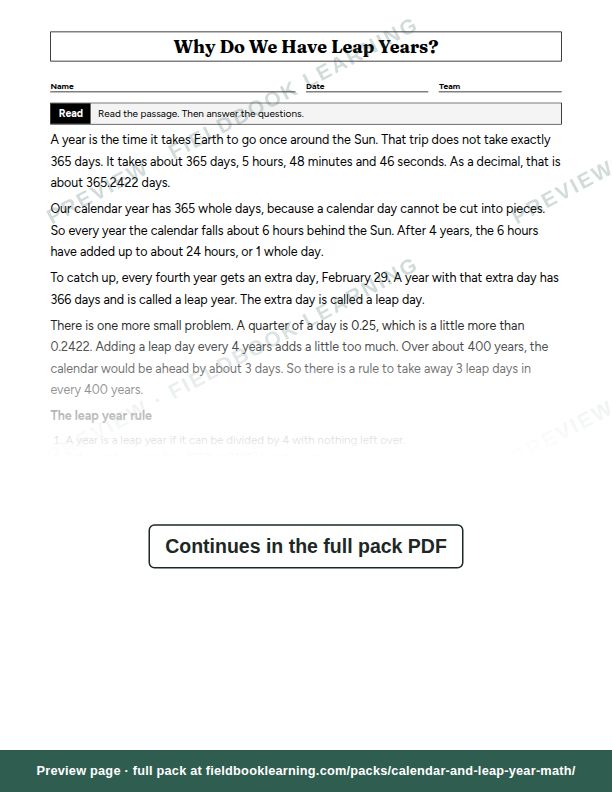
Then comes the big question: why do we have leap years? Children read how a year of about 365.2422 days leads to the rule (divisible by 4, except century years unless divisible by 400), test it on real years such as 1900, 2000 and 2100, count leap years in a range and solve puzzles about people born on February 29.
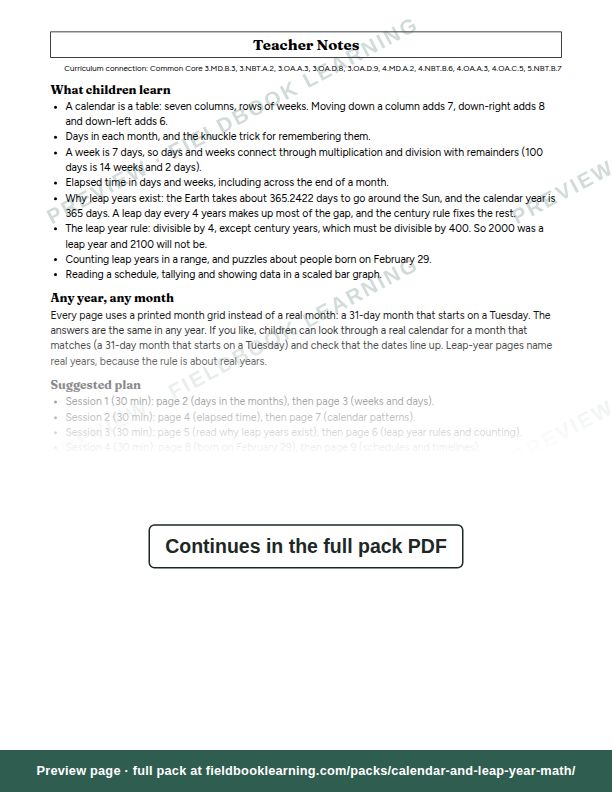
Every grid is a printed month that starts on a Tuesday, so the answers work in any year. Teacher notes give a five-session plan and ways to adjust the work for each grade. Inside: teacher notes, ten children’s pages (including a check-up of 8 questions) and a worked answer key. Print in black and white on any printer. The free sample is the teacher notes and the reading on why we have leap years.
Sample pages
What's inside
- 01Teacher NotesTeacher notes
- 02How Many Days Are in the Month?Practice
- 03Weeks and DaysPractice
- 04Days Later, Weeks LaterActivity
- 05Why Do We Have Leap Years?Reading
- 06Is It a Leap Year?Practice
- 07Patterns on a CalendarActivity
- 08Born on February 29Activity
- 09Schedules and TimelinesActivity
- 10Months by Length: Tally and GraphActivity
- 11Calendar and Leap Year Check-UpAssessment
- 12Answer KeyAnswer key
Reviews from buyers
You might also like
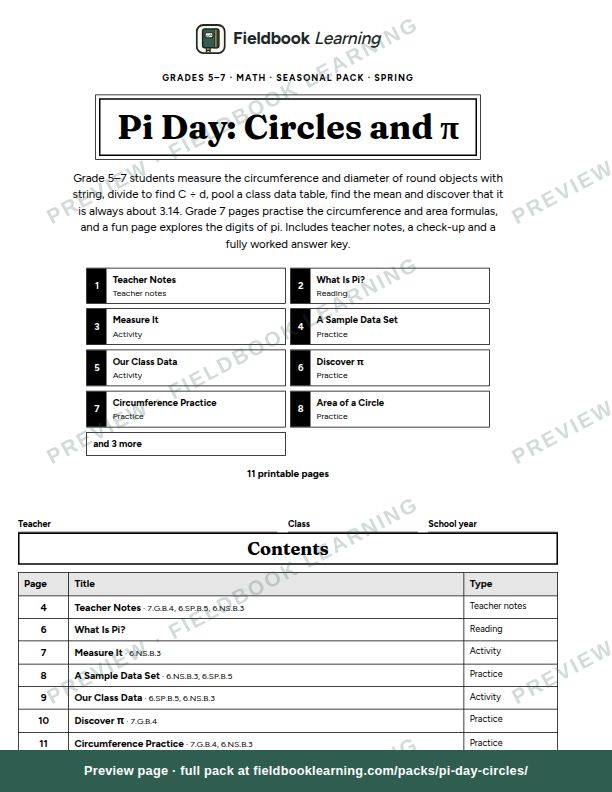
Pi Day: Circles and π
Grade 5–7 students measure the circumference and diameter of round objects with string, divide to find C ÷ d, pool a class data table, find the mean and discover that it is always about 3.14. Grade 7 pages practise the circumference and area formulas, and a fun page explores the digits of pi. Includes teacher notes, a check-up and a fully worked answer key.
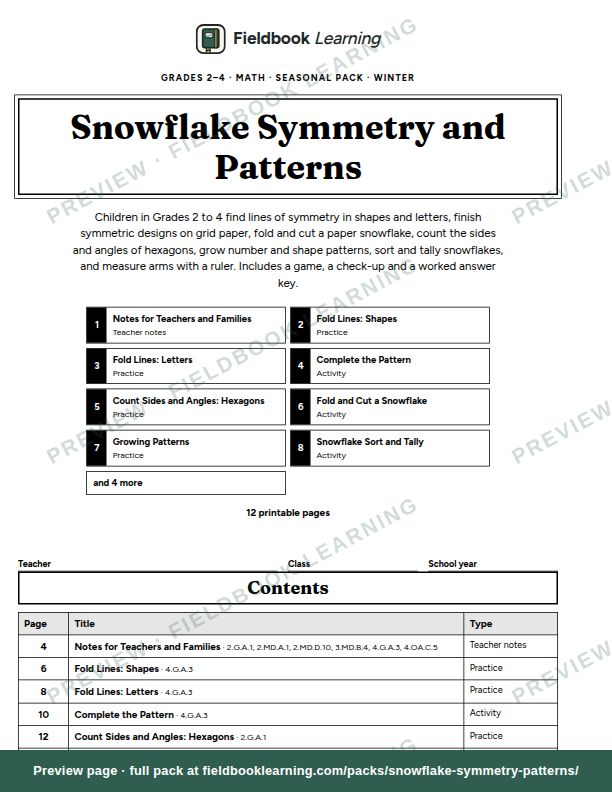
Snowflake Symmetry and Patterns
Children in Grades 2 to 4 find lines of symmetry in shapes and letters, finish symmetric designs on grid paper, fold and cut a paper snowflake, count the sides and angles of hexagons, grow number and shape patterns, sort and tally snowflakes, and measure arms with a ruler. Includes a game, a check-up and a worked answer key.
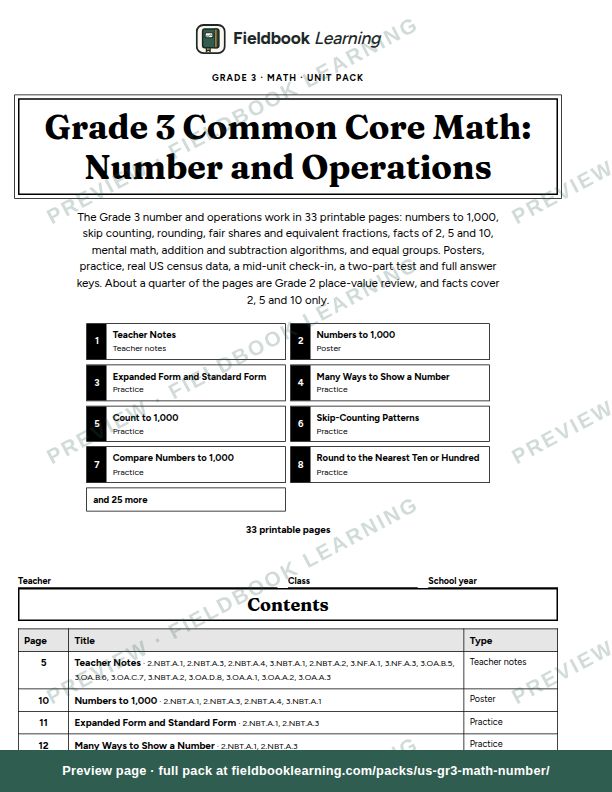
Grade 3 Common Core Math: Number and Operations
The Grade 3 number and operations work in 33 printable pages: numbers to 1,000, skip counting, rounding, fair shares and equivalent fractions, facts of 2, 5 and 10, mental math, addition and subtraction algorithms, and equal groups. Posters, practice, real US census data, a mid-unit check-in, a two-part test and full answer keys. About a quarter of the pages are Grade 2 place-value review, and facts cover 2, 5 and 10 only.