The Shortest Day: Daylight Science
Grade 2–4 children find out why winter days are short. They read about Earth's tilt, work out hours of daylight from real December and June sunrise and sunset times for Canadian and US cities, graph the results, compare noon shadow lengths and see why Australia's December is summer. Includes teacher notes, a cut-and-paste sort, exit tickets and a worked answer key.
11 printable pages · teacher notes and answer key · Ontario, Alberta, British Columbia, United States (Common Core)
This pack isn't on your account yet. Buy it below, or sign in with the email you bought it with.
Email me this sample
Editable student pages (Word): change the wording, add lines or cut a question. Opens in Word or Google Docs.
Yours to keep, with free updates. Pay by card in US dollars.
Included in every school licence: one purchase order covers every pack for your whole staff.
Already bought it? Download the PDF (sign in with the email you bought it with).
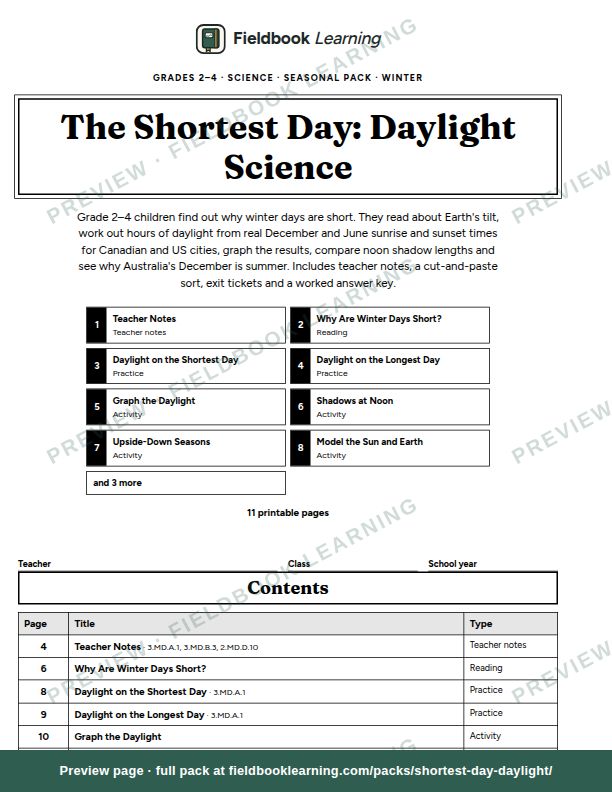
Why does the Sun go down so early in December? This pack answers it with real numbers. Children read about Earth’s tilt, then use sunrise and sunset times for Whitehorse, Edmonton, Vancouver, Toronto, Seattle and Miami on the December and June solstices of 2025 to work out how many hours of daylight each place gets. They graph the results, see that the places farthest north swing the most, and compare how long a shadow is at midday in winter and in summer.
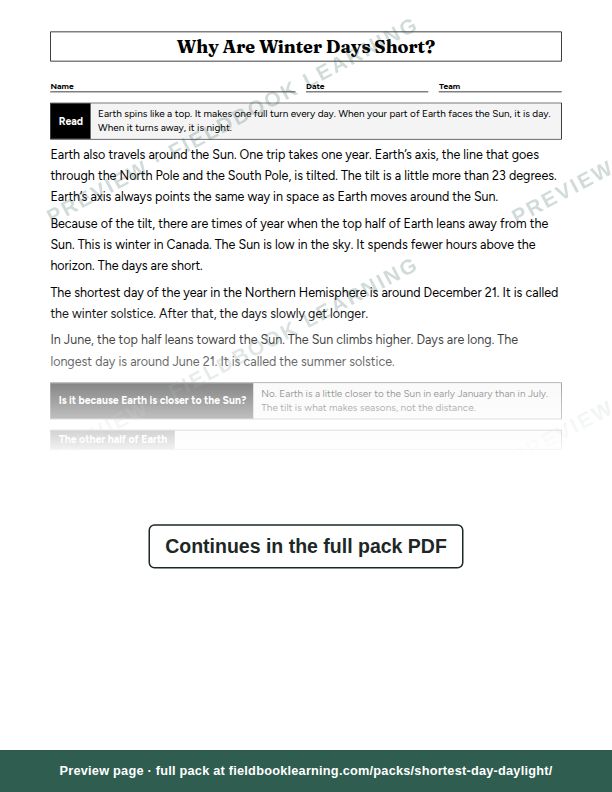
The winter solstice is taught here as science: Earth, the Sun and the tilt of the axis. One page looks at Sydney, Australia, where December has the longest days of the year, so children see that the same tilt makes opposite seasons in the north and south.
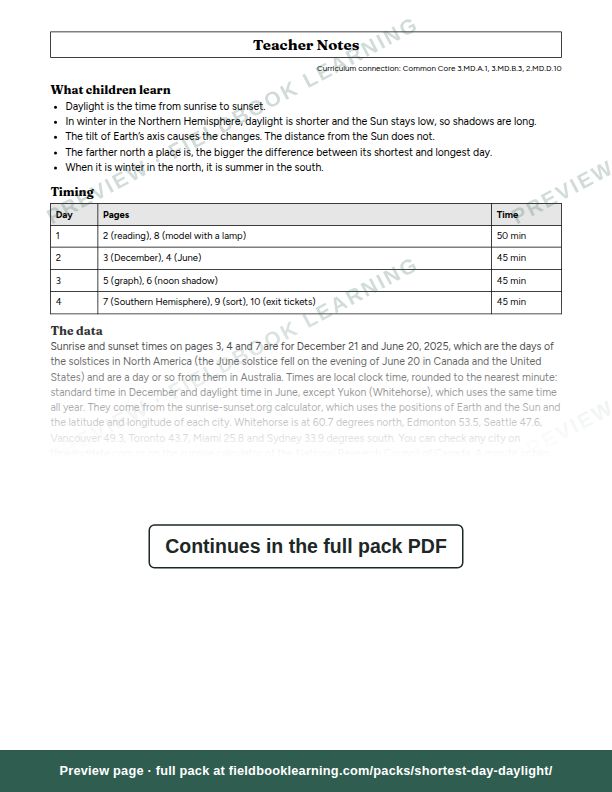
Inside: teacher notes with the data sources, a reading, two daylight-calculation pages, a graph page, a noon-shadow page, a Southern Hemisphere page, a model with a lamp and a ball, a cut-and-paste sort, exit tickets and an answer key with every answer worked. Print in black and white on any printer. The free sample is the teacher notes and the reading.
Sample pages
What's inside
- 01Teacher NotesTeacher notes
- 02Why Are Winter Days Short?Reading
- 03Daylight on the Shortest DayPractice
- 04Daylight on the Longest DayPractice
- 05Graph the DaylightActivity
- 06Shadows at NoonActivity
- 07Upside-Down SeasonsActivity
- 08Model the Sun and EarthActivity
- 09Which Half of Earth?Cut and paste
- 10Exit TicketsAssessment
- 11Answer KeyAnswer key
Reviews from buyers
You might also like
Science Fair Planner (K–8)
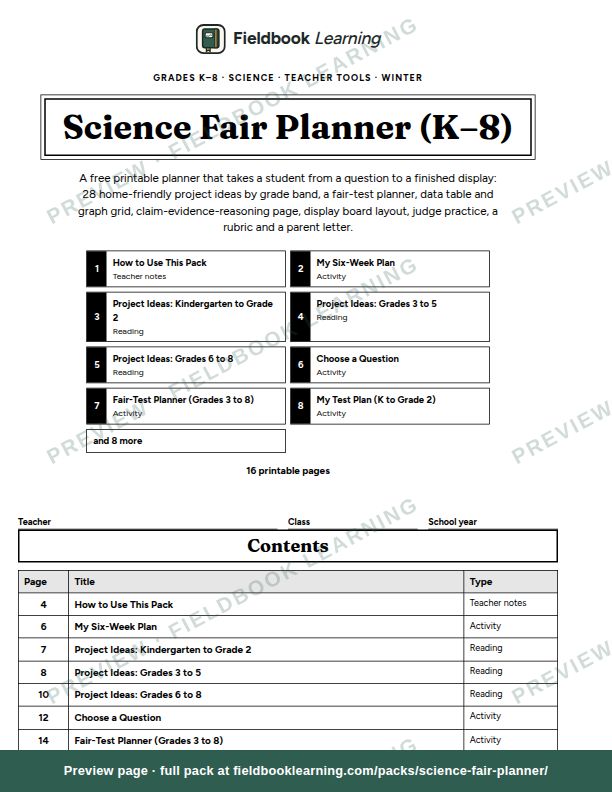
A free printable planner that takes a student from a question to a finished display: 28 home-friendly project ideas by grade band, a fair-test planner, data table and graph grid, claim-evidence-reasoning page, display board layout, judge practice, a rubric and a parent letter.
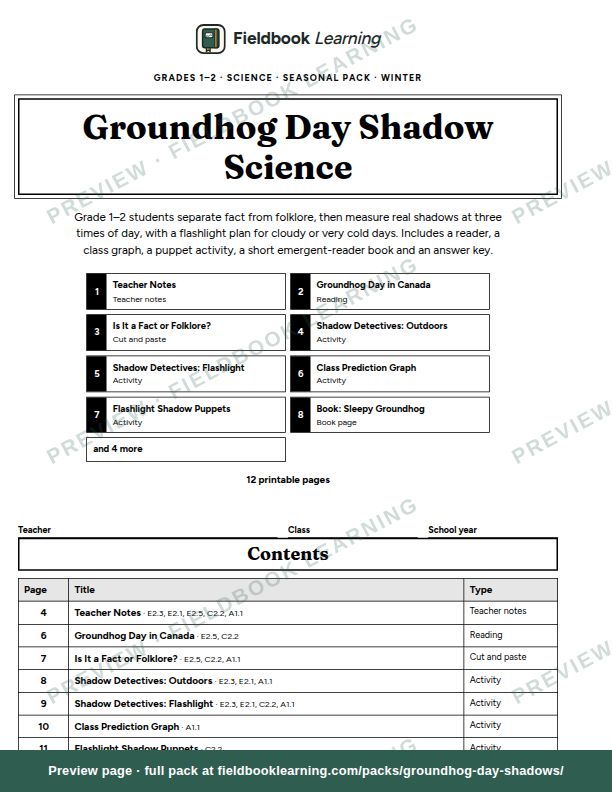
Groundhog Day Shadow Science
Grade 1–2 students separate fact from folklore, then measure real shadows at three times of day, with a flashlight plan for cloudy or very cold days. Includes a reader, a class graph, a puppet activity, a short emergent-reader book and an answer key.
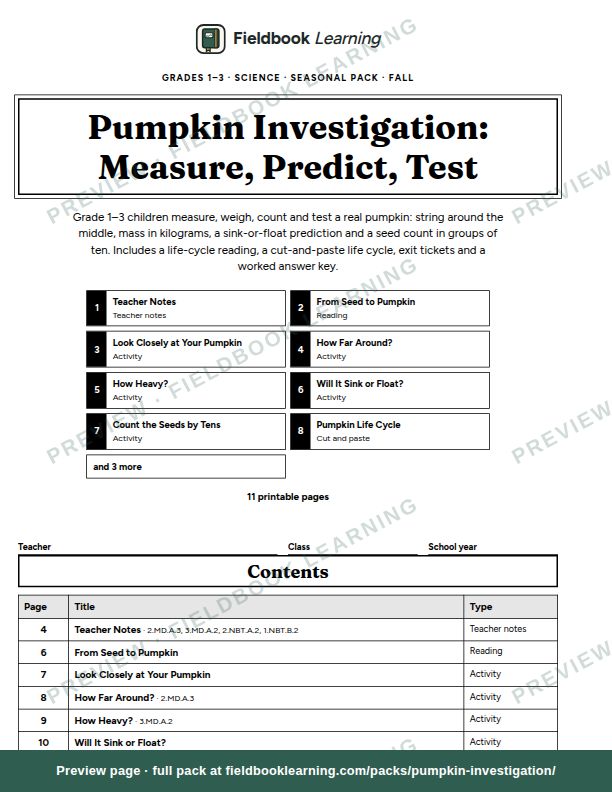
Pumpkin Investigation: Measure, Predict, Test
Grade 1–3 children measure, weigh, count and test a real pumpkin: string around the middle, mass in kilograms, a sink-or-float prediction and a seed count in groups of ten. Includes a life-cycle reading, a cut-and-paste life cycle, exit tickets and a worked answer key.