 Preview · the opening mission
Read this to the class:
Maya's bean plants were growing on the kitchen windowsill. One morning she noticed something funny. All the plants were leaning toward the window, like they wanted to look outside. "Grandpa, did you push them?" she asked. "Not me," said Grandpa. Your team's job: find out why plants lean toward the window, and whether a plant can find the light even inside a maze.
Teams of three, with jobs that swap each day: the Gardener turns and waters the plants, the Looker says which way the stems are pointing, and the Drawer leads the drawing while everyone draws on their own sheet.
Look inside the PDF
Sample pages, stamped “preview”. The download is the clean, full lesson.
In the full lesson PDF
- Predict (5 min)
- Hunt (20 min)
- Reveal (10–15 min)
- Act (10 min)
- Background for the teacher
- Assessment
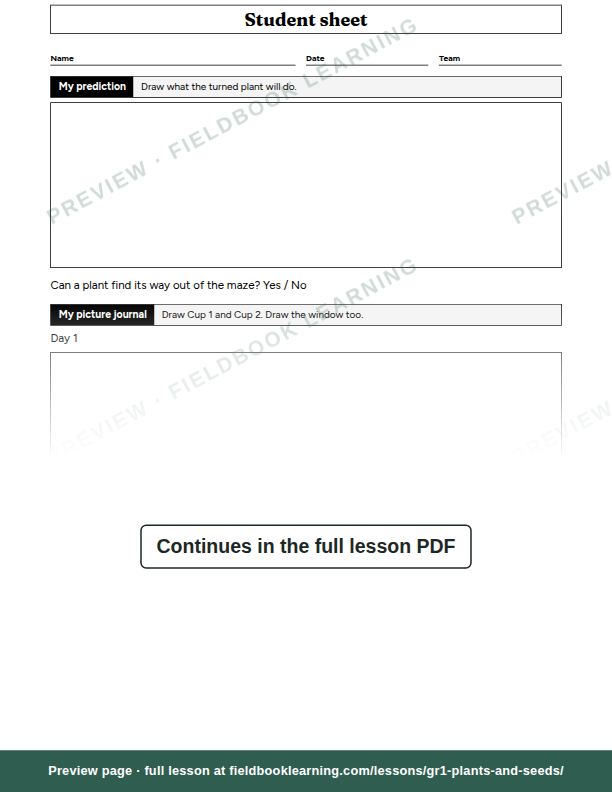
- Student sheet
On the student sheet
- My prediction
- My picture journal
- Which way?
- Help Maya
US Letter, prints cleanly in black and white. The student sheet is on its own page, ready to photocopy.
Free with an account (any 3 lessons), or US$19 / C$25 for all 3 lessons in this unit.
What students show by the end
- Observes the change
- Explains with light
- Uses evidence
From the lesson’s rubric, which scores each one as not yet, getting there or got it.
Questions teachers ask
How long does “Why do plants grow toward the window?” take?
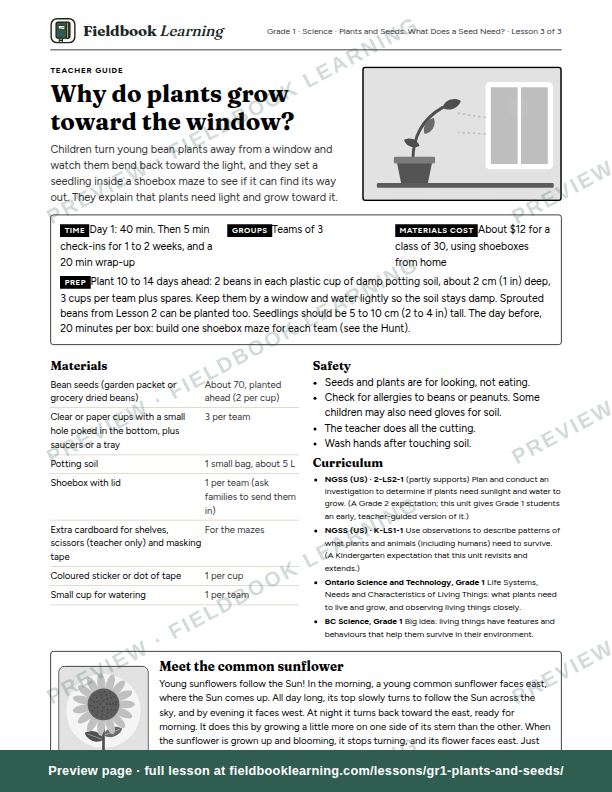
Day 1: 40 min. Then 5 min check-ins for 1 to 2 weeks, and a 20 min wrap-up. Group size: teams of 3.
How much prep does it need?
Plant 10 to 14 days ahead: 2 beans in each plastic cup of damp potting soil, about 2 cm (1 in) deep, 3 cups per team plus spares. Keep them by a window and water lightly so the soil stays damp. Sprouted beans from Lesson 2 can be planted too. Seedlings should be 5 to 10 cm (2 to 4 in) tall. The day before, 20 minutes per box: build one shoebox maze for each team (see the Hunt).
What materials do I need?
Bean seeds (garden packet or grocery dried beans); clear or paper cups with a small hole poked in the bottom, plus saucers or a tray; potting soil; shoebox with lid; extra cardboard for shelves, scissors (teacher only) and masking tape; coloured sticker or dot of tape; and 1 more. Cost: about $12 for a class of 30, using shoeboxes from home.
Which curriculum standards does it cover?
NGSS (US): 2-LS2-1 (partly) and K-LS1-1. It also matches Ontario Science and Technology, Grade 1 and BC Science, Grade 1.
What’s in the lesson PDF?
A teacher guide that walks you through predict, hunt, reveal, act, background for the teacher and assessment, then a student sheet (“My prediction”, “My picture journal”, “Which way?” and “Help Maya”) on its own page, ready to photocopy. It’s US Letter and prints cleanly in black and white.
Can I try it for free?
Yes. A free account includes any 3 full lessons of your choice, and this can be one of them. After that, this unit is US$19 (C$25) for all 3 lessons, yours to keep, or every lesson is US$79 (C$109) a year.