Bouncing Light: Mirrors, Water and Colour
Steer a beam around a wall with mirrors, find out why a pencil looks broken in water, and split white light into the colours hiding inside it. Three hands-on lessons on reflection, refraction and colour that build on shadows and work in any climate.
Or try any 3 lessons free with an account.
Already bought it? Download the whole unit as one printable workbook: cover, contents, curriculum connections, every lesson, readings, practice pages, a unit test and an answer key, in black and white.
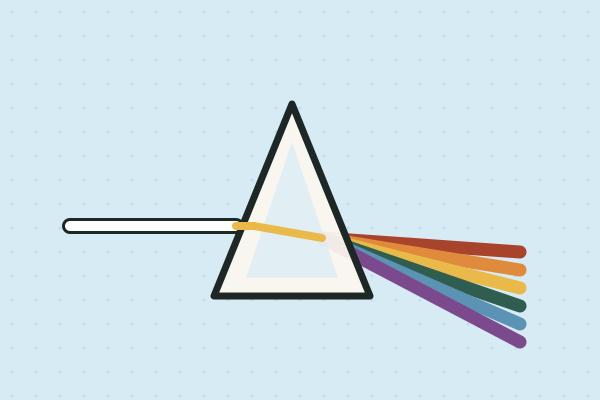
3 lessons in this unit
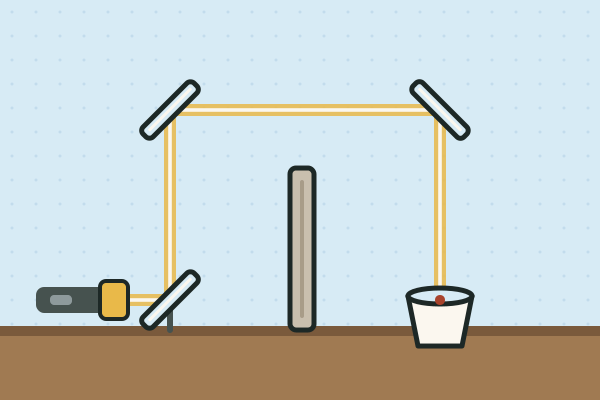 Lesson 1 · 55–65 minHow can a mirror steer a beam of light?Teams shine a slit beam at a mirror, measure the angle it arrives and the angle it leaves, and find the rule for bouncing light. Then they use the rule to steer a beam round a cardboard wall, and test with a dark box how we really see things.
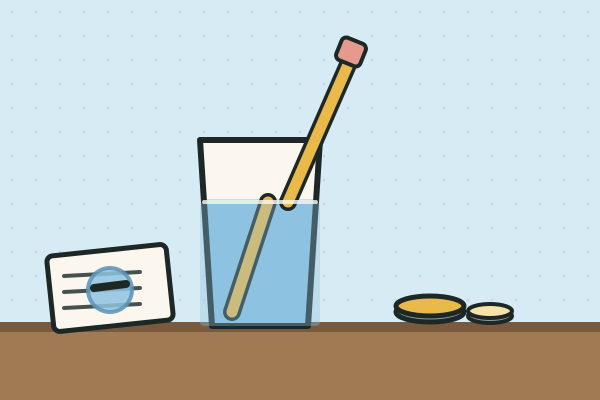 Lesson 2 · 50–60 minWhy does a pencil look broken in water?Teams look at a pencil in a cup of water, make a hidden coin appear by pouring in water, and turn a water drop into a magnifying lens. Then they explain that light changes direction when it passes from air into water.
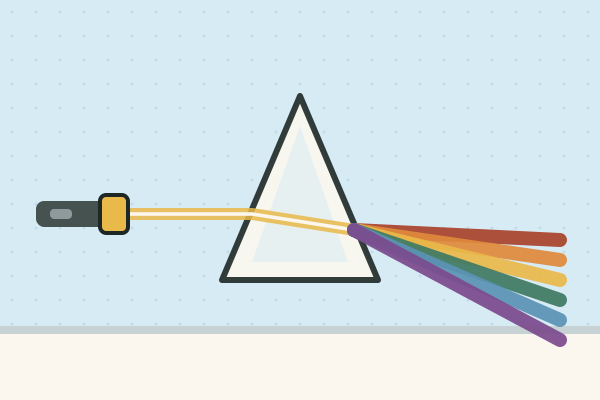 Lesson 3 · 55–65 minWhat colours are hiding in white light?Teams spread a flashlight beam into a band of colours with a CD or a plastic prism, then shine coloured light on coloured paper. They explain that white light is a mixture, and that an object looks the colour of the light it reflects.
Materials for the whole unit · one list, lesson by lesson
Lesson 1: How can a mirror steer a beam of light?
- Small LED flashlight1 per team
- Slit card (black card with a 2 mm slit), taped to the flashlight1 per flashlight
- Small flat mirror, about 10 x 15 cm, plastic or with taped edges2 per team
- Modelling clay (to stand the mirror upright)1 lump per mirror
- White paper, prepared as in the prep3 sheets per team
- Protractor and ruler1 each per team
- Cereal-box card, about 15 cm tall (the maze wall)1 per team
- Shoebox with a peephole and a lid hole, with a small object inside1 for the class
- Masking tape and pencilsA few
About $25 for a class of 30 (less if you have flashlights and small mirrors)
Lesson 2: Why does a pencil look broken in water?
- Tall clear plastic cup or jar, about 300 mL1 per team
- Opaque mug or paper cup1 per team
- Coin1 per team
- Modelling clay1 small lump per team
- Clear plastic square (a page protector or clear lid), about 10 cm1 per team
- Plastic straw or dropper1 per team
- Pencil1 per team
- Page of printed text, about 3 mm tall1 per team
- Jug of water and towels1 jug per 4 teams, towels for spills
About $10 for a class of 30
Lesson 3: What colours are hiding in white light?
- Small LED flashlight with slit card1 per team
- Undamaged old CD or DVD (or an acrylic prism)1 per team
- White card, about 15 x 20 cm1 per team
- Squares of coloured paper, about 5 cm: red, green, blue, yellow, white, black1 set per team
- Clear red and green cellophane or coloured plastic, in a double layer1 square of each per team
- Rubber bands2 per team
- Pencils and coloured pencils1 set per team
About $15 for a class of 30 (less if you have flashlights and old CDs)
Students use a flashlight with a slit card and a mirror to measure how a beam bounces, then use that rule to steer light round a cardboard wall to hit a target. They build a dark box to test whether we see because light enters our eyes or because our eyes send something out. They look at a pencil, a coin and a printed word through water, and work out where the light really goes. Finally they split white light into a band of colours, shine coloured light on coloured paper, and explain why a green leaf can look black.
By the end, students can explain that light travels in straight lines until something makes it bounce or bend, that a mirror sends a beam off at the same angle it arrived (measured from the normal), that we see things when light reflected from them enters our eyes, that light changes direction when it passes from air into water or plastic, and that white light is a mixture of colours. Everything uses flashlights, small mirrors, clear cups and coloured paper, and the safety rules are built into every step: no one looks at the Sun, and no light is ever aimed at a face.