 Preview · the opening mission
Read this to the class:
Mei is stirring her juice with a pencil when she gasps. The pencil has snapped in two! The bottom half looks shifted to one side. She pulls it out. It is perfectly straight. "Water can't break a pencil," she says. "So what is going on?" Your team's job: investigate the pencil, the coin and the water drop, and work out where the light really goes.
Teams of three, with rotating jobs: Pourer (handles water), Observer (looks and describes), Recorder (writes and draws).
Look inside the PDF
Sample pages, stamped “preview”. The download is the clean, full lesson.
In the full lesson PDF
- Predict (5–10 min)
- Hunt (20 min)
- Reveal (10–15 min)
- Act (10 min)
- Background for the teacher
- Assessment
- Student sheet
- Worksheet: Label it
- Worksheet: Try it at home
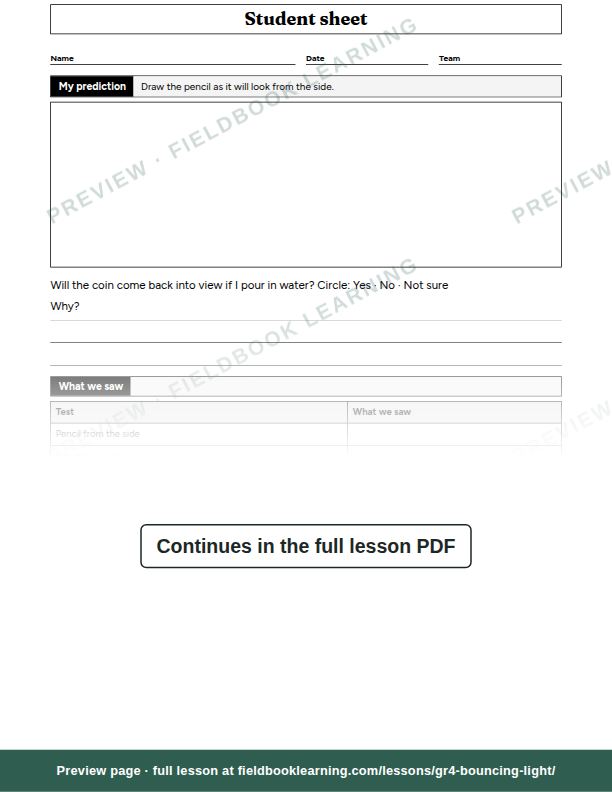
On the student sheet
- My prediction
- What we saw
- What we kept the same, and what we changed
- The coin
- A note to Mei
- Exit ticket
- Label it
- Try it at home
US Letter, prints cleanly in black and white. The student sheet is on its own page, ready to photocopy.
Free with an account (any 3 lessons), or US$19 / C$25 for all 3 lessons in this unit.
What students show by the end
- Observes carefully
- Fair test
- Explains refraction
From the lesson’s rubric, which scores each one as not yet, getting there or got it.
Questions teachers ask
How long does “Why does a pencil look broken in water?” take?
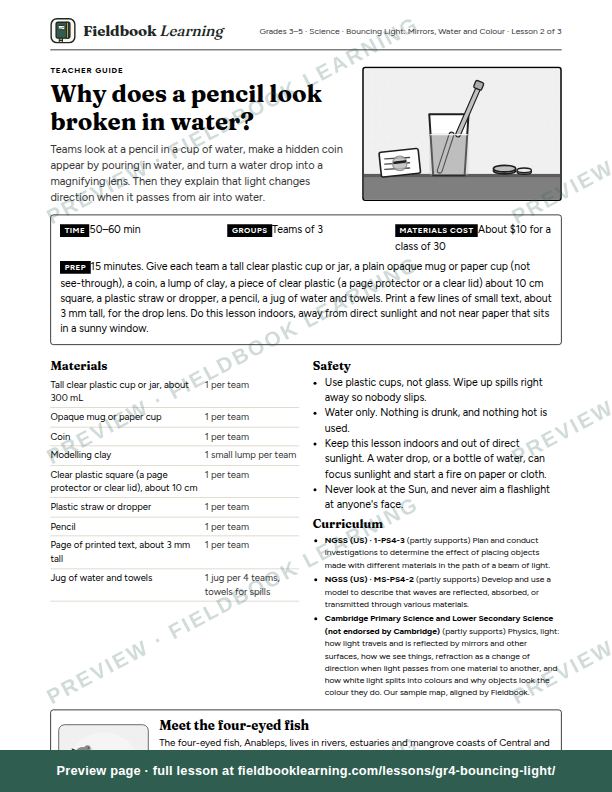
50–60 min. Group size: teams of 3.
How much prep does it need?
15 minutes. Give each team a tall clear plastic cup or jar, a plain opaque mug or paper cup (not see-through), a coin, a lump of clay, a piece of clear plastic (a page protector or a clear lid) about 10 cm square, a plastic straw or dropper, a pencil, a jug of water and towels. Print a few lines of small text, about 3 mm tall, for the drop lens. Do this lesson indoors, away from direct sunlight and not near paper that sits in a sunny window.
What materials do I need?
Tall clear plastic cup or jar, about 300 mL; opaque mug or paper cup; coin; modelling clay; clear plastic square (a page protector or clear lid), about 10 cm; plastic straw or dropper; and 3 more. Cost: about $10 for a class of 30.
Which curriculum standards does it cover?
NGSS (US): 1-PS4-3 (partly) and MS-PS4-2 (partly). It also matches Cambridge Primary Science and Lower Secondary Science (not endorsed by Cambridge).
What’s in the lesson PDF?
A teacher guide that walks you through predict, hunt, reveal, act, background for the teacher and assessment, then a student sheet (“My prediction”; “What we saw”; “What we kept the same, and what we changed”; “The coin”; “A note to Mei”; “Exit ticket”; “Label it” and “Try it at home”) on its own page, ready to photocopy. It’s US Letter and prints cleanly in black and white.
Can I try it for free?
Yes. A free account includes any 3 full lessons of your choice, and this can be one of them. After that, this unit is US$19 (C$25) for all 3 lessons, yours to keep, or every lesson is US$79 (C$109) a year.