Flowers, Fruit and Seeds: How Plants Make More Plants
What is a flower really for? Is a tomato a fruit? How can a seed travel without legs? Three hands-on lessons on pollination, fruits and seeds, and seed dispersal, from a flower you can take apart, through foods you can cut open, to seed models you can drop, blow and float. Nothing is tasted, and it works in any climate.
Or try any 3 lessons free with an account.
Already bought it? Download the whole unit as one printable workbook: cover, contents, curriculum connections, every lesson, readings, practice pages, a unit test and an answer key, in black and white.
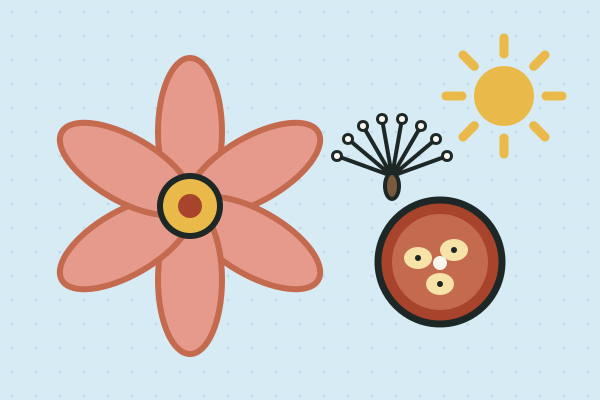
3 lessons in this unit
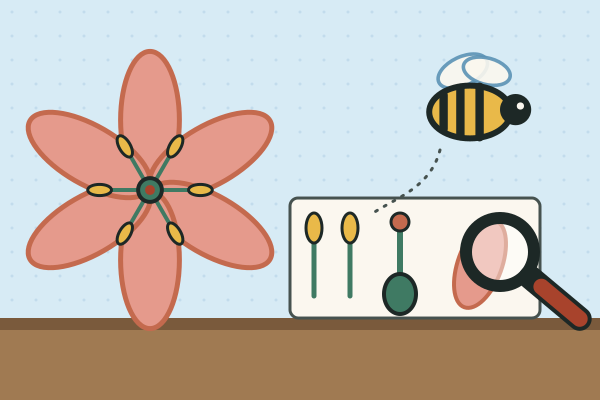 Lesson 1 · 50–60 minWhat is a flower really for?Teams take a real flower apart, find the petals, the pollen-making stamens and the seed-making pistil, and use a cotton bud as a model bee to test why fuzzy carriers move pollen well. They explain what pollination is, what it is not, and why a flower looks the way it does.
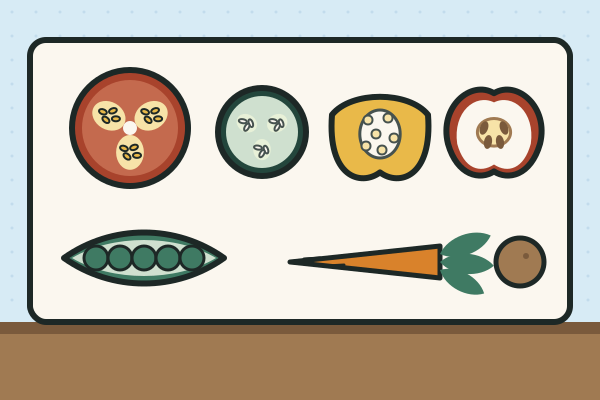 Lesson 2 · 50–60 minIs a tomato a fruit?Teams cut open thirteen foods to find where the seeds are, sort them with a scientist's rule instead of a cook's, and follow a flower into a fruit. They find that tomatoes, cucumbers and peppers are fruits, that a carrot is a root, and that a banana is a fruit with almost no seeds.
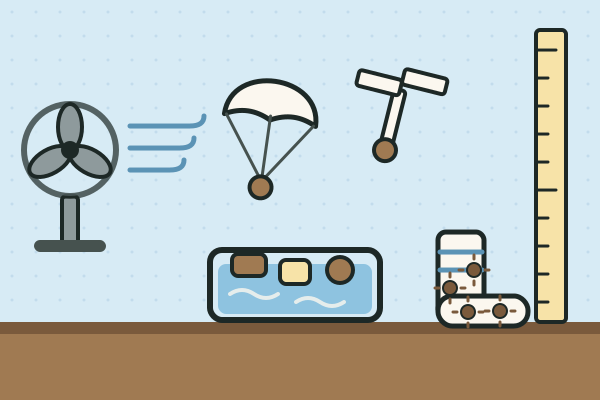 Lesson 3 · 60–75 minHow can a seed travel without legs?Teams build a model seed for wind, water or animals, carrying the same clay seed, and test every model with a fair drop, fan, float and wool test. They find that no design wins every test, and explain how real seeds are shaped for the way they travel.
Materials for the whole unit · one list, lesson by lesson
Lesson 1: What is a flower really for?
- Large open flower (lily, tulip, alstroemeria or hibiscus; shop-bought, not picked wild)1 per team
- Hand lens1 per team
- Plastic knife (butter-knife style)1 per team
- Cotton bud, and a smooth craft stick2 of each per team
- Clear sticky tape and index cards for model stigmas2 strips and 2 cards per team
- Black paper square, paper plate, newspaper1 each per team
- Plain paper and pencils for the parts sheet, tape to stick the parts down1 sheet per team
- Wet wipes or soap and water for hand-washingFor the class
About $15 for a class of 30
Lesson 2: Is a tomato a fruit?
- Tomatoes4 for the class
- Cucumbers2 for the class
- Sweet bell peppers (never chilli peppers)3 for the class
- Courgettes (zucchini)2 for the class
- Apples4 for the class
- Fresh pea or green bean podsAbout 30 for the class
- Bananas2 for the class
- Carrots, potatoes, celery, lettuce, onions, broccoli2 to 3 of each, or 1 head, for the class
- Plastic knives (butter-knife style)1 per team
- Hand lens, paper plate or board, paper towels1 each per team
- Sorting mat and sticky notes (see prep)1 set per team
- Soap and water or wet wipesFor the class
About $25 for a class of 30
Lesson 3: How can a seed travel without legs?
- Modelling clay, a pea-sized ball (about 1 cm, about 1 g)1 per team, plus spares
- Paper (scrap), coffee filters, cotton wool balls2 sheets, 2 filters and 5 balls per team
- Foam packing pieces or small sponge, plastic wrap or foil3 pieces and a 20 cm square per team
- Hook-and-loop tape (hook side), cut in 2 cm squares, or pipe cleaners with the ends folded in6 squares or 3 pipe cleaners per team
- String 40 cm, clear tape, blunt scissors1 each per team
- Stopwatch or phone timer1 per team
- Table fan with a guard1 or 2 for the class
- Tape measure or metre stick, masking tape1 each per station
- Shallow tray or tub, about 5 cm of water, paper towels1 or 2 for the class
- Wool sock and a bottle to put it on1 or 2 for the class
About $20 for a class of 30
Students take a real flower apart and find the pollen-making stamens and the seed-making pistil, then use a cotton bud as a model bee to find out why fuzzy bodies move pollen well. They cut open thirteen foods to see where the seeds are, sort them with a scientist’s rule rather than a cook’s, and follow a tomato from flower to fruit. Finally they build model seeds for wind, water or animals and test them with a fair drop, fan, float and wool test.
By the end, students can explain that pollination is the moving of pollen to a stigma and that fertilisation, inside the flower, comes after it; that a fruit is the ripened ovary that holds the seeds, so a tomato, a cucumber and a pepper are fruits; and that seeds are shaped for the way they travel, which is why no design wins every test. It extends the Grade 1 unit Plants and Seeds. Everything uses shop-bought flowers, kitchen foods, paper and clay, and nothing is tasted.