 Preview · the opening mission
Read this to the class:
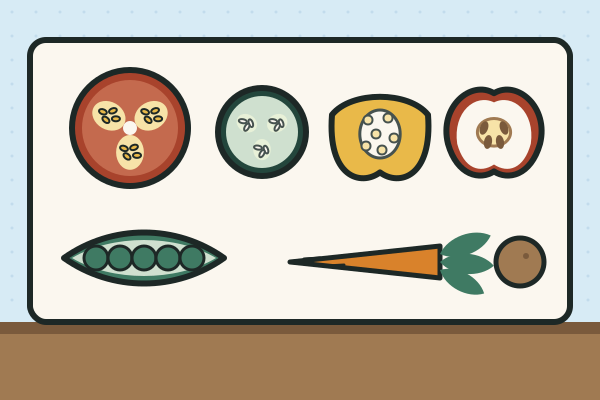
At a market stall in Lima, a sign says "Vegetables". A shopper points at the tomatoes and says, "Tomatoes are fruit, so that sign is wrong." The stallholder says, "I cook with them in dinner, not in a pudding." They both look at you. Your team's job: cut open the food, find out where the seeds are, and decide how a scientist should sort it.
Teams of three, with rotating jobs: Cutter (handles the plastic knife and the halves), Lens Keeper (looks for seeds and describes), Recorder (sorts the notes and fills the table).
Nobody tastes anything.
Look inside the PDF
Sample pages, stamped “preview”. The download is the clean, full lesson.
In the full lesson PDF
- Predict (5–10 min)
- Hunt (20–25 min)
- Reveal (10–15 min)
- Act (10 min)
- Background for the teacher
- Assessment
- Student sheet
- Worksheet: Label it
- Worksheet: Try it at home
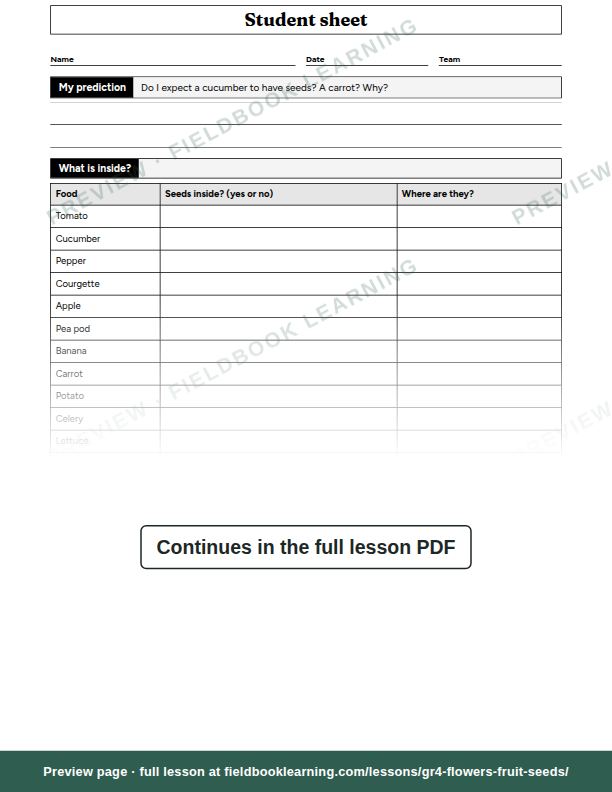
On the student sheet
- My prediction
- What is inside?
- Counting seeds
- My drawings
- The foods with no seeds
- What we kept the same, and what we changed
- My Fruit test card
- Is a tomato a fruit?
- Exit ticket
- Label it
- Try it at home
US Letter, prints cleanly in black and white. The student sheet is on its own page, ready to photocopy.
Free with an account (any 3 lessons), or US$19 / C$25 for all 3 lessons in this unit.
What students show by the end
- Finds seeds
- Uses the science rule
- Sorts fairly
From the lesson’s rubric, which scores each one as not yet, getting there or got it.
Questions teachers ask
How long does “Is a tomato a fruit?” take?
50–60 min. Group size: teams of 3.
How much prep does it need?
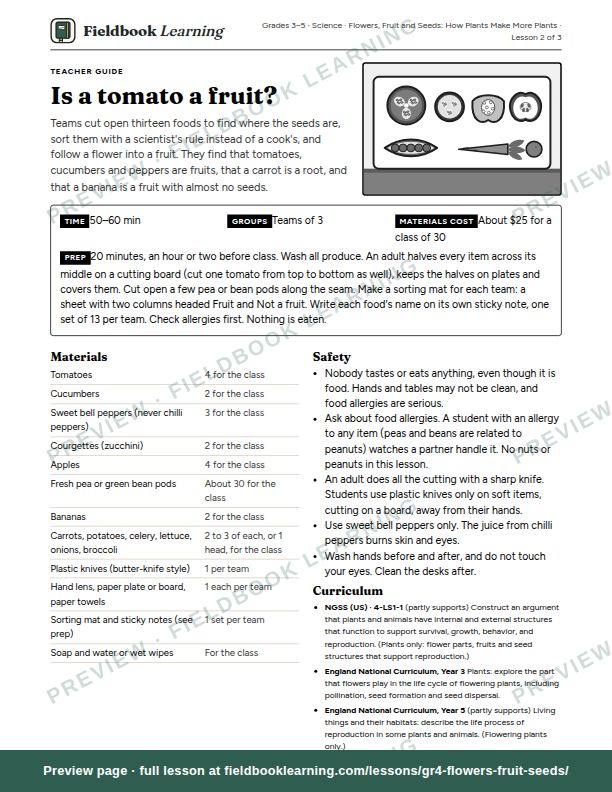
20 minutes, an hour or two before class. Wash all produce. An adult halves every item across its middle on a cutting board (cut one tomato from top to bottom as well), keeps the halves on plates and covers them. Cut open a few pea or bean pods along the seam. Make a sorting mat for each team: a sheet with two columns headed Fruit and Not a fruit. Write each food's name on its own sticky note, one set of 13 per team. Check allergies first. Nothing is eaten.
What materials do I need?
Tomatoes; cucumbers; sweet bell peppers (never chilli peppers); courgettes (zucchini); apples; fresh pea or green bean pods; and 6 more. Cost: about $25 for a class of 30.
Which curriculum standards does it cover?
NGSS (US): 4-LS1-1 (partly). It also matches England National Curriculum, Year 3; England National Curriculum, Year 5 and Cambridge Primary Science, Stages 3 and 5 (not endorsed by Cambridge).
What’s in the lesson PDF?
A teacher guide that walks you through predict, hunt, reveal, act, background for the teacher and assessment, then a student sheet (“My prediction”; “What is inside?”; “Counting seeds”; “My drawings”; “The foods with no seeds”; “What we kept the same, and what we changed”; “My Fruit test card”; “Is a tomato a fruit?”; “Exit ticket”; “Label it” and “Try it at home”) on its own page, ready to photocopy. It’s US Letter and prints cleanly in black and white.
Can I try it for free?
Yes. A free account includes any 3 full lessons of your choice, and this can be one of them. After that, this unit is US$19 (C$25) for all 3 lessons, yours to keep, or every lesson is US$79 (C$109) a year.