Years 4–7 in England and Wales · Cambridge Primary Stage 4 to Lower Secondary Stage 7 · IB PYP to MYP 1, ages 8–12
Stars and the Night Sky
Where the stars go in the daytime, why they wheel across the sky all night and why Orion is a winter sight in Canada but a summer one in Australia. Students sort real star data, spin and orbit as human models and read a printed sky chart. No materials needed: just the printed sheets, in either hemisphere.
Or try any 3 lessons free with an account. Prices in US dollars.
Already bought it? Download the whole unit as one printable workbook (53 pages): cover, contents, curriculum connections, every lesson, readings, practice pages, a unit test and an answer key, in black and white. Want to change the wording? Get every student page as one editable Word file.
3 lessons in this unit
 Lesson 1 · 45–60 min · 8 pagesWhy do stars come out at night?Teams sort ten real star cards by distance and then by how bright each star looks, and pace out the distances as a human line. They find that the nearest star after the Sun is too faint to see, explain why the Sun outshines every other star and where the stars go in the daytime.
 Lesson 2 · 45–60 min · 11 pagesWhy do the stars seem to move across the sky?Students spin slowly under star posters to feel why the stars rise and set, match star-trail pictures to Canada, Singapore and Australia, and use the Big Dipper and the Southern Cross to find north and south. They explain why Polaris barely moves and why the south has no bright pole star.
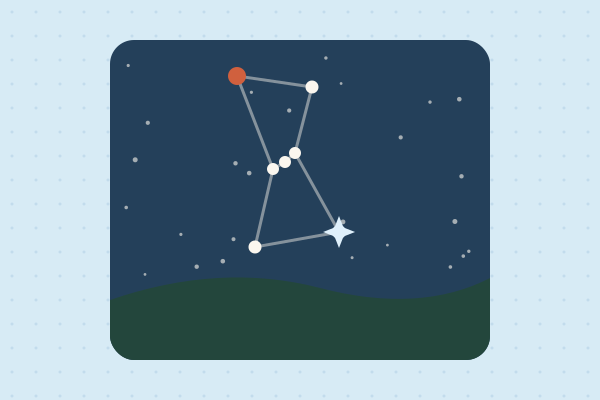
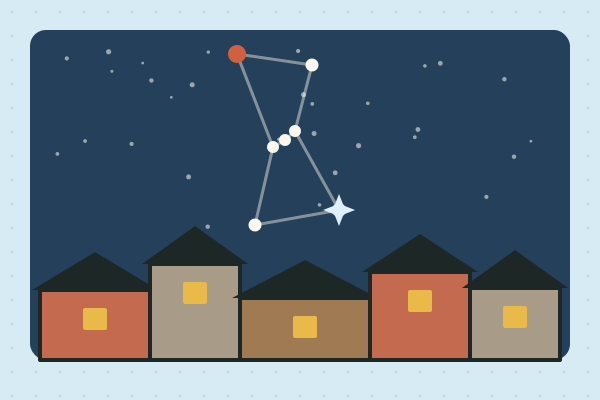 Lesson 3 · 45–60 min · 10 pagesWhy do we see different stars in different seasons?Students walk a year around a paper Sun, facing out into the night at each season, to find out why Orion fills the evening sky in some months and vanishes in others. They join the dots of a printed sky chart, invent their own star pattern and plan a star count that measures light pollution.
Students line up as ten real stars, pacing out how far away each one is and then reshuffling by how bright it looks, to find out why the nearest star after the Sun can’t be seen without a telescope while Rigel, about 860 light years away, is one of the brightest. They spin slowly under star posters to see why the stars wheel across the sky, match star-trail pictures to Canada, Singapore and Australia, and find south with the Southern Cross. Then they walk a year around a paper Sun to find out why Orion belongs to some months and not others, and join the dots of a printed sky chart.
By the end, students can explain that the Sun is a star, that the stars are still there in the daytime, and that how bright a star looks depends on both its distance and how much light it really gives off. They can use Earth’s spin to explain why stars rise and set, why Polaris barely moves and why the south has no bright pole star, and use Earth’s orbit to explain why the night sky changes with the seasons, north and south of the equator. Everything uses printed cards, charts and the room.