 Preview · the opening mission
Read this to the class:
Amira's little brother looked out of the window at bedtime. "The stars just came out," he said. "Where were they all day? Were they asleep?" Amira wasn't sure. And why are some stars bright and some faint? Your team's job: use real data about ten stars to find out why the stars come out at night and why some look brighter than others.
Teams of three, with three rotating jobs: Reader (reads each card aloud), Sorter (moves the cards) and Recorder (writes the orders on the sheet).
Look inside the PDF
Sample pages, stamped “preview”. The download is the clean, full lesson.
In the full lesson PDF
8 printable pages
- Predict (5–10 min)
- Hunt (20 min)
- Reveal (10–15 min)
- Act (10 min)
- Background for the teacher
- Assessment
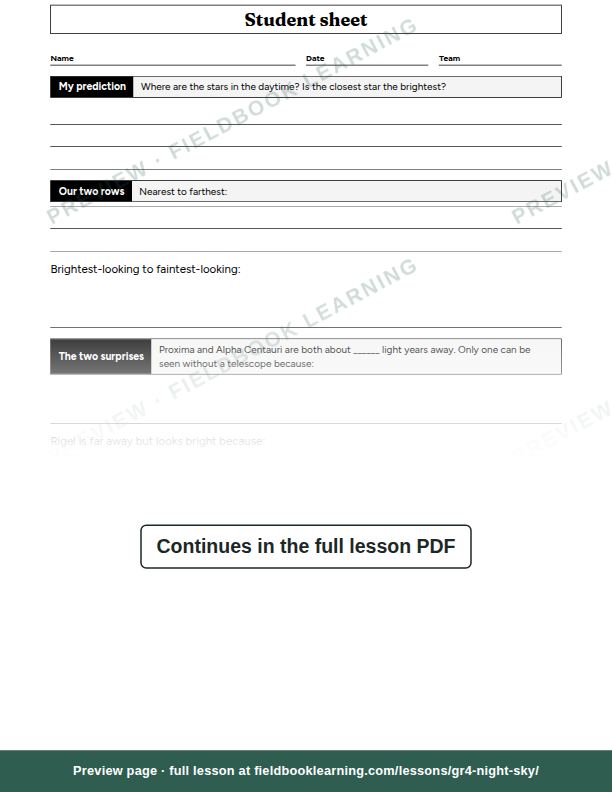
- Student sheet
- Worksheet: Star cards
- Worksheet: Label it
- Worksheet: Try it at home
On the student sheet
- My prediction
- Our two rows
- The two surprises
- A note to Amira's little brother
- Exit ticket
- Star cards
- Label it
- Try it at home
US Letter, prints cleanly in black and white. The student sheet is on its own page, ready to photocopy.
Free with an account (any 3 lessons), or US$19 for all 3 lessons in this unit.
What students show by the end
- The Sun is a star
- Brightness and distance
- Stars in the daytime
From the lesson’s rubric, which scores each one as not yet, getting there or got it.
Questions teachers ask
How long does “Why do stars come out at night?” take?
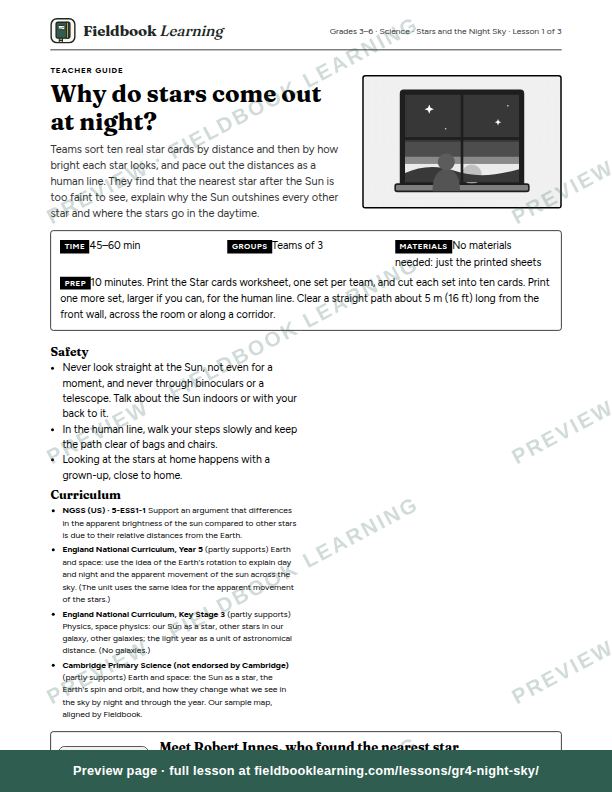
45–60 min. Group size: teams of 3.
How much prep does it need?
10 minutes. Print the Star cards worksheet, one set per team, and cut each set into ten cards. Print one more set, larger if you can, for the human line. Clear a straight path about 5 m (16 ft) long from the front wall, across the room or along a corridor.
What materials do I need?
None. No materials needed: just the printed sheets.
Which curriculum standards does it cover?
NGSS (US): 5-ESS1-1. It also matches England National Curriculum, Year 5; England National Curriculum, Key Stage 3 and Cambridge Primary Science (not endorsed by Cambridge).
What’s in the lesson PDF?
A teacher guide that walks you through predict, hunt, reveal, act, background for the teacher and assessment, then a student sheet (“My prediction”, “Our two rows”, “The two surprises”, “A note to Amira's little brother”, “Exit ticket”, “Star cards”, “Label it” and “Try it at home”) on its own page, ready to photocopy. It’s US Letter and prints cleanly in black and white.
Can I try it for free?
Yes. A free account includes any 3 full lessons of your choice, and this can be one of them. After that, this unit is US$19 for all 3 lessons, yours to keep, or every lesson is US$199 a year.