 Preview · the opening mission
Read this to the class:
At a summer camp, Theo saw a bright star just above the top of a tall tree at 9 o'clock at night. At 11 o'clock he looked again. The star was nowhere near the tree. It had slid across the sky to the west. But a camp leader pointed to another star, partway up the northern sky, and said, "That one is always there. You can find your way by it." Your team's job: find out why the stars seem to move across the sky, and why one of them hardly moves at all.
Teams of three, with three rotating jobs: Spinner (does the moving), Watcher (watches the Spinner and the posters) and Recorder (writes what the team saw).
Look inside the PDF
Sample pages, stamped “preview”. The download is the clean, full lesson.
In the full lesson PDF
11 printable pages
- Predict (5–10 min)
- Hunt (20 min)
- Reveal (10–15 min)
- Act (10 min)
- Background for the teacher
- Assessment
- Student sheet
- Worksheet: Star trails and pole finders
- Worksheet: Star posters
- Worksheet: Label it
- Worksheet: Try it at home
On the student sheet
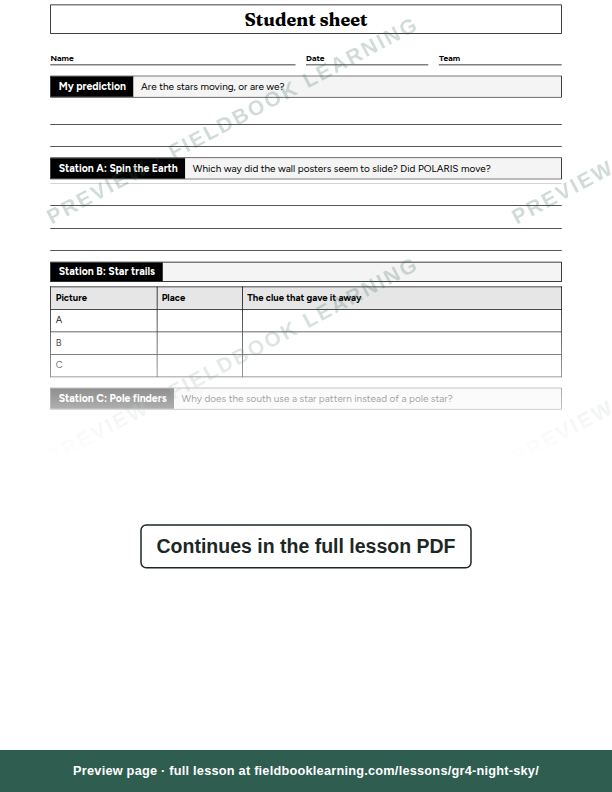
- My prediction
- Station A: Spin the Earth
- Station B: Star trails
- Station C: Pole finders
- A note for Theo
- Exit ticket
- Star trails and pole finders
- Star posters
- Label it
- Try it at home
US Letter, prints cleanly in black and white. The student sheet is on its own page, ready to photocopy.
Free with an account (any 3 lessons), or US$19 for all 3 lessons in this unit.
What students show by the end
- Earth's spin
- The pole star
- Hemispheres
From the lesson’s rubric, which scores each one as not yet, getting there or got it.
Questions teachers ask
How long does “Why do the stars seem to move across the sky?” take?
45–60 min. Group size: teams of 3, in three stations.
How much prep does it need?
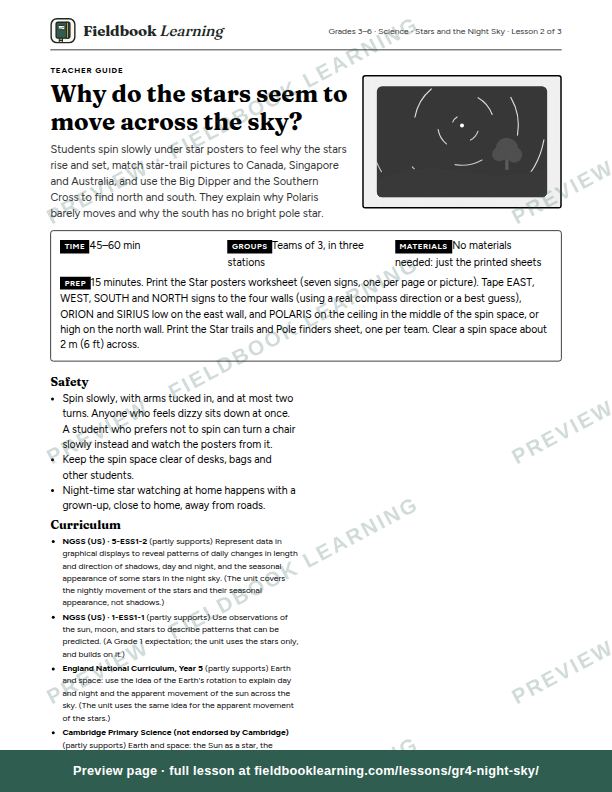
15 minutes. Print the Star posters worksheet (seven signs, one per page or picture). Tape EAST, WEST, SOUTH and NORTH signs to the four walls (using a real compass direction or a best guess), ORION and SIRIUS low on the east wall, and POLARIS on the ceiling in the middle of the spin space, or high on the north wall. Print the Star trails and Pole finders sheet, one per team. Clear a spin space about 2 m (6 ft) across.
What materials do I need?
None. No materials needed: just the printed sheets.
Which curriculum standards does it cover?
NGSS (US): 5-ESS1-2 (partly) and 1-ESS1-1 (partly). It also matches England National Curriculum, Year 5 and Cambridge Primary Science (not endorsed by Cambridge).
What’s in the lesson PDF?
A teacher guide that walks you through predict, hunt, reveal, act, background for the teacher and assessment, then a student sheet (“My prediction”, “Station A: Spin the Earth”, “Station B: Star trails”, “Station C: Pole finders”, “A note for Theo”, “Exit ticket”, “Star trails and pole finders”, “Star posters”, “Label it” and “Try it at home”) on its own page, ready to photocopy. It’s US Letter and prints cleanly in black and white.
Can I try it for free?
Yes. A free account includes any 3 full lessons of your choice, and this can be one of them. After that, this unit is US$19 for all 3 lessons, yours to keep, or every lesson is US$199 a year.