 Preview · the opening mission
This lesson teaches science and English together (CLIL: content and language integrated learning). It is written for students learning English at about CEFR A2–B1.
| Students will… | |
|---|---|
| Science | Measure how fast warm water cools in different wrappings, and explain that insulators slow heat down by trapping still air. |
| Language: words | Use the key words: heat, warm, cold, insulator, conductor, felt, wool, layer, still air, temperature, measure, compare. |
| Language: speaking | Predict and give a reason: I think ___ will be best because ___. Compare: Felt is a better insulator than foil. |
| Language: writing | Write a short recommendation using should and because, with a number from the data. |
Before the lesson: teach the key words with the real objects (hold up the felt, the foil, the thermometer). The Key words worksheet has English, Russian and Kazakh, with a space to draw each word.
Look inside the PDF
Sample pages, stamped “preview”. The download is the clean, full lesson.
In the full lesson PDF
- Mission (5 min)
- Predict (5 min)
- Hunt (25 min)
- Reveal (10–15 min)
- Act (10 min)
- Background for the teacher
- Assessment
- Student sheet
- Worksheet: Key words
- Worksheet: Talk about it
- Worksheet: Label the yurt wall
- Worksheet: Try it at home
On the student sheet
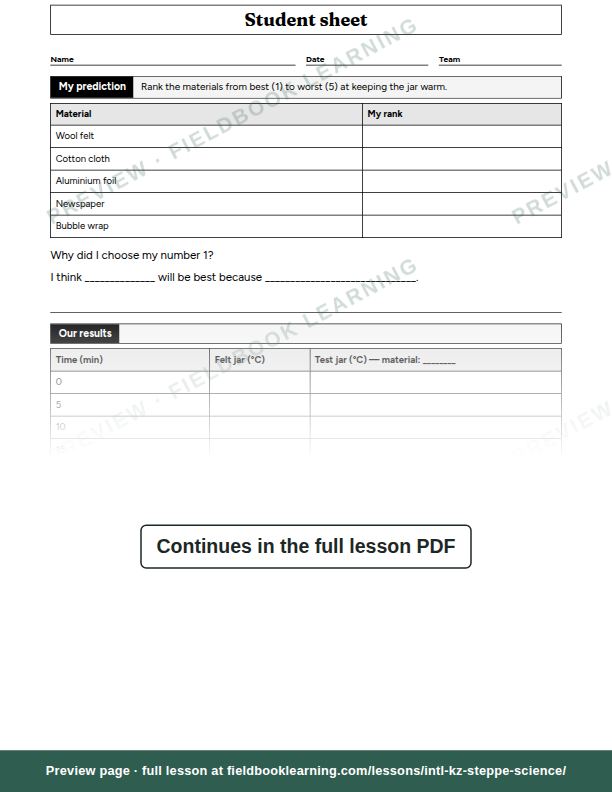
- My prediction
- Our results
- Class results
- Graph it
- My recommendation to Grandmother
- Exit ticket
- Key words
- Talk about it
- Label the yurt wall
- Try it at home
US Letter, prints cleanly in black and white. The student sheet is on its own page, ready to photocopy.
Free with an account (any 3 lessons), or US$19 / C$25 for all 1 lessons in this unit.
What students show by the end
- Collects fair data
- Explains with heat transfer
- Uses evidence to design
From the lesson’s rubric, which scores each one as not yet, getting there or got it.
Questions teachers ask
How long does “How does a felt yurt keep a family warm at −30 °C?” take?
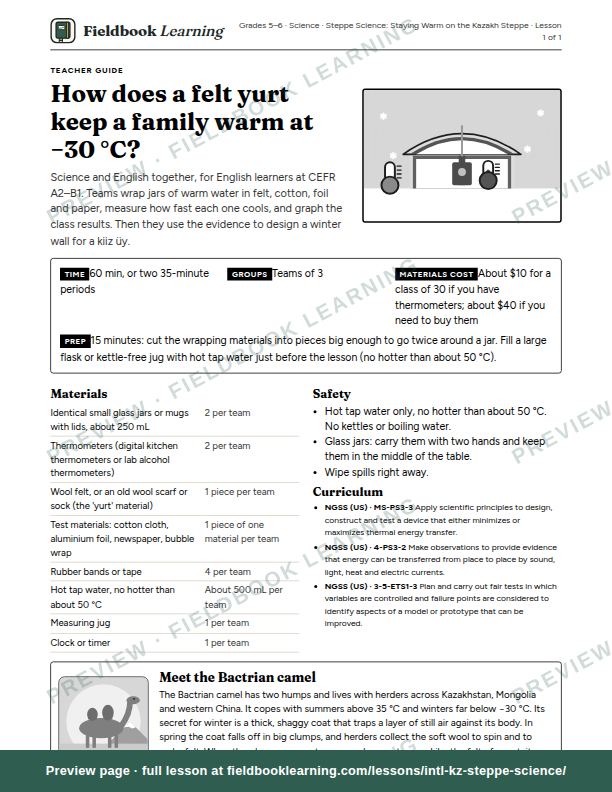
60 min, or two 35-minute periods. Group size: teams of 3.
How much prep does it need?
15 minutes: cut the wrapping materials into pieces big enough to go twice around a jar. Fill a large flask or kettle-free jug with hot tap water just before the lesson (no hotter than about 50 °C).
What materials do I need?
Identical small glass jars or mugs with lids, about 250 mL; thermometers (digital kitchen thermometers or lab alcohol thermometers); wool felt, or an old wool scarf or sock (the 'yurt' material); test materials; rubber bands or tape; hot tap water, no hotter than about 50 °C; and 2 more. Cost: about $10 for a class of 30 if you have thermometers; about $40 if you need to buy them.
Which curriculum standards does it cover?
NGSS (US): MS-PS3-3, 4-PS3-2 and 3-5-ETS1-3.
What’s in the lesson PDF?
A teacher guide that walks you through mission, predict, hunt, reveal, act, background for the teacher and assessment, then a student sheet (“My prediction”, “Our results”, “Class results”, “Graph it”, “My recommendation to Grandmother”, “Exit ticket”, “Key words”, “Talk about it”, “Label the yurt wall” and “Try it at home”) on its own page, ready to photocopy. It’s US Letter and prints cleanly in black and white.
Can I try it for free?
Yes. A free account includes any 3 full lessons of your choice, and this can be one of them. After that, this unit is US$19 (C$25) for all 1 lessons, yours to keep, or every lesson is US$79 (C$109) a year.