Weather Watchers: What Will the Sky Do Today?
Is it sunny, windy or wet today, and how can we tell? Young scientists keep a class weather chart for two weeks, build wind socks to catch the wind and make a rain gauge from a bottle to measure the rain.
Or try any 3 lessons free with an account.
Already bought it? Download the whole unit as one printable workbook: cover, contents, curriculum connections, every lesson, readings, practice pages, a unit test and an answer key, in black and white.
3 lessons in this unit
 Lesson 1 · 30 min to start, 5 min a day for two weeks, 30 min to graphWhat's the weather like today?Children look at the sky at the same time every school day for two weeks and add a weather picture to a big class chart. Then they count the sunny, cloudy, rainy and snowy days, build a bar graph together and use it to say what kind of weather their two weeks had.
 Lesson 2 · 40–45 min, plus 5 min on two or three other daysWhich way is the wind blowing?Children make a paper-plate wind sock with crepe-paper streamers and take it into the schoolyard to see which way the wind blows and how strong it is. They find out that we can't see wind, but we can see what it does, and they sort days into calm, breezy and windy.
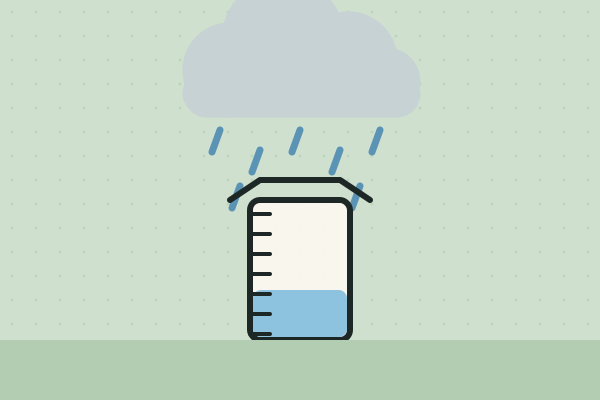 Lesson 3 · 40 min, plus 5 min a day for a weekHow much rain fell?Teams build a rain gauge from a clear, straight-sided bottle with a ruler taped on, set it outside and measure the rain each day for a week. On a dry week they make a watering-can 'storm' instead, and test what happens when rain lands on grass, soil and pavement.
Materials for the whole unit · one list, lesson by lesson
Lesson 1: What's the weather like today?
- Chart paper2 sheets
- Paper squares or sticky notes, 8 cm (3 in), in yellow, grey, blue and whiteAbout 20 of each colour
- Crayons or markers1 set per team
- Masking tape or a glue stick1 for the class
- A clipboard1 for the day's weather team
About $10 for a class of 30
Lesson 2: Which way is the wind blowing?
- Paper plates1 per team
- Crepe paper streamers, or strips cut from plastic grocery bags6 to 8 strips per team
- Clear tape or a stapler1 per team
- String or yarn60 cm (24 in) per team
- Hole punch1 for the teacher
- Crayons or markers1 set per team
- A desk fan (backup for a still day)1 for the teacher, optional
About $10 for a class of 30
Lesson 3: How much rain fell?
- Clear plastic bottle with straight sides, about 2 L, top cut off1 per team
- Plastic ruler with centimetres (and inches)1 per team
- Clear packing tape1 roll for the class
- Masking tape and a marker1 per team
- Small stones or a brick to keep the gauge from blowing overA handful per team
- Watering can1 for the class
- A jug of water1 for the class
About $10 for a class of 30, mostly recycled bottles
Children become the class weather team. They look at the sky at the same time every school day for two weeks, add a picture to a big weather chart and turn their chart into a bar graph to count the sunny, cloudy, rainy and snowy days. They make a paper-plate wind sock and take it into the schoolyard to see which way the wind blows and whether today is calm, breezy or windy. Last, they build a rain gauge from a clear bottle and a ruler and measure how much rain falls, with a watering-can “storm” for weeks when the sky stays dry.
By the end of the unit, children can describe the weather using a few simple words and pictures, show what they saw on a chart, and make a small claim with evidence: “I think it was a rainy week because I saw four rain days on our graph.” Everything uses paper plates, crepe paper, recycled bottles and classroom supplies.