 Preview · the opening mission
Read this to the class:
Theo's kite was stuck on the ground. He ran one way. Flop. He ran the other way. Flop. "Which way is the wind going?" he asked his sister. She licked her finger and held it up. "I can't see the wind," Theo said. "How do you know where it is?" Your job: build a wind catcher, take it outside and find out which way the wind is blowing and how strong it is today.
Teams of three. The jobs rotate: the Holder holds the wind sock up high and still, the Watcher looks at the streamers and says what they do, and the Pointer points the way the streamers fly.
Look inside the PDF
Sample pages, stamped “preview”. The download is the clean, full lesson.
In the full lesson PDF
- Predict (5 min)
- Hunt (25 min)
- Reveal (10 min)
- Act (5 min)
- Background for the teacher
- Assessment
- Student sheet
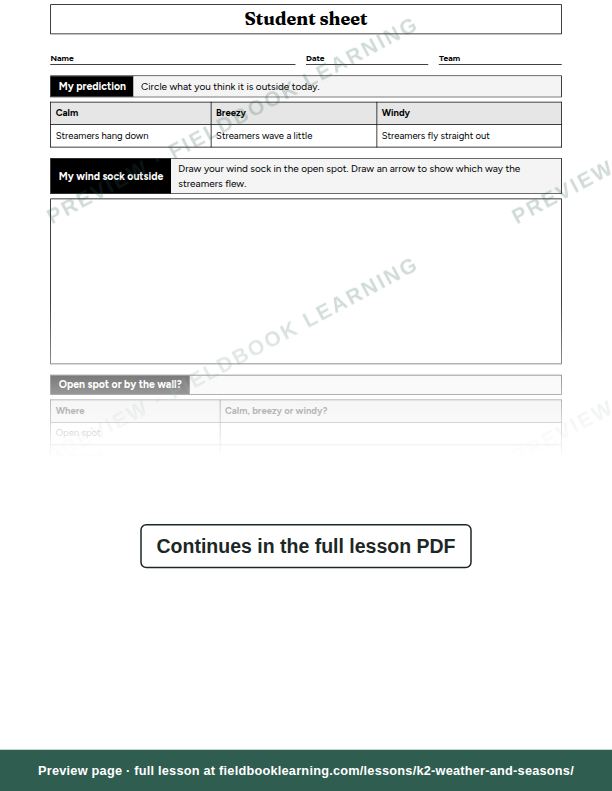
On the student sheet
- My prediction
- My wind sock outside
- Open spot or by the wall?
- Wind on other days
- What I found
US Letter, prints cleanly in black and white. The student sheet is on its own page, ready to photocopy.
Free with an account (any 3 lessons), or US$19 / C$25 for all 3 lessons in this unit.
What students show by the end
- Observes wind
- Wind direction
- Claim with evidence
From the lesson’s rubric, which scores each one as not yet, getting there or got it.
Questions teachers ask
How long does “Which way is the wind blowing?” take?
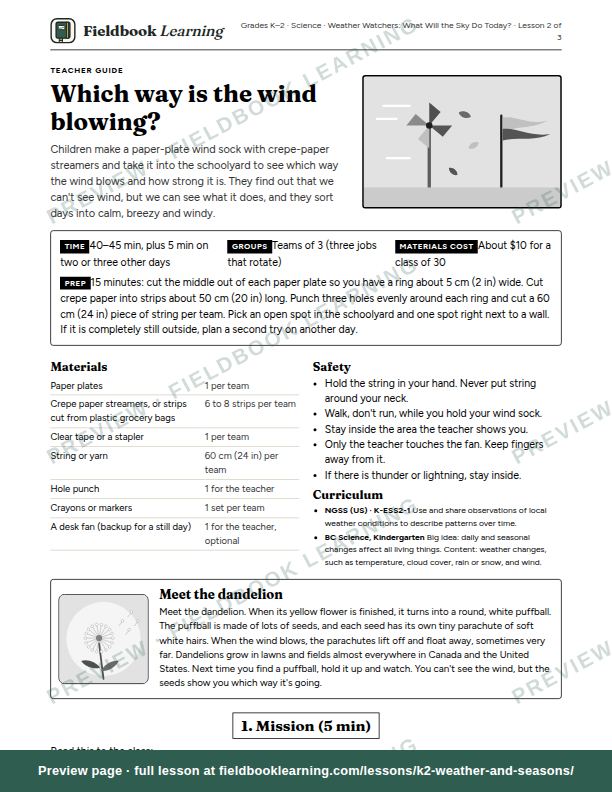
40–45 min, plus 5 min on two or three other days. Group size: teams of 3 (three jobs that rotate).
How much prep does it need?
15 minutes: cut the middle out of each paper plate so you have a ring about 5 cm (2 in) wide. Cut crepe paper into strips about 50 cm (20 in) long. Punch three holes evenly around each ring and cut a 60 cm (24 in) piece of string per team. Pick an open spot in the schoolyard and one spot right next to a wall. If it is completely still outside, plan a second try on another day.
What materials do I need?
Paper plates; crepe paper streamers, or strips cut from plastic grocery bags; clear tape or a stapler; string or yarn; hole punch; crayons or markers; and 1 more. Cost: about $10 for a class of 30.
Which curriculum standards does it cover?
NGSS (US): K-ESS2-1. It also matches BC Science, Kindergarten.
What’s in the lesson PDF?
A teacher guide that walks you through predict, hunt, reveal, act, background for the teacher and assessment, then a student sheet (“My prediction”, “My wind sock outside”, “Open spot or by the wall?”, “Wind on other days” and “What I found”) on its own page, ready to photocopy. It’s US Letter and prints cleanly in black and white.
Can I try it for free?
Yes. A free account includes any 3 full lessons of your choice, and this can be one of them. After that, this unit is US$19 (C$25) for all 3 lessons, yours to keep, or every lesson is US$79 (C$109) a year.