 Preview · the opening mission
Read this to the class:
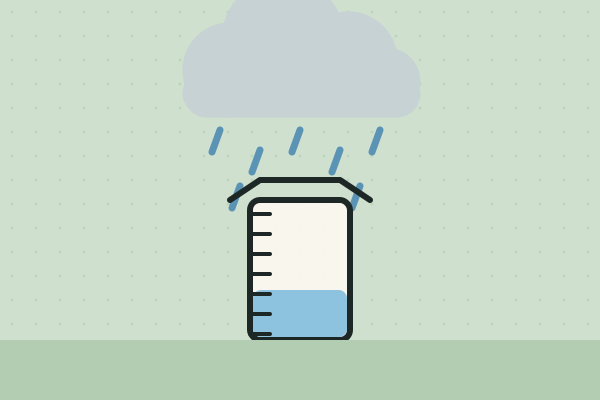
After a big rainy night, Sofia's dad said, "We got a lot of rain!" Her neighbour said, "Not that much." Sofia looked at the puddles. Who was right? Puddles are big in some spots and tiny in others. "We need a way to catch the rain and measure it," she said. Your job: build a rain catcher that measures, and find out how much rain falls on our school.
Teams of three. The jobs rotate each day: the Builder sets up and carries the gauge, the Reader looks at the water and reads the ruler, and the Recorder draws the water level on the sheet.
Look inside the PDF
Sample pages, stamped “preview”. The download is the clean, full lesson.
In the full lesson PDF
- Predict (5 min)
- Hunt (20 min, then 5 min a day)
- Reveal (10 min)
- Act (10 min)
- Background for the teacher
- Assessment
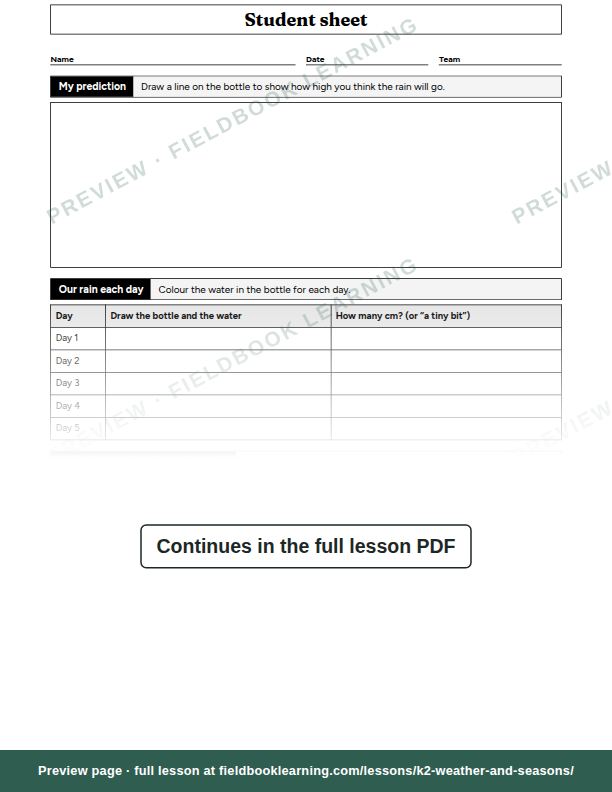
- Student sheet
On the student sheet
- My prediction
- Our rain each day
- Watering-can storm (no-rain week)
- What I found
US Letter, prints cleanly in black and white. The student sheet is on its own page, ready to photocopy.
Free with an account (any 3 lessons), or US$19 / C$25 for all 3 lessons in this unit.
What students show by the end
- Reads the gauge
- Compares days
- Claim with evidence
From the lesson’s rubric, which scores each one as not yet, getting there or got it.
Questions teachers ask
How long does “How much rain fell?” take?
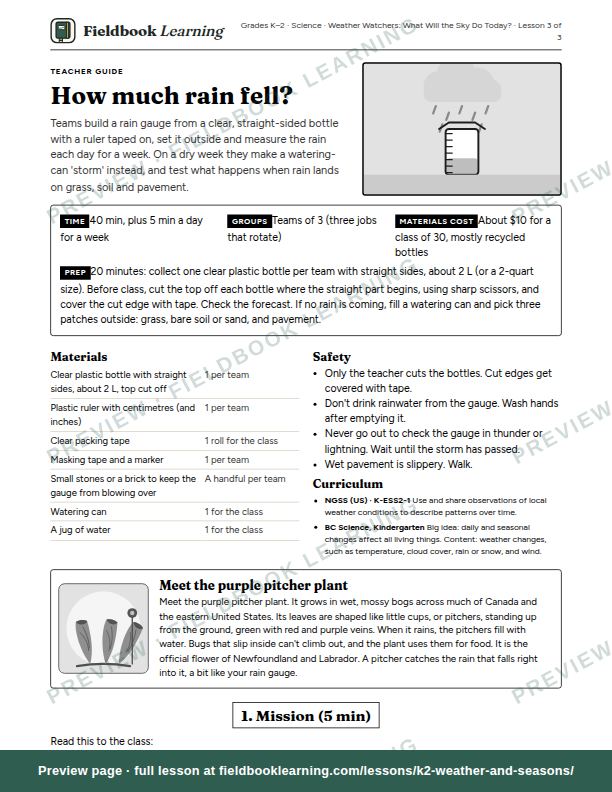
40 min, plus 5 min a day for a week. Group size: teams of 3 (three jobs that rotate).
How much prep does it need?
20 minutes: collect one clear plastic bottle per team with straight sides, about 2 L (or a 2-quart size). Before class, cut the top off each bottle where the straight part begins, using sharp scissors, and cover the cut edge with tape. Check the forecast. If no rain is coming, fill a watering can and pick three patches outside: grass, bare soil or sand, and pavement.
What materials do I need?
Clear plastic bottle with straight sides, about 2 L, top cut off; plastic ruler with centimetres (and inches); clear packing tape; masking tape and a marker; small stones or a brick to keep the gauge from blowing over; watering can; and 1 more. Cost: about $10 for a class of 30, mostly recycled bottles.
Which curriculum standards does it cover?
NGSS (US): K-ESS2-1. It also matches BC Science, Kindergarten.
What’s in the lesson PDF?
A teacher guide that walks you through predict, hunt, reveal, act, background for the teacher and assessment, then a student sheet (“My prediction”, “Our rain each day”, “Watering-can storm (no-rain week)” and “What I found”) on its own page, ready to photocopy. It’s US Letter and prints cleanly in black and white.
Can I try it for free?
Yes. A free account includes any 3 full lessons of your choice, and this can be one of them. After that, this unit is US$19 (C$25) for all 3 lessons, yours to keep, or every lesson is US$79 (C$109) a year.