 Preview · the opening mission
Read this to the class:
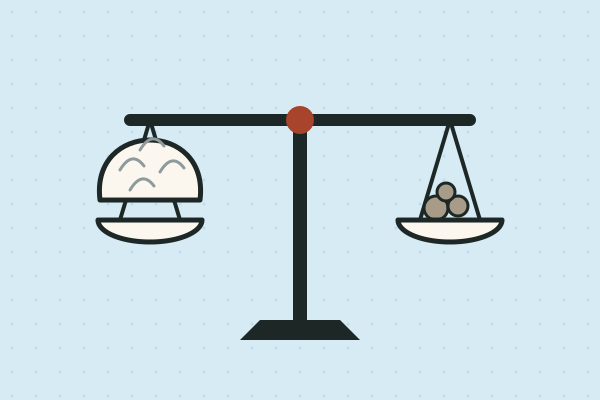
A Grade 3 student brought a riddle home to her grandpa: "Which is heavier, a kilogram of feathers or a kilogram of rocks?" Grandpa said, "Rocks, obviously. Feathers are light!" Her little brother said, "Feathers, because there are way more of them." They argued all through supper. Your team's job: learn to measure mass in grams and kilograms, and settle the argument with real data.
Teams of three, with jobs that rotate: Builder (sets up and loads the balance), Reader (reads the balance or the scale), Recorder (writes estimates and measurements).
Look inside the PDF
Sample pages, stamped “preview”. The download is the clean, full lesson.
In the full lesson PDF
- Predict (5–10 min)
- Hunt (20 min)
- Reveal (10–15 min)
- Act (10 min)
- Background for the teacher
- Assessment
- Student sheet
On the student sheet
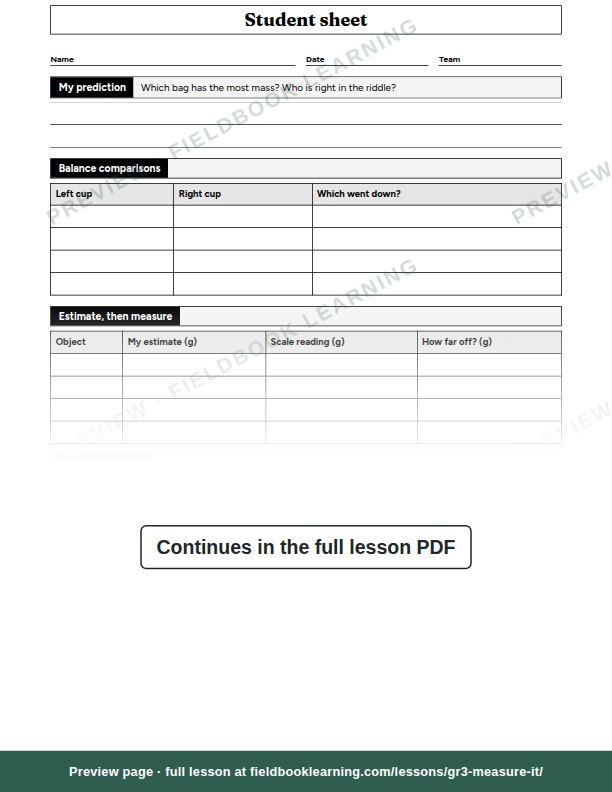
- My prediction
- Balance comparisons
- Estimate, then measure
- The mystery bags
- My answer for Grandpa
- Exit ticket
US Letter, prints cleanly in black and white. The student sheet is on its own page, ready to photocopy.
Free with an account (any 3 lessons), or US$19 / C$25 for all 4 lessons in this unit.
What students show by the end
- Uses a balance and a scale
- Estimates in grams
- Uses data in a claim
From the lesson’s rubric, which scores each one as not yet, getting there or got it.
Questions teachers ask
How long does “Which weighs more, a kilogram of feathers or a kilogram of rocks?” take?
55–60 min. Group size: teams of 3.
How much prep does it need?
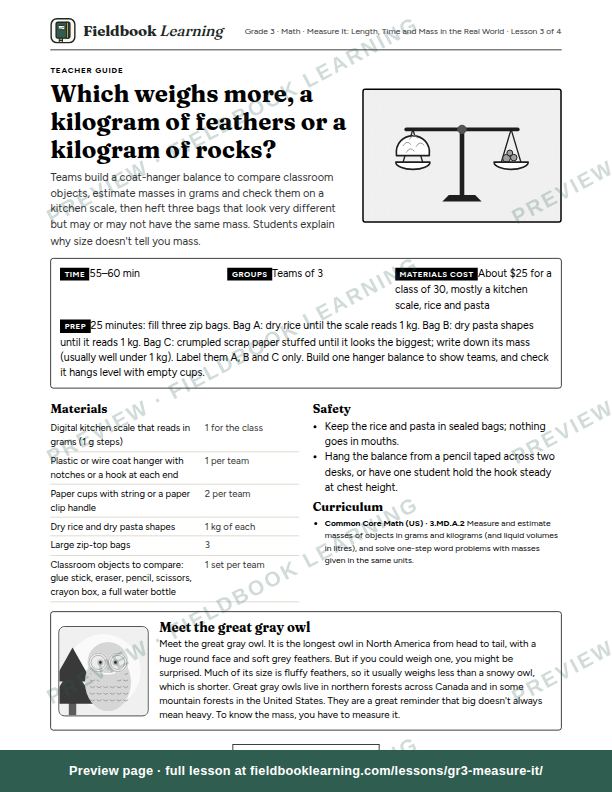
25 minutes: fill three zip bags. Bag A: dry rice until the scale reads 1 kg. Bag B: dry pasta shapes until it reads 1 kg. Bag C: crumpled scrap paper stuffed until it looks the biggest; write down its mass (usually well under 1 kg). Label them A, B and C only. Build one hanger balance to show teams, and check it hangs level with empty cups.
What materials do I need?
Digital kitchen scale that reads in grams (1 g steps); plastic or wire coat hanger with notches or a hook at each end; paper cups with string or a paper clip handle; dry rice and dry pasta shapes; large zip-top bags; classroom objects to compare. Cost: about $25 for a class of 30, mostly a kitchen scale, rice and pasta.
Which curriculum standards does it cover?
Common Core Math (US): 3.MD.A.2.
What’s in the lesson PDF?
A teacher guide that walks you through predict, hunt, reveal, act, background for the teacher and assessment, then a student sheet (“My prediction”; “Balance comparisons”; “Estimate, then measure”; “The mystery bags”; “My answer for Grandpa” and “Exit ticket”) on its own page, ready to photocopy. It’s US Letter and prints cleanly in black and white.
Can I try it for free?
Yes. A free account includes any 3 full lessons of your choice, and this can be one of them. After that, this unit is US$19 (C$25) for all 4 lessons, yours to keep, or every lesson is US$79 (C$109) a year.