 Preview · the opening mission
Read this to the class:
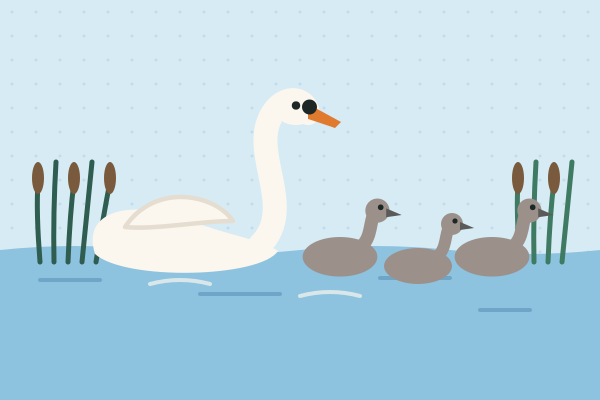
Down at the lake, Mateo saw a big white swan swimming with five fluffy grey babies. "Those can't be her babies," he said. "They're the wrong colour!" His friend Aisha had a cat at home with three kittens, and every one of them had stripes like their mother. So who is right? Do baby animals look like their parents? Your team's job: match each young plant or animal to its parent, and find how each one is like its parent and how it is different.
Teams of three, with three jobs that rotate: Holder (holds up each card for the team to see), Matcher (puts the pairs together) and Checker (asks "how do we know?" before a match is glued or written down).
Look inside the PDF
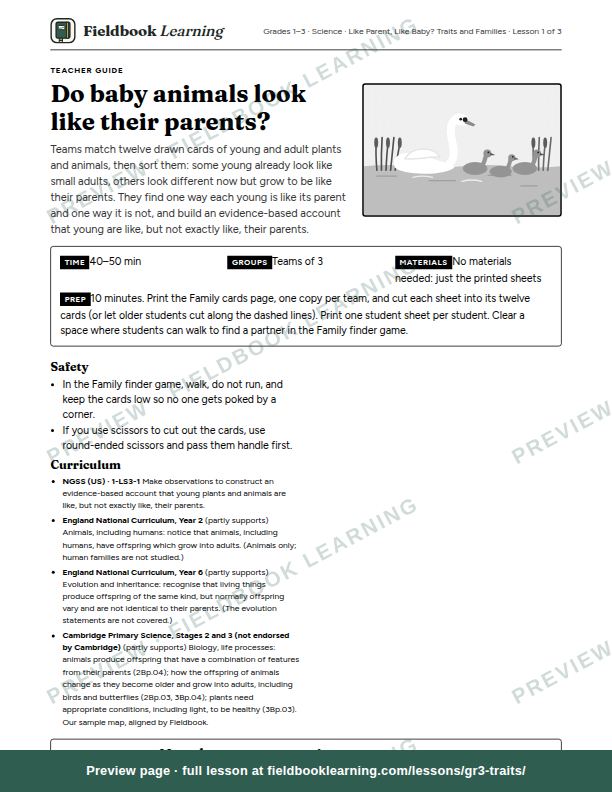
Sample pages, stamped “preview”. The download is the clean, full lesson.
In the full lesson PDF
8 printable pages
- Predict (5 min)
- Hunt (20 min)
- Reveal (10 min)
- Act (10 min)
- Background for the teacher
- Assessment
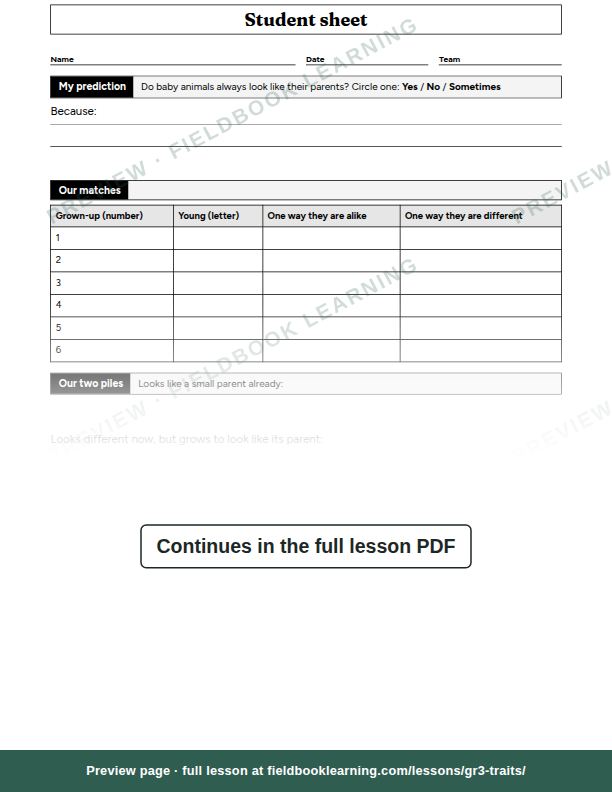
- Student sheet
- Worksheet: Family cards
- Worksheet: Label it
- Worksheet: Try it at home
On the student sheet
- My prediction
- Our matches
- Our two piles
- Like my parent, not exactly
- Exit ticket
- Family cards
- Label it
- Try it at home
US Letter, prints cleanly in black and white. The student sheet is on its own page, ready to photocopy.
Free with an account (any 3 lessons), or US$19 for all 3 lessons in this unit.
What students show by the end
- Matches young to parents
- Says how young are alike and different
- Uses evidence
From the lesson’s rubric, which scores each one as not yet, getting there or got it.
Questions teachers ask
How long does “Do baby animals look like their parents?” take?
40–50 min. Group size: teams of 3.
How much prep does it need?
10 minutes. Print the Family cards page, one copy per team, and cut each sheet into its twelve cards (or let older students cut along the dashed lines). Print one student sheet per student. Clear a space where students can walk to find a partner in the Family finder game.
What materials do I need?
None. No materials needed: just the printed sheets.
Which curriculum standards does it cover?
NGSS (US): 1-LS3-1. It also matches England National Curriculum, Year 2; England National Curriculum, Year 6 and Cambridge Primary Science, Stages 2 and 3 (not endorsed by Cambridge).
What’s in the lesson PDF?
A teacher guide that walks you through predict, hunt, reveal, act, background for the teacher and assessment, then a student sheet (“My prediction”; “Our matches”; “Our two piles”; “Like my parent, not exactly”; “Exit ticket”; “Family cards”; “Label it” and “Try it at home”) on its own page, ready to photocopy. It’s US Letter and prints cleanly in black and white.
Can I try it for free?
Yes. A free account includes any 3 full lessons of your choice, and this can be one of them. After that, this unit is US$19 for all 3 lessons, yours to keep, or every lesson is US$199 a year.