 Preview · the opening mission
Read this to the class:
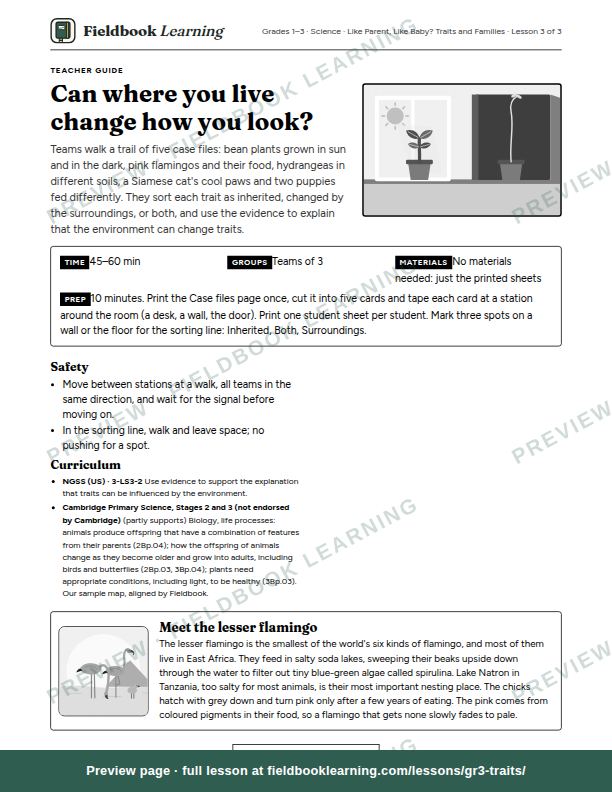
Sam's class planted beans from one packet. Half the pots went on a sunny windowsill, and half were left in a dark cupboard by mistake. Ten days later, the cupboard beans were more than twice as tall, but thin, floppy and yellow. "They're the same seeds," said Sam. "Why do they look so different?" Can where you live change how you look? Your team's job: visit five case files, find what each living thing got from its parents and what its surroundings changed, and sort the evidence.
Teams of three, with jobs that rotate at each station: Reader, Detective (finds the change and its cause) and Recorder.
Look inside the PDF
Sample pages, stamped “preview”. The download is the clean, full lesson.
In the full lesson PDF
8 printable pages
- Predict (5–10 min)
- Hunt (20 min)
- Reveal (10–15 min)
- Act (10 min)
- Background for the teacher
- Assessment
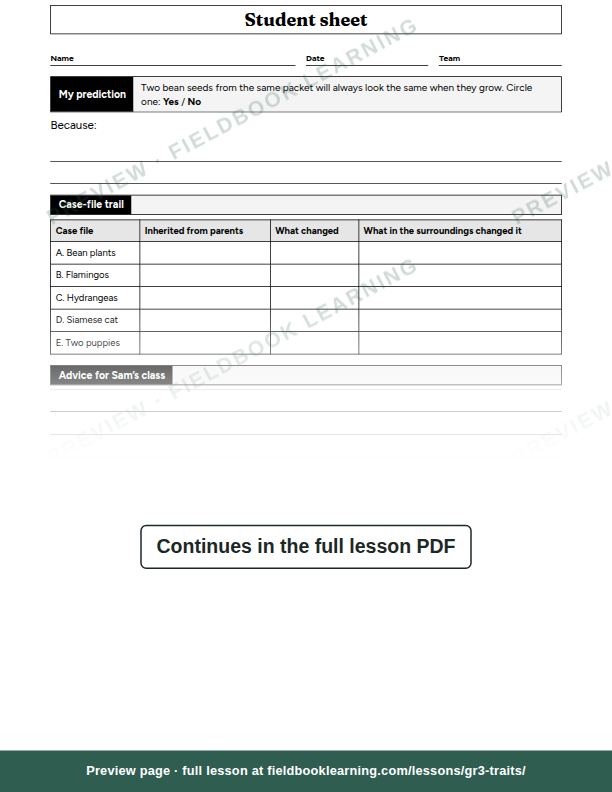
- Student sheet
- Worksheet: Case files
- Worksheet: Label it
- Worksheet: Try it at home
On the student sheet
- My prediction
- Case-file trail
- Advice for Sam's class
- Exit ticket
- Case files
- Label it
- Try it at home
US Letter, prints cleanly in black and white. The student sheet is on its own page, ready to photocopy.
Free with an account (any 3 lessons), or US$19 for all 3 lessons in this unit.
What students show by the end
- Uses evidence from the case files
- Sorts inherited and environment
- Explains with the bean data
From the lesson’s rubric, which scores each one as not yet, getting there or got it.
Questions teachers ask
How long does “Can where you live change how you look?” take?
45–60 min. Group size: teams of 3.
How much prep does it need?
10 minutes. Print the Case files page once, cut it into five cards and tape each card at a station around the room (a desk, a wall, the door). Print one student sheet per student. Mark three spots on a wall or the floor for the sorting line: Inherited, Both, Surroundings.
What materials do I need?
None. No materials needed: just the printed sheets.
Which curriculum standards does it cover?
NGSS (US): 3-LS3-2. It also matches Cambridge Primary Science, Stages 2 and 3 (not endorsed by Cambridge).
What’s in the lesson PDF?
A teacher guide that walks you through predict, hunt, reveal, act, background for the teacher and assessment, then a student sheet (“My prediction”, “Case-file trail”, “Advice for Sam's class”, “Exit ticket”, “Case files”, “Label it” and “Try it at home”) on its own page, ready to photocopy. It’s US Letter and prints cleanly in black and white.
Can I try it for free?
Yes. A free account includes any 3 full lessons of your choice, and this can be one of them. After that, this unit is US$19 for all 3 lessons, yours to keep, or every lesson is US$199 a year.