 Preview · the opening mission
Read this to the class:
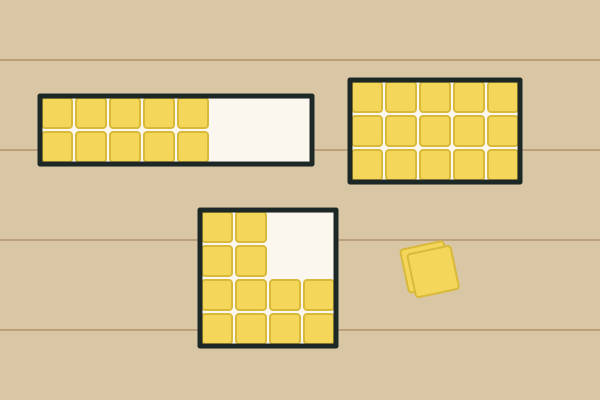
The school library is getting three new reading mats, and the librarian can only afford to carpet one of them this year. "Carpet the biggest one," she said, "so the most children can sit on it." Three mats are taped out at your station. One is long and thin, one is a rectangle, and one is a square. Your team's job: find out which mat really is the biggest, and prove it so the librarian can trust you.
Teams of three, with jobs that rotate after each mat: Tiler (places the sticky notes), Checker (looks for gaps and overlaps), Recorder (writes every count).
Look inside the PDF
Sample pages, stamped “preview”. The download is the clean, full lesson.
In the full lesson PDF
7 printable pages
- Predict (5–10 min)
- Hunt (20 min)
- Reveal (10–15 min)
- Act (10 min)
- Background for the teacher
- Assessment
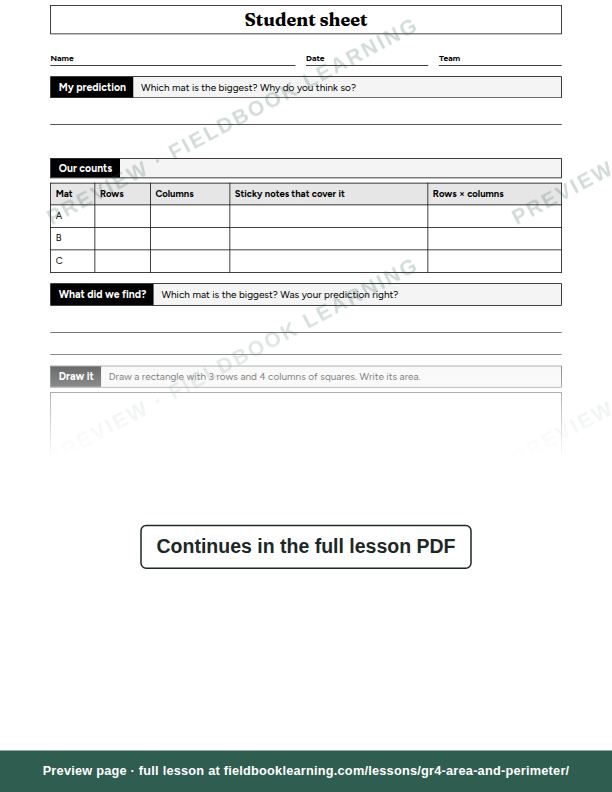
- Student sheet
- Worksheet: Label it
- Worksheet: Try it at home
On the student sheet
- My prediction
- Our counts
- What did we find?
- Draw it
- My note to the librarian
- Exit ticket
- Label it
- Try it at home
US Letter, prints cleanly in black and white. The student sheet is on its own page, ready to photocopy.
Free with an account (any 3 lessons), or US$19 for all 4 lessons in this unit.
What students show by the end
- Measures area with unit squares
- Connects rows and columns to multiplying
- Uses data in a claim
From the lesson’s rubric, which scores each one as not yet, getting there or got it.
Questions teachers ask
How long does “Which mat is the biggest?” take?
50–60 min. Group size: teams of 3.
How much prep does it need?
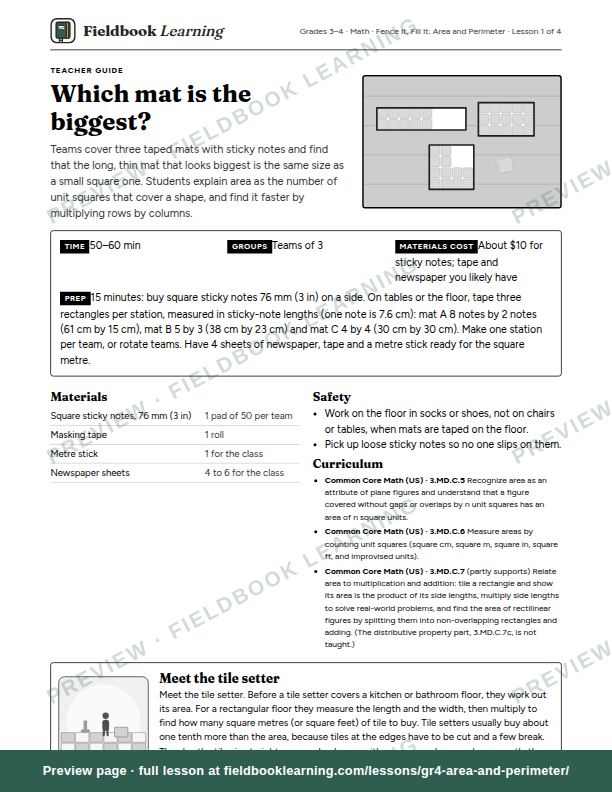
15 minutes: buy square sticky notes 76 mm (3 in) on a side. On tables or the floor, tape three rectangles per station, measured in sticky-note lengths (one note is 7.6 cm): mat A 8 notes by 2 notes (61 cm by 15 cm), mat B 5 by 3 (38 cm by 23 cm) and mat C 4 by 4 (30 cm by 30 cm). Make one station per team, or rotate teams. Have 4 sheets of newspaper, tape and a metre stick ready for the square metre.
What materials do I need?
Square sticky notes, 76 mm (3 in); masking tape; metre stick; newspaper sheets. Cost: about $10 for sticky notes; tape and newspaper you likely have.
Which curriculum standards does it cover?
Common Core Math (US): 3.MD.C.5, 3.MD.C.6 and 3.MD.C.7 (partly).
What’s in the lesson PDF?
A teacher guide that walks you through predict, hunt, reveal, act, background for the teacher and assessment, then a student sheet (“My prediction”, “Our counts”, “What did we find?”, “Draw it”, “My note to the librarian”, “Exit ticket”, “Label it” and “Try it at home”) on its own page, ready to photocopy. It’s US Letter and prints cleanly in black and white.
Can I try it for free?
Yes. A free account includes any 3 full lessons of your choice, and this can be one of them. After that, this unit is US$19 for all 4 lessons, yours to keep, or every lesson is US$199 a year.