Simple Circuits: Make It Light Up
Light a bulb with one wire, hunt for materials that let electricity through, find out why string lights all go dark at once, and build a burglar alarm. Four hands-on lessons on closed loops, safe and cheap.
Or try any 3 lessons free with an account.
Already bought it? Download the whole unit as one printable workbook: cover, contents, curriculum connections, every lesson, readings, practice pages, a unit test and an answer key, in black and white.
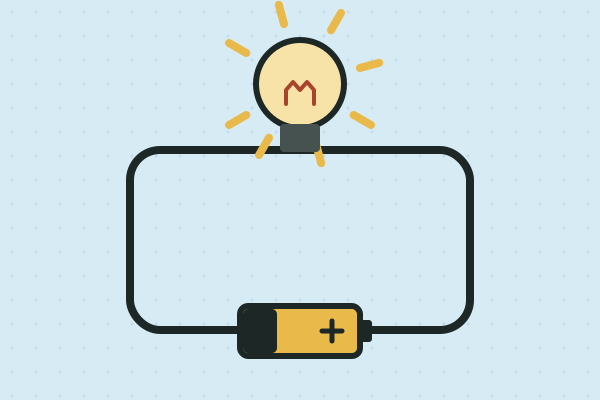
4 lessons in this unit
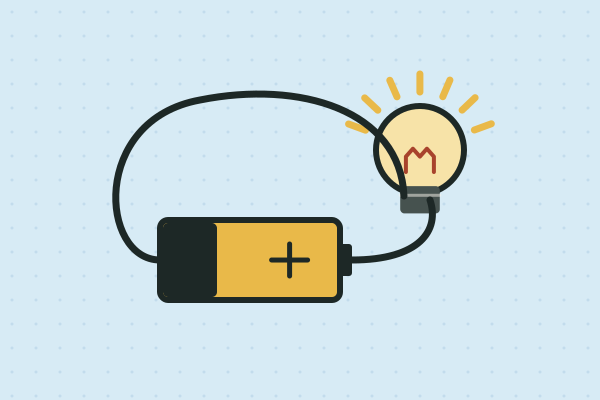 Lesson 1 · 45–60 minCan you light a bulb with one wire?Teams get one AA battery, one wire and one small bulb, and keep trying until the bulb lights, drawing every setup that works and every one that doesn't. Then they explain why a bulb only lights when electricity can travel in a complete loop.
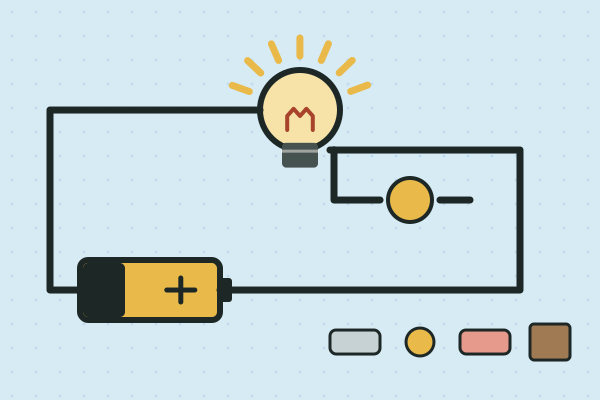 Lesson 2 · 45–60 minWhat lets electricity through?Teams build a circuit tester with a gap in it, then bridge the gap with coins, foil, pencil graphite, an eraser, paper clips and plastic. They sort the results into conductors and insulators and explain why electrical wires are metal on the inside and plastic on the outside.
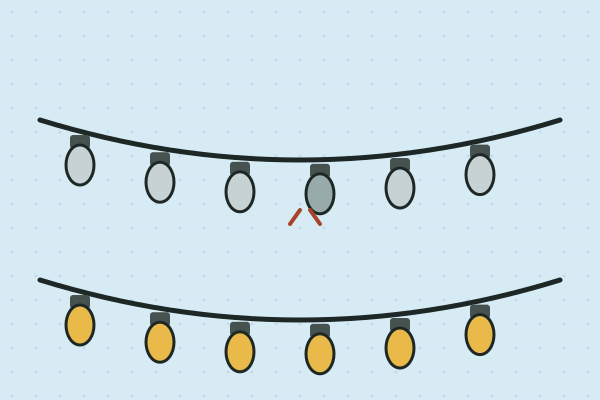 Lesson 3 · 45–60 minWhy do some string lights all go out at once?Teams wire two bulbs in a single loop, then in two separate loops, unscrew one bulb each time and compare brightness. They explain why one loose bulb can darken a whole string of lights, and why a house is wired so it doesn't.
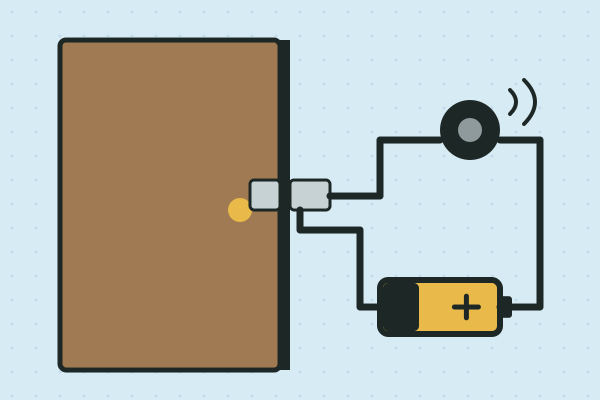 Lesson 4 · 60–75 minCan you build a burglar alarm?Teams design and build a homemade switch from a clothes peg or foil and cardboard that closes a circuit when a door or box lid opens, sounding a buzzer or lighting an LED. They test it, improve it and use evidence to argue their alarm is the most reliable.
Materials for the whole unit · one list, lesson by lesson
Lesson 1: Can you light a bulb with one wire?
- AA alkaline battery, 1.5 V (dollar-store packs are fine)1 per team, plus spares
- Insulated wire, about 20 cm (8 in), ends stripped (any thin hookup or bell wire; a hardware-store spool is about $5)1 per team
- Small screw-base flashlight bulb rated 1.5 V (2.5 V bulbs also work, but glow dimmer on one battery)1 per team, plus spares
- Bulb holder and battery holder from the classroom kit1 of each, for the teacher's check
- Magnifying glass (optional)A few to share
About $10 for a class of 30, if you already have small bulbs
Lesson 2: What lets electricity through?
- Battery holder for 2 AA batteries, with 2 AA alkaline batteries (3 V total)1 per team
- Bulb holder with a small 2.5 V flashlight bulb (or a red LED with a 100 ohm resistor, or an LED sold with its own battery pack)1 per team
- Alligator-clip leads (about $8 for a pack of 10 online), or stripped insulated wire3 per team
- Test objects: a coin, a strip of aluminum foil, a pencil sharpened at both ends, an eraser, a bare metal paper clip, a plastic-coated paper clip, a plastic spoon or ruler, a craft stick, a rubber band, paper1 set per team
- Mechanical-pencil lead, 0.7 mm or thicker (optional, for the graphite test)A few pieces to share
About $10 for a class of 30, if you have battery holders and bulbs
Lesson 3: Why do some string lights all go out at once?
- Battery holder for 2 AA batteries, with 2 AA alkaline batteries (3 V total)1 per team
- Bulb holder with a matching 2.5 V flashlight bulb2 per team, plus one spare bulb
- Alligator-clip leads (about $8 for a pack of 10 online)4 per team
- A string of holiday mini lights, unplugged, to pass around (optional)1 for the class
About $5 for a class of 30, if you have battery holders and bulbs
Lesson 4: Can you build a burglar alarm?
- Battery holder for 2 AA batteries, with 2 AA alkaline batteries (3 V total)1 per team
- Active buzzer rated 3 V, with red and black leads (about $8 for 10 online or at an electronics shop), or a red LED with a 100 ohm resistor1 per team
- Alligator-clip leads, or stripped insulated wire and tape3 to 4 per team
- Wooden spring clothes peg (dollar store, about $2 for 20)1 per team
- Aluminum foil, cardboard, masking tape, string or yarnTo share
- Plastic or cardstock tab, about 2 × 6 cm (1 × 2½ in)2 per team
- Shoebox with a lid, or a cupboard door1 per team or a few to share
About $20 for 10 teams, if you have battery holders
Students start with a puzzle that stumps plenty of adults: light a bulb with one AA battery and one wire. From there they build a circuit tester and sort classroom objects into conductors and insulators, wire two bulbs in a row and side by side to solve the mystery of the string of lights that all go out at once, and finish with a design challenge: a homemade switch that sounds a buzzer when someone opens a door or a box.
By the end, students can explain that electricity only does its job when there is a complete, unbroken loop from one end of the battery, through the device and back to the other end, and that a switch is simply a way to open and close that loop. Everything runs on 1.5 V AA batteries, and safety rules about short circuits, wall outlets and coin cells are built into every lesson.