 Preview · the opening mission
Read this to the class:
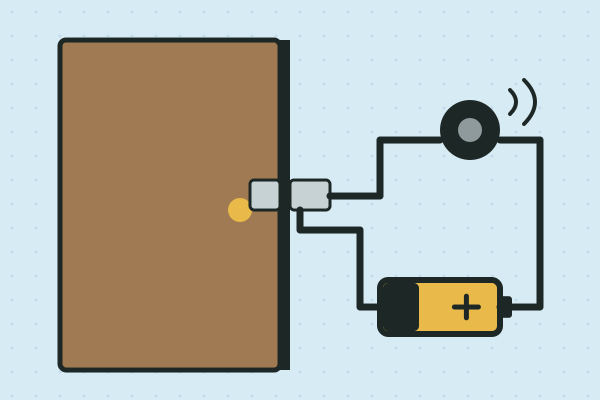
Someone keeps sneaking into the class supply cupboard and taking the good markers. The principal won't buy a real alarm. But you know how to open and close a circuit. Your team's job: build an alarm that goes off the moment the cupboard door or a box lid opens, and stays quiet when it's closed.
Jobs rotate between build rounds: Builder (assembles the switch), Tester (opens the box and checks for warmth), Recorder (draws designs and records tests).
Look inside the PDF
Sample pages, stamped “preview”. The download is the clean, full lesson.
In the full lesson PDF
- Predict (5–10 min)
- Hunt (25 min)
- Reveal (10 min)
- Act (10 min)
- Background for the teacher
- Assessment
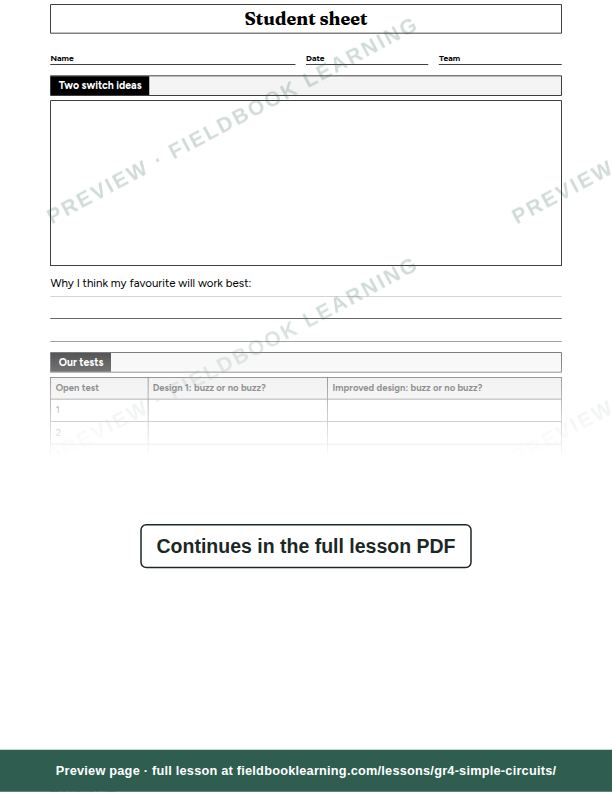
- Student sheet
On the student sheet
- Two switch ideas
- Our tests
- The one thing we changed
- Pitch to the principal
- Exit ticket
US Letter, prints cleanly in black and white. The student sheet is on its own page, ready to photocopy.
Free with an account (any 3 lessons), or US$19 / C$25 for all 4 lessons in this unit.
What students show by the end
- Meets the criteria
- Improves with evidence
- Explains the switch
From the lesson’s rubric, which scores each one as not yet, getting there or got it.
Questions teachers ask
How long does “Can you build a burglar alarm?” take?
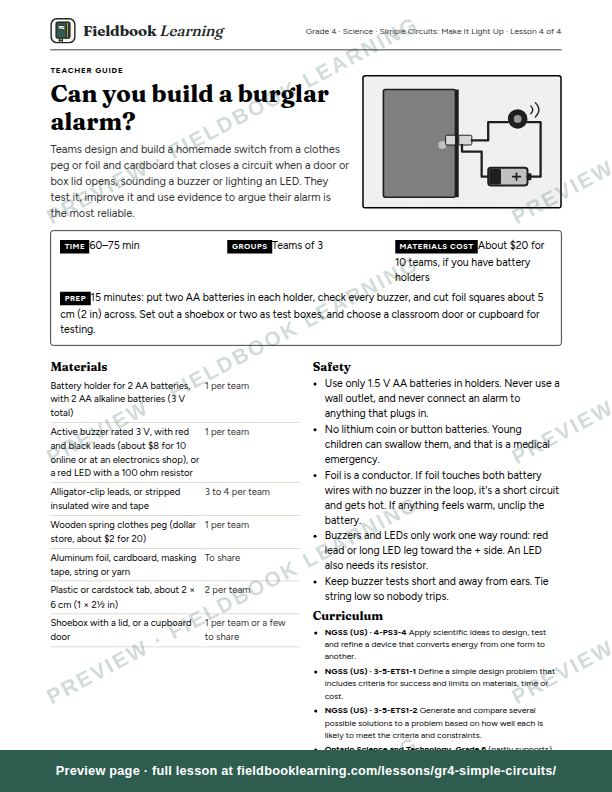
60–75 min. Group size: teams of 3.
How much prep does it need?
15 minutes: put two AA batteries in each holder, check every buzzer, and cut foil squares about 5 cm (2 in) across. Set out a shoebox or two as test boxes, and choose a classroom door or cupboard for testing.
What materials do I need?
Battery holder for 2 AA batteries, with 2 AA alkaline batteries (3 V total); active buzzer rated 3 V, with red and black leads (about $8 for 10 online or at an electronics shop), or a red LED with a 100 ohm resistor; alligator-clip leads, or stripped insulated wire and tape; wooden spring clothes peg (dollar store, about $2 for 20); aluminum foil, cardboard, masking tape, string or yarn; plastic or cardstock tab, about 2 × 6 cm (1 × 2½ in); and 1 more. Cost: about $20 for 10 teams, if you have battery holders.
Which curriculum standards does it cover?
NGSS (US): 4-PS3-4, 3-5-ETS1-1 and 3-5-ETS1-2. It also matches Ontario Science and Technology, Grade 6 and Cambridge Primary Science, Stages 4 and 6 (not endorsed by Cambridge).
What’s in the lesson PDF?
A teacher guide that walks you through predict, hunt, reveal, act, background for the teacher and assessment, then a student sheet (“Two switch ideas”, “Our tests”, “The one thing we changed”, “Pitch to the principal” and “Exit ticket”) on its own page, ready to photocopy. It’s US Letter and prints cleanly in black and white.
Can I try it for free?
Yes. A free account includes any 3 full lessons of your choice, and this can be one of them. After that, this unit is US$19 (C$25) for all 4 lessons, yours to keep, or every lesson is US$79 (C$109) a year.