 Preview · the opening mission
Read this to the class:
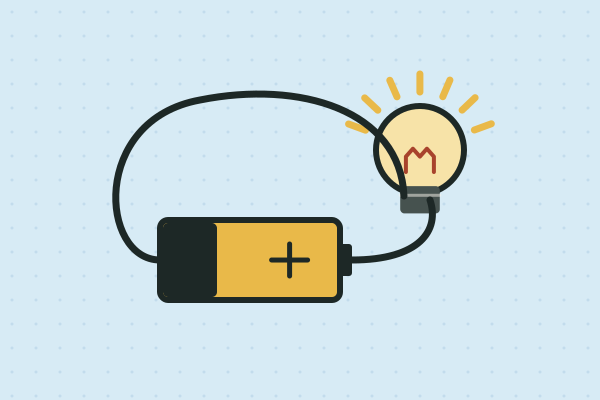
The power went out during a storm. Grandpa found a flashlight in the drawer, but it fell apart in his hands: one battery, one tiny bulb and one loose wire rolled across the table. The flashlight case was cracked and useless. Your team's job: get the bulb to light using only the battery and that one wire.
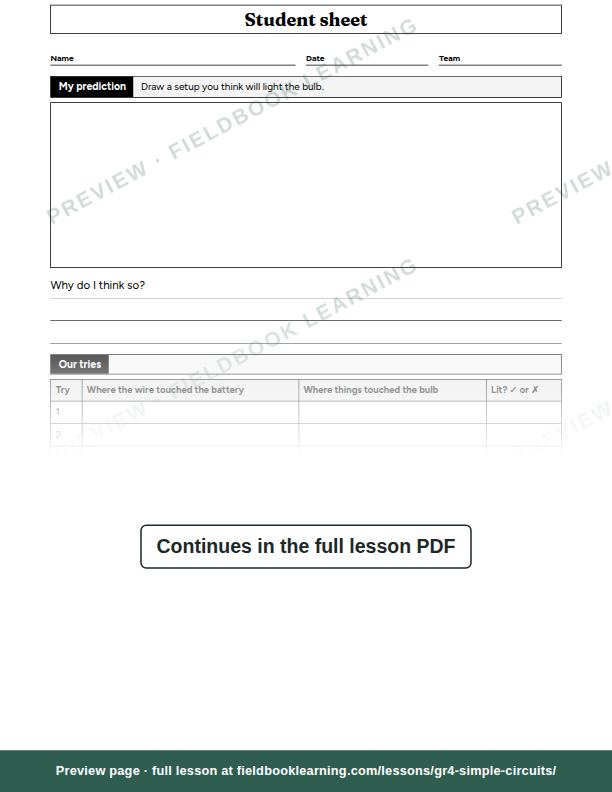
Teams of three, with three jobs that rotate after every try or two: Builder (holds the parts), Checker (watches for warm wires and calls "let go"), Recorder (draws every setup).
Look inside the PDF
Sample pages, stamped “preview”. The download is the clean, full lesson.
In the full lesson PDF
- Predict (5–10 min)
- Hunt (20 min)
- Reveal (10–15 min)
- Act (10 min)
- Background for the teacher
- Assessment
- Student sheet
On the student sheet
- My prediction
- Our tries
- One setup that worked and one that didn't
- What we kept the same, and what we changed
- Claim, evidence, reasoning
- Instructions for Grandpa
- Exit ticket
US Letter, prints cleanly in black and white. The student sheet is on its own page, ready to photocopy.
What students show by the end
- Builds a working circuit
- Explains the loop
- Uses evidence
From the lesson’s rubric, which scores each one as not yet, getting there or got it.
Questions teachers ask
How long does “Can you light a bulb with one wire?” take?
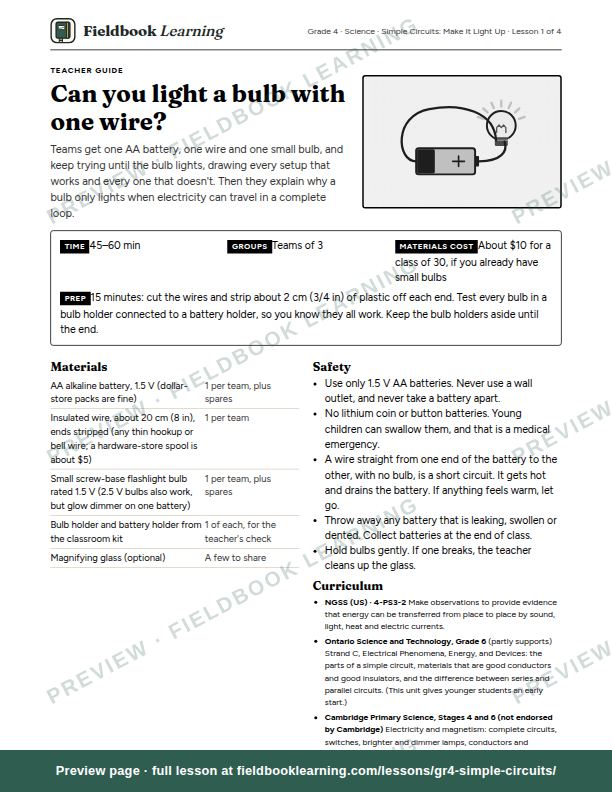
45–60 min. Group size: teams of 3.
How much prep does it need?
15 minutes: cut the wires and strip about 2 cm (3/4 in) of plastic off each end. Test every bulb in a bulb holder connected to a battery holder, so you know they all work. Keep the bulb holders aside until the end.
What materials do I need?
AA alkaline battery, 1.5 V (dollar-store packs are fine); insulated wire, about 20 cm (8 in), ends stripped (any thin hookup or bell wire; a hardware-store spool is about $5); small screw-base flashlight bulb rated 1.5 V (2.5 V bulbs also work, but glow dimmer on one battery); bulb holder and battery holder from the classroom kit; magnifying glass (optional). Cost: about $10 for a class of 30, if you already have small bulbs.
Which curriculum standards does it cover?
NGSS (US): 4-PS3-2. It also matches Ontario Science and Technology, Grade 6 and Cambridge Primary Science, Stages 4 and 6 (not endorsed by Cambridge).
What’s in the lesson PDF?
A teacher guide that walks you through predict, hunt, reveal, act, background for the teacher and assessment, then a student sheet (“My prediction”; “Our tries”; “One setup that worked and one that didn't”; “What we kept the same, and what we changed”; “Claim, evidence, reasoning”; “Instructions for Grandpa” and “Exit ticket”) on its own page, ready to photocopy. It’s US Letter and prints cleanly in black and white.
Can I try it for free?
Yes. This is one of our sample lessons: the complete PDF is free to everyone, with no sign-in.