 Preview · the opening mission
Read this to the class:
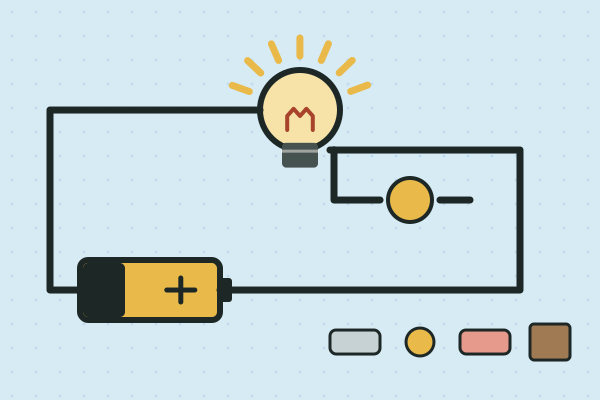
A family is fixing up an old lamp. Someone asks: "Why is the wire wrapped in plastic? Couldn't they just use metal all the way?" Someone else wonders if a pencil, a coin or a strip of foil could stand in for a missing piece of wire. Nobody is sure. Your team's job: build a tester and find out which materials let electricity through.
Jobs rotate halfway through: Builder (connects and touches the clips), Checker (watches the bulb and feels for warmth), Recorder (fills in the table).
Look inside the PDF
Sample pages, stamped “preview”. The download is the clean, full lesson.
In the full lesson PDF
- Predict (5–10 min)
- Hunt (20 min)
- Reveal (10–15 min)
- Act (10 min)
- Background for the teacher
- Assessment
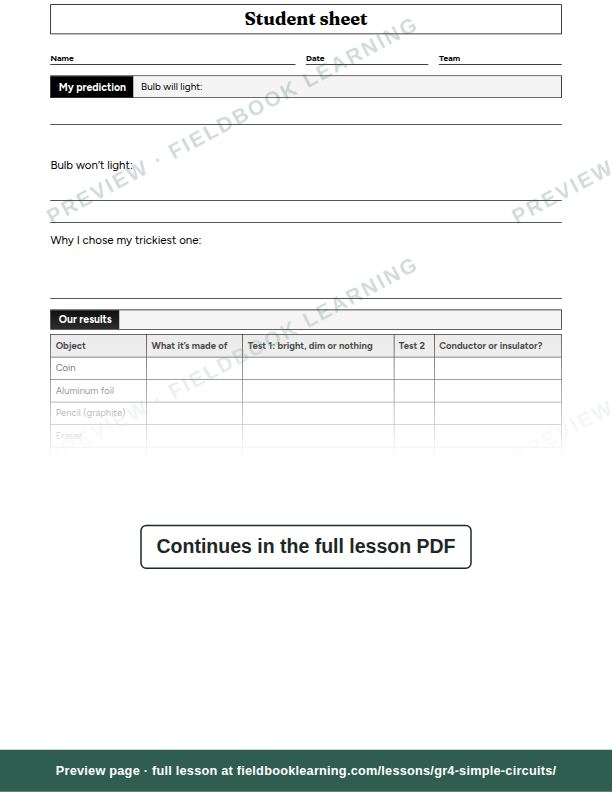
- Student sheet
On the student sheet
- My prediction
- Our results
- Draw our tester
- What we kept the same, and what we changed
- Claim, evidence, reasoning
- Answer to the family
- Exit ticket
US Letter, prints cleanly in black and white. The student sheet is on its own page, ready to photocopy.
Free with an account (any 3 lessons), or US$19 / C$25 for all 4 lessons in this unit.
What students show by the end
- Tests fairly
- Sorts materials
- Explains with evidence
From the lesson’s rubric, which scores each one as not yet, getting there or got it.
Questions teachers ask
How long does “What lets electricity through?” take?
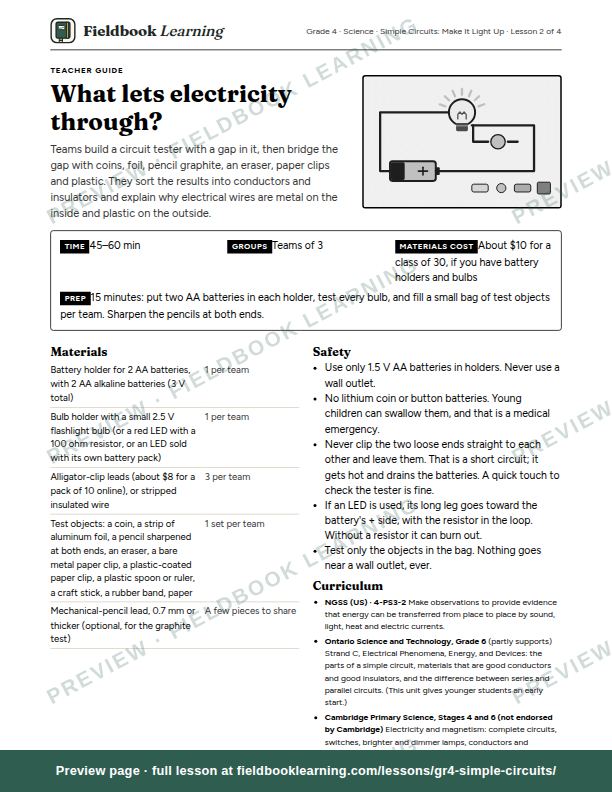
45–60 min. Group size: teams of 3.
How much prep does it need?
15 minutes: put two AA batteries in each holder, test every bulb, and fill a small bag of test objects per team. Sharpen the pencils at both ends.
What materials do I need?
Battery holder for 2 AA batteries, with 2 AA alkaline batteries (3 V total); bulb holder with a small 2.5 V flashlight bulb (or a red LED with a 100 ohm resistor, or an LED sold with its own battery pack); alligator-clip leads (about $8 for a pack of 10 online), or stripped insulated wire; test objects; mechanical-pencil lead, 0.7 mm or thicker (optional, for the graphite test). Cost: about $10 for a class of 30, if you have battery holders and bulbs.
Which curriculum standards does it cover?
NGSS (US): 4-PS3-2. It also matches Ontario Science and Technology, Grade 6 and Cambridge Primary Science, Stages 4 and 6 (not endorsed by Cambridge).
What’s in the lesson PDF?
A teacher guide that walks you through predict, hunt, reveal, act, background for the teacher and assessment, then a student sheet (“My prediction”; “Our results”; “Draw our tester”; “What we kept the same, and what we changed”; “Claim, evidence, reasoning”; “Answer to the family” and “Exit ticket”) on its own page, ready to photocopy. It’s US Letter and prints cleanly in black and white.
Can I try it for free?
Yes. A free account includes any 3 full lessons of your choice, and this can be one of them. After that, this unit is US$19 (C$25) for all 4 lessons, yours to keep, or every lesson is US$79 (C$109) a year.