Clean Water Challenge: Mixtures, Dissolving and Separating
Where does the salt go when it disappears in water? Can a filter make muddy water safe to drink? How do you get fresh water out of salt water? Three hands-on lessons on dissolving, separating mixtures and the solar still, with nothing tasted and nothing boiled by children.
Or try any 3 lessons free with an account.
Already bought it? Download the whole unit as one printable workbook: cover, contents, curriculum connections, every lesson, readings, practice pages, a unit test and an answer key, in black and white.
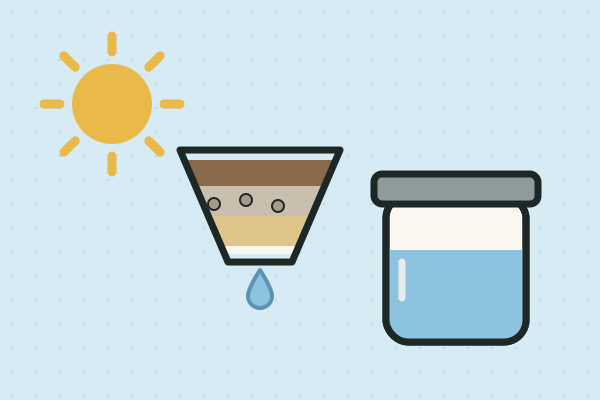
3 lessons in this unit
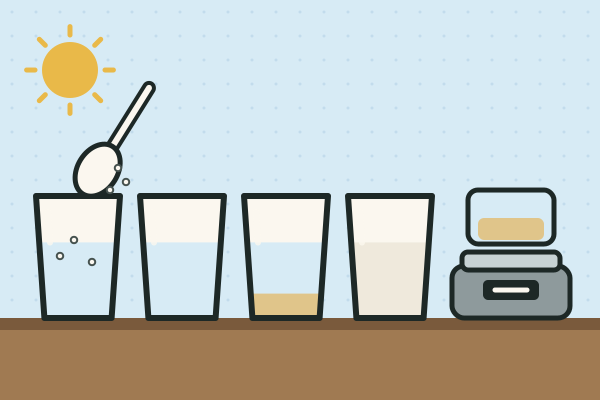 Lesson 1 · 50–60 minWhere does the salt go when it disappears in water?Teams stir salt, sugar, sand and flour into water to sort what dissolves from what only mixes, then weigh a jar before and after to find out whether dissolved salt is really gone. They use the evidence to name three mystery powders and to explain, in their own words, why dissolving is not melting.
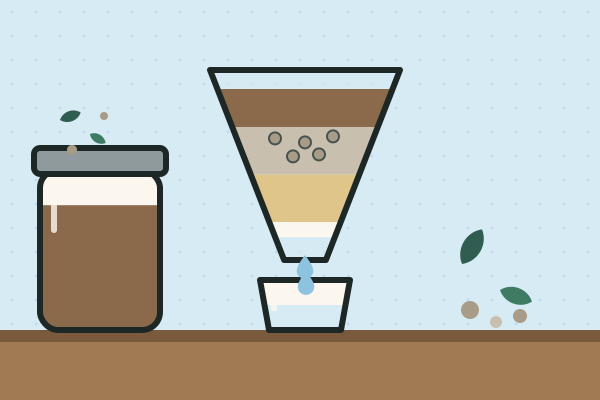 Lesson 2 · 50–60 minCan a filter make muddy water safe to drink?Teams separate a made-up muddy, gritty, salty mixture by sieving, settling and filtering through cloth, a coffee filter and layers of gravel and sand, and score how clear each filter makes it. Then they find out what every filter missed: dissolved salt and dye, and germs, and why clear water is not the same as safe water.
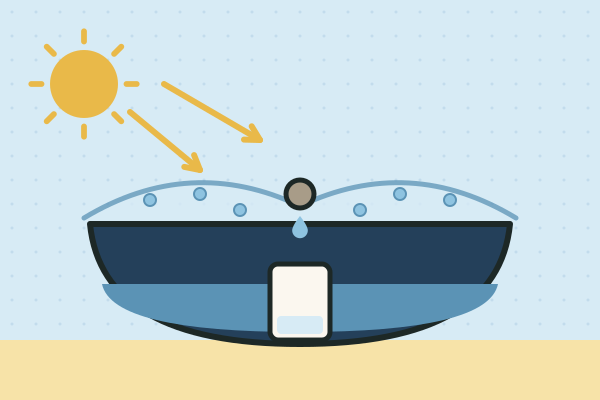 Lesson 3 · 50 min to set up and test, plus 2–3 hours of strong sun (or a 30-minute warm-water still indoors)How can you get fresh water out of salt water?Teams build a solar still from a bowl, a cup and clear plastic film, and watch salt water turn to vapour and back to liquid in the cup, leaving the salt and blue dye behind. They weigh the whole still before and after, and test the collected water with a drop on a dark plate. Cloudy days and cool rooms get an adult-run warm-water version.
Materials for the whole unit · one list, lesson by lesson
Lesson 1: Where does the salt go when it disappears in water?
- Clear plastic cups or jars, about 250 mL (1 cup)5 per team
- Measuring jug marked in mL1 per team
- Teaspoon or craft sticks, for stirring1 per cup
- Table saltAbout 60 g per team
- SugarAbout 10 g per team
- Clean sand, rinsed and driedAbout 30 g per team
- Plain flourAbout 10 g per team
- Kitchen scale that reads to 1 g1 per 2 or 3 teams
- Small paper cups, for weighing powder6 per team
- Tray or plate to stand the jars on, and paper towels1 per team
- Room-temperature tap waterAbout 500 mL per team
About $15 for a class of 30, mostly for kitchen scales if you don't have them (one scale per 2 or 3 teams is enough)
Lesson 2: Can a filter make muddy water safe to drink?
- Made-up muddy water (see prep)About 600 mL per team
- Plastic bottle, 1.5–2 L, cut in half by an adult, top half used as a funnel1 per team
- Clear plastic cups or jars, about 250 mL6 per team
- Kitchen sieve, colander or tea strainer1 per team
- Coffee filters (paper)3 per team
- Clean cotton cloth, such as a handkerchief or old cotton T-shirt, cut in 20 cm squares1 per team
- Clean sand, rinsedAbout 200 mL (1 cup) per team
- Small gravel, rinsedAbout 100 mL (1/2 cup) per team
- Clearness card (see prep)1 per team
- Dark plate or saucer1 per team
- Elastic band, pencil, measuring jug, timer1 each per team
About $15 for a class of 30
Lesson 3: How can you get fresh water out of salt water?
- Wide bowl, about 20–25 cm across, dark if possible1 per team
- Small heavy cup or egg cup, about 100 mL, shorter than the bowl's rim1 per team
- Clear plastic film (cling film)A piece about 40 cm square per team
- Elastic band or masking tape1 per team
- Small clean pebble or marble1 per team
- Salt water, coloured blue (see prep)300 mL per team
- Kitchen scale that reads to 1 g and holds at least 1 kg1 per 2 or 3 teams
- Measuring syringe or small measuring cup marked in mL1 per team
- Dark plate or saucer, and tap water1 plate per team
- For the warm-water still: zip-top bag of ice cubes, sealed1 per team
- For the warm-water still: thermometer (adult use)1
About $15 for a class of 30
Students stir salt, sugar, sand and flour into water to find out which dissolve and which only mix, then weigh a jar before and after to see whether dissolved salt is really gone. They sieve, settle and filter a made-up muddy, salty mixture through cloth, a coffee filter and layers of gravel and sand, and find out what every filter missed. Finally they build a solar still that turns salt water into drops of fresh water in a cup, and they test the water with a drop on a dark plate instead of a taste.
By the end, students can explain that dissolving is not melting, that dissolved things are still there and the mass stays the same, that filters and sieves only stop what is bigger than their holes, and that clear water is not the same as safe water. Nobody ever drinks the test water, nothing is boiled by children, and everything uses kitchen or garden materials. The unit works in any climate: it has a sun version of the still and an adult-run warm-water version for cloudy days and cool rooms.