 Preview · the opening mission
Read this to the class:
Mei Ling stirs a spoonful of sugar into a glass of cold water. After a minute, the sugar has vanished. "Gone!" says her brother Tomás. "Melted," says her friend Kofi. "Hiding," says Mei Ling. "If it's gone, the glass should weigh less now." Nobody knows. Your team's job: find out what disappears in water and what doesn't, and then weigh it to settle the argument.
Teams of three, with rotating jobs: Stirrer (stirs and pours), Weigher (works the scale), Recorder (writes every result down).
Look inside the PDF
Sample pages, stamped “preview”. The download is the clean, full lesson.
In the full lesson PDF
- Predict (5–10 min)
- Hunt (20–25 min)
- Reveal (10–15 min)
- Act (10 min)
- Background for the teacher
- Assessment
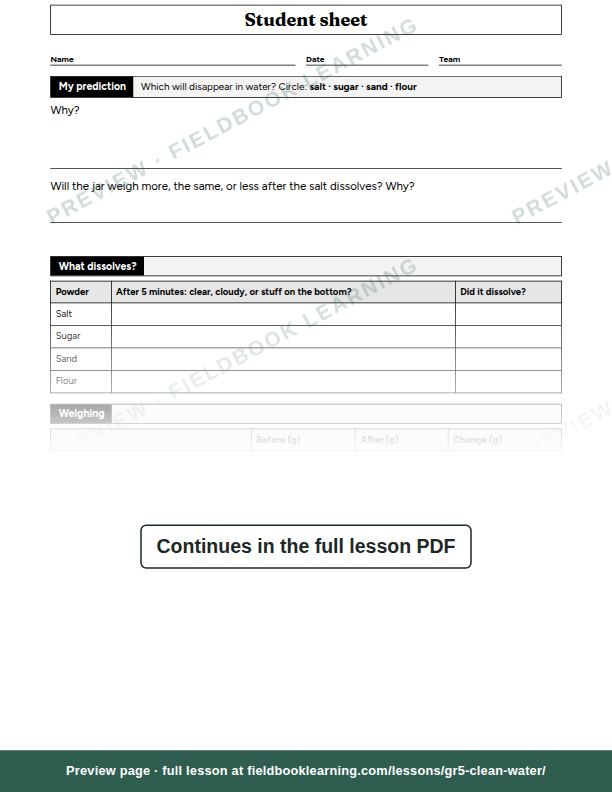
- Student sheet
- Worksheet: Label it
- Worksheet: Try it at home
On the student sheet
- My prediction
- What dissolves?
- Weighing
- What we kept the same, and what we changed
- Mystery powders
- Settle the argument
- Exit ticket
- Label it
- Try it at home
US Letter, prints cleanly in black and white. The student sheet is on its own page, ready to photocopy.
Free with an account (any 3 lessons), or US$19 / C$25 for all 3 lessons in this unit.
What students show by the end
- Sorts materials by what they do in water
- Measures and compares mass
- Explains dissolving
From the lesson’s rubric, which scores each one as not yet, getting there or got it.
Questions teachers ask
How long does “Where does the salt go when it disappears in water?” take?
50–60 min. Group size: teams of 3.
How much prep does it need?
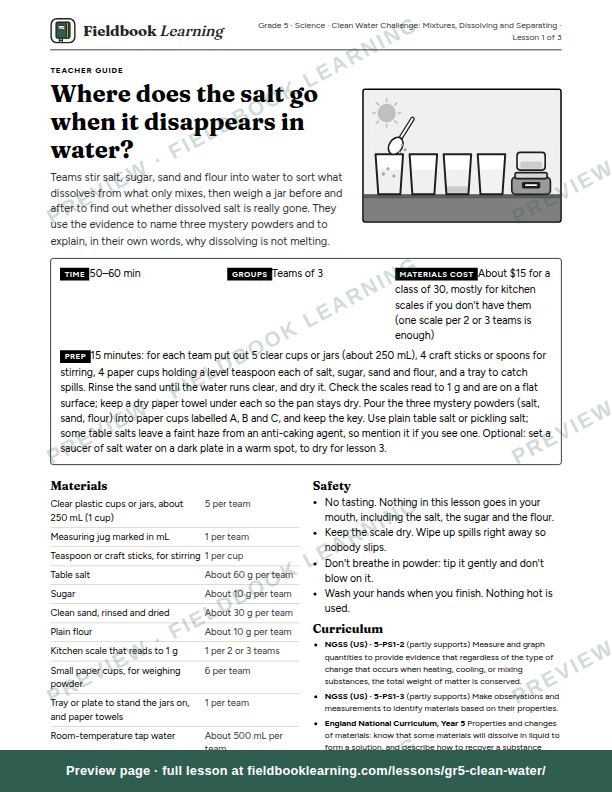
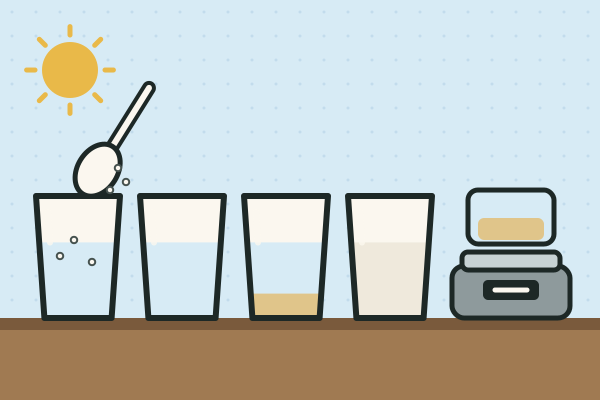
15 minutes: for each team put out 5 clear cups or jars (about 250 mL), 4 craft sticks or spoons for stirring, 4 paper cups holding a level teaspoon each of salt, sugar, sand and flour, and a tray to catch spills. Rinse the sand until the water runs clear, and dry it. Check the scales read to 1 g and are on a flat surface; keep a dry paper towel under each so the pan stays dry. Pour the three mystery powders (salt, sand, flour) into paper cups labelled A, B and C, and keep the key. Use plain table salt or pickling salt; some table salts leave a faint haze from an anti-caking agent, so mention it if you see one. Optional: set a saucer of salt water on a dark plate in a warm spot, to dry for lesson 3.
What materials do I need?
Clear plastic cups or jars, about 250 mL (1 cup); measuring jug marked in mL; teaspoon or craft sticks, for stirring; table salt; sugar; clean sand, rinsed and dried; and 5 more. Cost: about $15 for a class of 30, mostly for kitchen scales if you don't have them (one scale per 2 or 3 teams is enough).
Which curriculum standards does it cover?
NGSS (US): 5-PS1-2 (partly) and 5-PS1-3 (partly). It also matches England National Curriculum, Year 5 and Cambridge Primary Science, Stages 3, 5 and 6 (not endorsed by Cambridge).
What’s in the lesson PDF?
A teacher guide that walks you through predict, hunt, reveal, act, background for the teacher and assessment, then a student sheet (“My prediction”; “What dissolves?”; “Weighing”; “What we kept the same, and what we changed”; “Mystery powders”; “Settle the argument”; “Exit ticket”; “Label it” and “Try it at home”) on its own page, ready to photocopy. It’s US Letter and prints cleanly in black and white.
Can I try it for free?
Yes. A free account includes any 3 full lessons of your choice, and this can be one of them. After that, this unit is US$19 (C$25) for all 3 lessons, yours to keep, or every lesson is US$79 (C$109) a year.