 Preview · the opening mission
Read this to the class:
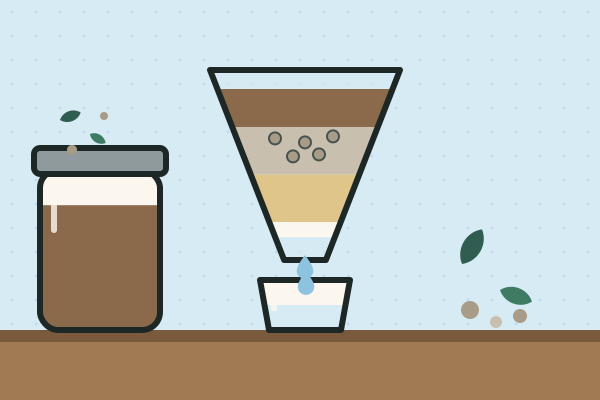
After a storm, the stream beside Lina's village runs brown. Her grandfather says, "Let it settle, pour it through a cloth, and it's fine." Her cousin says, "Use a coffee filter, then it's clean." The teacher says, "What do you mean by clean?" Nobody has an answer. Your team's job: separate a muddy mixture as well as you can, then test what your filter did and didn't take out.
Teams of three, with rotating jobs: Pourer (pours slowly and carefully), Timer (starts the clock and calls out minutes), Recorder (scores the water and writes the results).
Whatever it looks like at the end, nobody drinks this water.
Look inside the PDF
Sample pages, stamped “preview”. The download is the clean, full lesson.
In the full lesson PDF
- Predict (5–10 min)
- Hunt (20–25 min)
- Reveal (10–15 min)
- Act (10 min)
- Background for the teacher
- Assessment
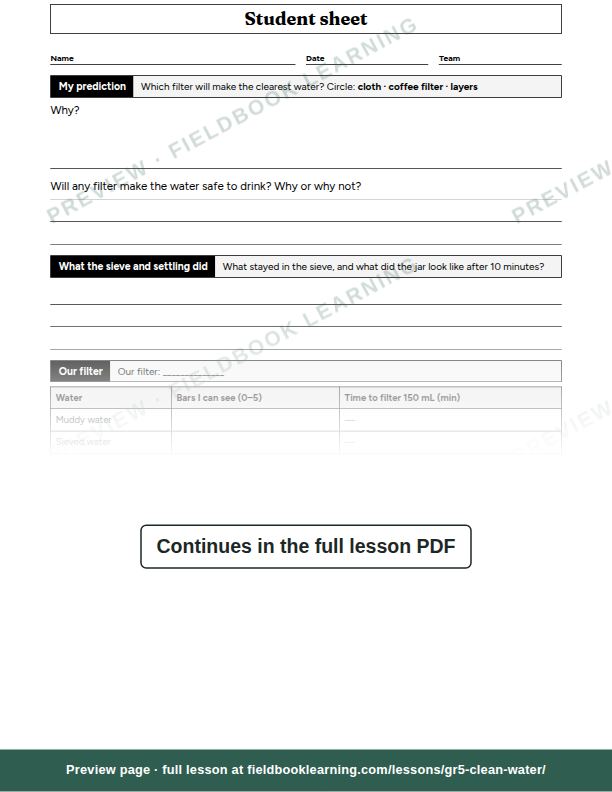
- Student sheet
- Worksheet: Label it
- Worksheet: Try it at home
On the student sheet
- My prediction
- What the sieve and settling did
- Our filter
- What was still in the filtered water?
- What we kept the same, and what we changed
- Advice for Lina's village
- Exit ticket
- Label it
- Try it at home
US Letter, prints cleanly in black and white. The student sheet is on its own page, ready to photocopy.
Free with an account (any 3 lessons), or US$19 / C$25 for all 3 lessons in this unit.
What students show by the end
- Separates a mixture
- Compares fairly
- Explains what filters miss
From the lesson’s rubric, which scores each one as not yet, getting there or got it.
Questions teachers ask
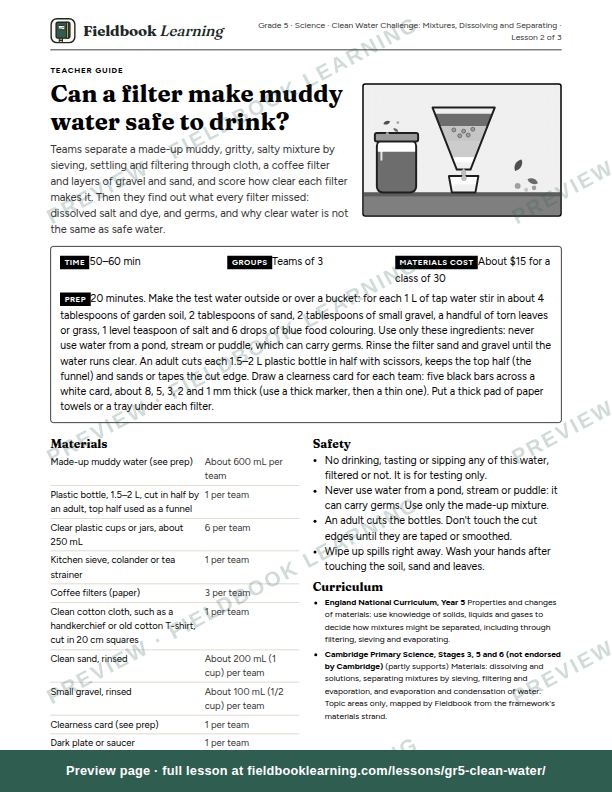
How long does “Can a filter make muddy water safe to drink?” take?
50–60 min. Group size: teams of 3.
How much prep does it need?
20 minutes. Make the test water outside or over a bucket: for each 1 L of tap water stir in about 4 tablespoons of garden soil, 2 tablespoons of sand, 2 tablespoons of small gravel, a handful of torn leaves or grass, 1 level teaspoon of salt and 6 drops of blue food colouring. Use only these ingredients: never use water from a pond, stream or puddle, which can carry germs. Rinse the filter sand and gravel until the water runs clear. An adult cuts each 1.5–2 L plastic bottle in half with scissors, keeps the top half (the funnel) and sands or tapes the cut edge. Draw a clearness card for each team: five black bars across a white card, about 8, 5, 3, 2 and 1 mm thick (use a thick marker, then a thin one). Put a thick pad of paper towels or a tray under each filter.
What materials do I need?
Made-up muddy water (see prep); plastic bottle, 1.5–2 L, cut in half by an adult, top half used as a funnel; clear plastic cups or jars, about 250 mL; kitchen sieve, colander or tea strainer; coffee filters (paper); clean cotton cloth, such as a handkerchief or old cotton T-shirt, cut in 20 cm squares; and 5 more. Cost: about $15 for a class of 30.
Which curriculum standards does it cover?
It matches England National Curriculum, Year 5 and Cambridge Primary Science, Stages 3, 5 and 6 (not endorsed by Cambridge).
What’s in the lesson PDF?
A teacher guide that walks you through predict, hunt, reveal, act, background for the teacher and assessment, then a student sheet (“My prediction”; “What the sieve and settling did”; “Our filter”; “What was still in the filtered water?”; “What we kept the same, and what we changed”; “Advice for Lina's village”; “Exit ticket”; “Label it” and “Try it at home”) on its own page, ready to photocopy. It’s US Letter and prints cleanly in black and white.
Can I try it for free?
Yes. A free account includes any 3 full lessons of your choice, and this can be one of them. After that, this unit is US$19 (C$25) for all 3 lessons, yours to keep, or every lesson is US$79 (C$109) a year.