 Preview · the opening mission
Read this to the class:
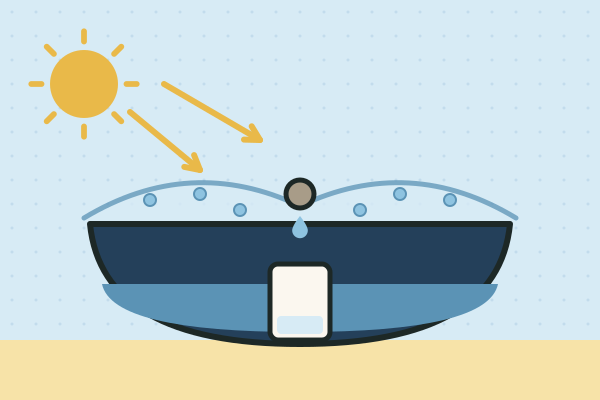
Nuria's island village sits beside the sea, but the village well has turned salty after a dry year, and the water boat is late. "We can't drink the sea," says Nuria. "We can't filter it either," says her teacher. "You saw why." Then she looks up at the strong sun. Your team's job: build a solar still that turns salt water into fresh water, and prove it worked.
Teams of three, with rotating jobs: Builder (bowl, cup and film), Measurer (water and scale), Recorder (writes everything down).
In the Mekong lesson How do salt farmers turn the sea into salt? the Sun is used to get the salt. Here it gets the water: same science, opposite goal.
Look inside the PDF
Sample pages, stamped “preview”. The download is the clean, full lesson.
In the full lesson PDF
- Predict (5–10 min)
- Hunt (20 min set-up, then wait)
- Reveal (10–15 min)
- Act (10 min)
- Background for the teacher
- Assessment
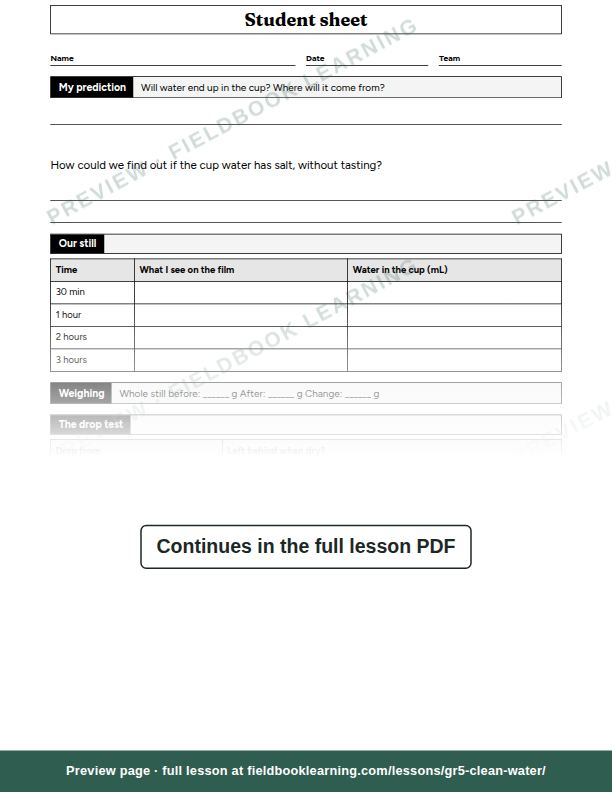
- Student sheet
- Worksheet: Label it
- Worksheet: Try it at home
On the student sheet
- My prediction
- Our still
- Weighing
- The drop test
- What we kept the same, and what we changed
- Letter to Nuria's village
- Exit ticket
- Label it
- Try it at home
US Letter, prints cleanly in black and white. The student sheet is on its own page, ready to photocopy.
Free with an account (any 3 lessons), or US$19 / C$25 for all 3 lessons in this unit.
What students show by the end
- Builds and runs the still
- Uses evidence
- Explains the still
From the lesson’s rubric, which scores each one as not yet, getting there or got it.
Questions teachers ask
How long does “How can you get fresh water out of salt water?” take?
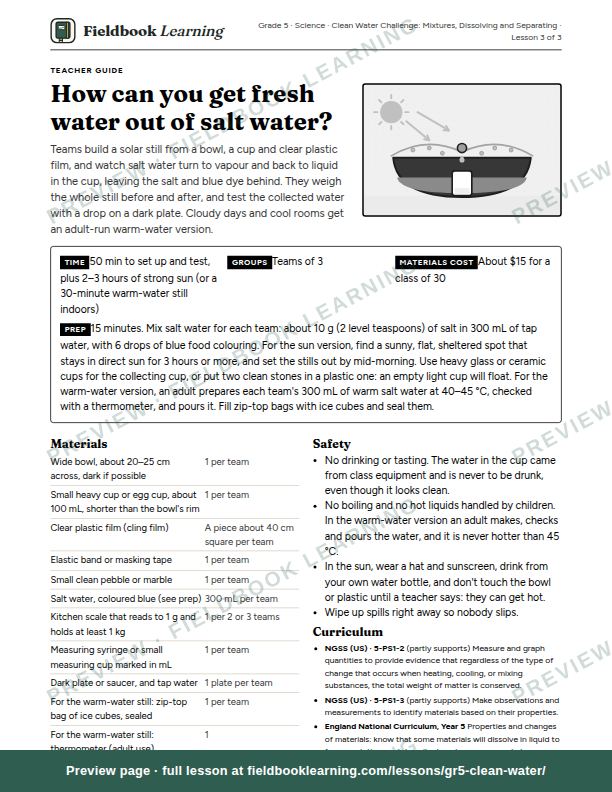
50 min to set up and test, plus 2–3 hours of strong sun (or a 30-minute warm-water still indoors). Group size: teams of 3.
How much prep does it need?
15 minutes. Mix salt water for each team: about 10 g (2 level teaspoons) of salt in 300 mL of tap water, with 6 drops of blue food colouring. For the sun version, find a sunny, flat, sheltered spot that stays in direct sun for 3 hours or more, and set the stills out by mid-morning. Use heavy glass or ceramic cups for the collecting cup, or put two clean stones in a plastic one: an empty light cup will float. For the warm-water version, an adult prepares each team's 300 mL of warm salt water at 40–45 °C, checked with a thermometer, and pours it. Fill zip-top bags with ice cubes and seal them.
What materials do I need?
Wide bowl, about 20–25 cm across, dark if possible; small heavy cup or egg cup, about 100 mL, shorter than the bowl's rim; clear plastic film (cling film); elastic band or masking tape; small clean pebble or marble; salt water, coloured blue (see prep); and 5 more. Cost: about $15 for a class of 30.
Which curriculum standards does it cover?
NGSS (US): 5-PS1-2 (partly) and 5-PS1-3 (partly). It also matches England National Curriculum, Year 5 and Cambridge Primary Science, Stages 3, 5 and 6 (not endorsed by Cambridge).
What’s in the lesson PDF?
A teacher guide that walks you through predict, hunt, reveal, act, background for the teacher and assessment, then a student sheet (“My prediction”; “Our still”; “Weighing”; “The drop test”; “What we kept the same, and what we changed”; “Letter to Nuria's village”; “Exit ticket”; “Label it” and “Try it at home”) on its own page, ready to photocopy. It’s US Letter and prints cleanly in black and white.
Can I try it for free?
Yes. A free account includes any 3 full lessons of your choice, and this can be one of them. After that, this unit is US$19 (C$25) for all 3 lessons, yours to keep, or every lesson is US$79 (C$109) a year.