 Preview · the opening mission
Read this to the class:
Every afternoon the caretaker empties our classroom bins. Where does it all go? Some of it goes to a landfill and stays there for a very long time. Some could be made into new things, and some could turn back into soil. Nobody at our school has ever checked how much of each we throw out. Your team's job: find out what is really in our garbage, and suggest one change the school could make.
Teams of three, with three jobs that rotate halfway through: Sorter (picks up and places items), Checker (reads the town's rules and decides tricky items), Recorder (writes weights and notes).
Look inside the PDF
Sample pages, stamped “preview”. The download is the clean, full lesson.
In the full lesson PDF
- Predict (5–10 min)
- Hunt (20 min)
- Reveal (10–15 min)
- Act (10 min)
- Background for the teacher
- Assessment
- Student sheet
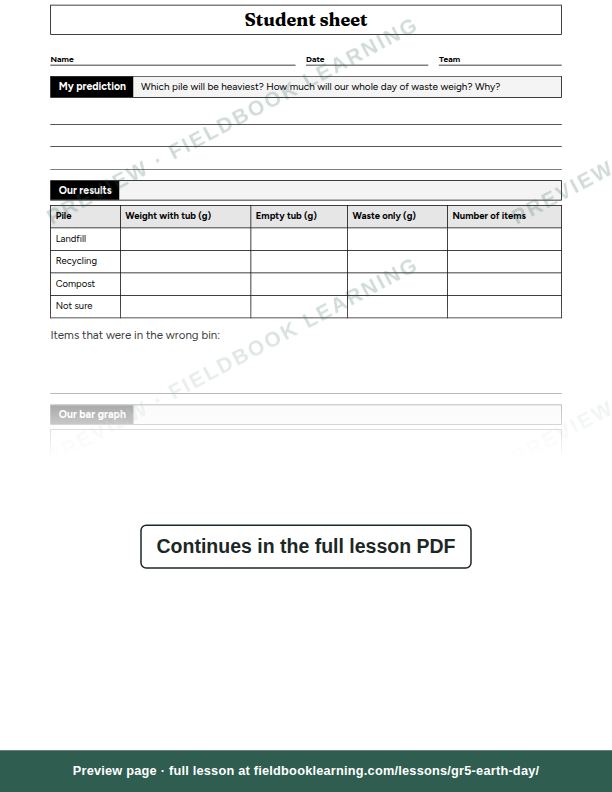
On the student sheet
- My prediction
- Our results
- Our bar graph
- Our recommendation
- Exit ticket
US Letter, prints cleanly in black and white. The student sheet is on its own page, ready to photocopy.
Free with an account (any 3 lessons), or US$19 / C$25 for all 4 lessons in this unit.
What students show by the end
- Sorts and measures
- Uses data
- Recommends
From the lesson’s rubric, which scores each one as not yet, getting there or got it.
Questions teachers ask
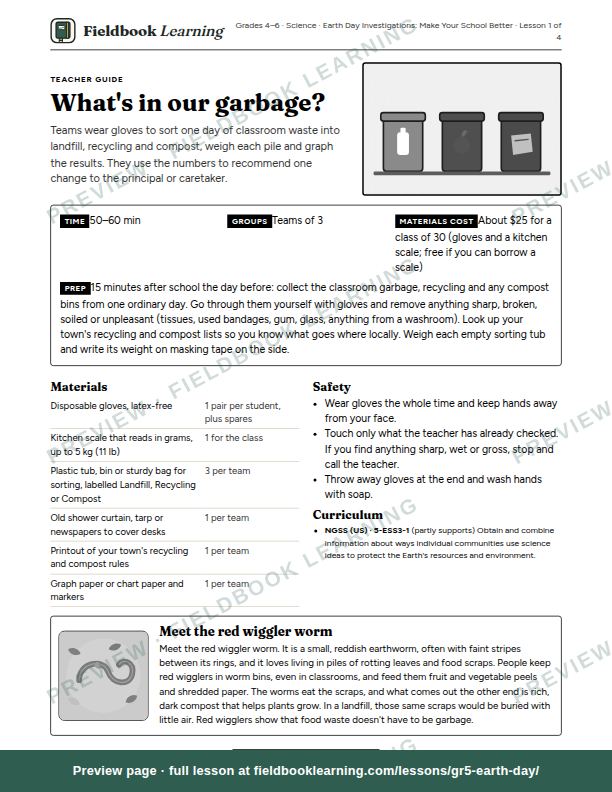
How long does “What's in our garbage?” take?
50–60 min. Group size: teams of 3.
How much prep does it need?
15 minutes after school the day before: collect the classroom garbage, recycling and any compost bins from one ordinary day. Go through them yourself with gloves and remove anything sharp, broken, soiled or unpleasant (tissues, used bandages, gum, glass, anything from a washroom). Look up your town's recycling and compost lists so you know what goes where locally. Weigh each empty sorting tub and write its weight on masking tape on the side.
What materials do I need?
Disposable gloves, latex-free; kitchen scale that reads in grams, up to 5 kg (11 lb); plastic tub, bin or sturdy bag for sorting, labelled Landfill, Recycling or Compost; old shower curtain, tarp or newspapers to cover desks; printout of your town's recycling and compost rules; graph paper or chart paper and markers. Cost: about $25 for a class of 30 (gloves and a kitchen scale; free if you can borrow a scale).
Which curriculum standards does it cover?
NGSS (US): 5-ESS3-1 (partly).
What’s in the lesson PDF?
A teacher guide that walks you through predict, hunt, reveal, act, background for the teacher and assessment, then a student sheet (“My prediction”, “Our results”, “Our bar graph”, “Our recommendation” and “Exit ticket”) on its own page, ready to photocopy. It’s US Letter and prints cleanly in black and white.
Can I try it for free?
Yes. A free account includes any 3 full lessons of your choice, and this can be one of them. After that, this unit is US$19 (C$25) for all 4 lessons, yours to keep, or every lesson is US$79 (C$109) a year.