 Preview · the opening mission
Read this to the class:
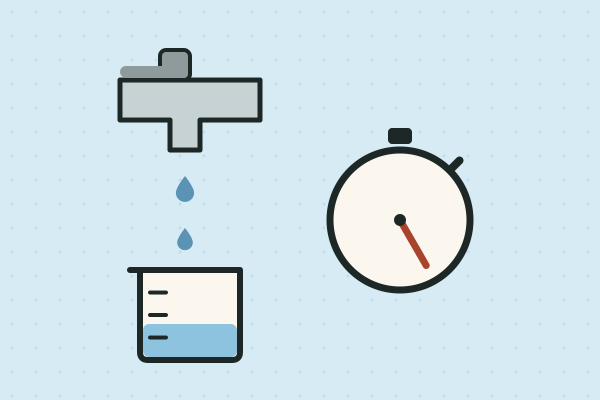
In a school washroom, a tap has been dripping for weeks. "It's only a drop," someone says. "That's nothing." Is it? One drop is tiny, but a tap drips all day and all night, on weekends and in the summer. Your team's job: find out how much water one dripping tap really wastes in a year, and tell the caretaker what you found.
Teams of three, with jobs that rotate at each step: Counter (counts drips), Timer (times one minute), Recorder (writes and does the first calculation).
Look inside the PDF
Sample pages, stamped “preview”. The download is the clean, full lesson.
In the full lesson PDF
- Predict (5–10 min)
- Hunt (20 min)
- Reveal (10–15 min)
- Act (10 min)
- Background for the teacher
- Assessment
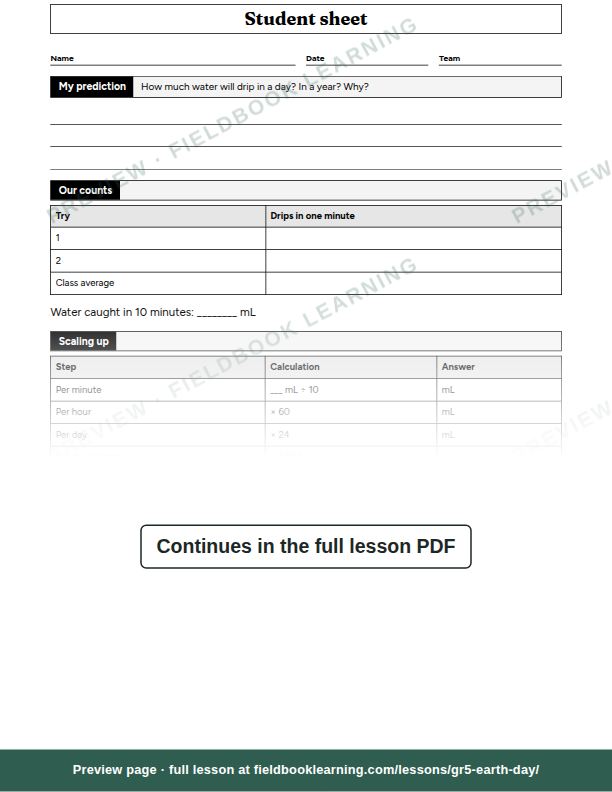
- Student sheet
On the student sheet
- My prediction
- Our counts
- Scaling up
- Our recommendation
- Draw your idea
- Exit ticket
US Letter, prints cleanly in black and white. The student sheet is on its own page, ready to photocopy.
Free with an account (any 3 lessons), or US$19 / C$25 for all 4 lessons in this unit.
What students show by the end
- Measures
- Scales up
- Recommends
From the lesson’s rubric, which scores each one as not yet, getting there or got it.
Questions teachers ask
How long does “How much water does a dripping tap waste?” take?
45–60 min. Group size: teams of 3.
How much prep does it need?
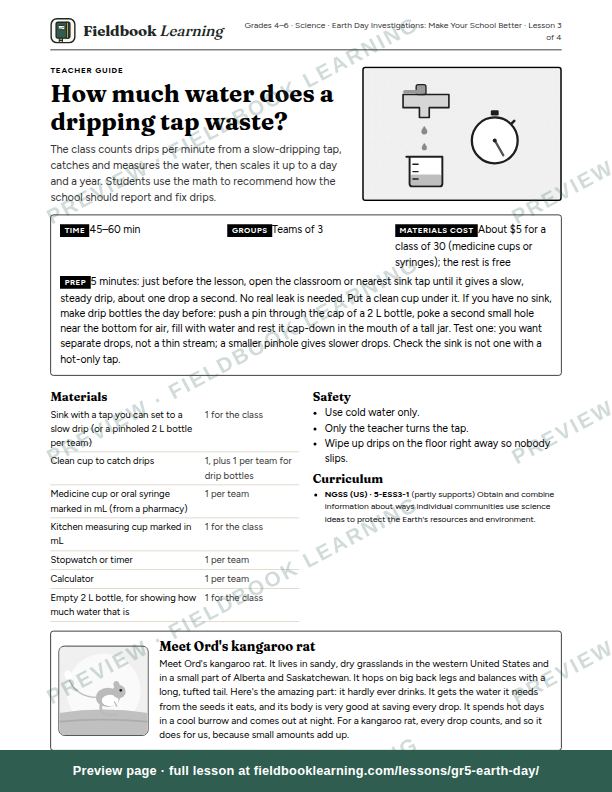
5 minutes: just before the lesson, open the classroom or nearest sink tap until it gives a slow, steady drip, about one drop a second. No real leak is needed. Put a clean cup under it. If you have no sink, make drip bottles the day before: push a pin through the cap of a 2 L bottle, poke a second small hole near the bottom for air, fill with water and rest it cap-down in the mouth of a tall jar. Test one: you want separate drops, not a thin stream; a smaller pinhole gives slower drops. Check the sink is not one with a hot-only tap.
What materials do I need?
Sink with a tap you can set to a slow drip (or a pinholed 2 L bottle per team); clean cup to catch drips; medicine cup or oral syringe marked in mL (from a pharmacy); kitchen measuring cup marked in mL; stopwatch or timer; calculator; and 1 more. Cost: about $5 for a class of 30 (medicine cups or syringes); the rest is free.
Which curriculum standards does it cover?
NGSS (US): 5-ESS3-1 (partly).
What’s in the lesson PDF?
A teacher guide that walks you through predict, hunt, reveal, act, background for the teacher and assessment, then a student sheet (“My prediction”, “Our counts”, “Scaling up”, “Our recommendation”, “Draw your idea” and “Exit ticket”) on its own page, ready to photocopy. It’s US Letter and prints cleanly in black and white.
Can I try it for free?
Yes. A free account includes any 3 full lessons of your choice, and this can be one of them. After that, this unit is US$19 (C$25) for all 4 lessons, yours to keep, or every lesson is US$79 (C$109) a year.