Forces at Work: Gravity, Resistance, Levers and Pulleys
Do heavy things really fall faster? Why are fast swimmers shaped like torpedoes? How can a small push lift a big load? Three hands-on lessons on gravity, air and water resistance, friction, levers and pulleys, measured in newtons with homemade and simple tools.
Or try any 3 lessons free with an account.
Already bought it? Download the whole unit as one printable workbook: cover, contents, curriculum connections, every lesson, readings, practice pages, a unit test and an answer key, in black and white.
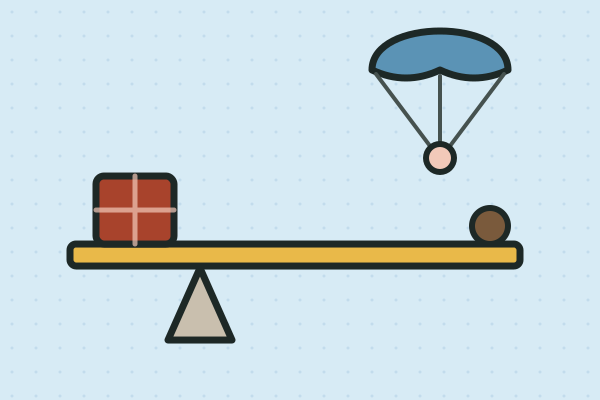
3 lessons in this unit
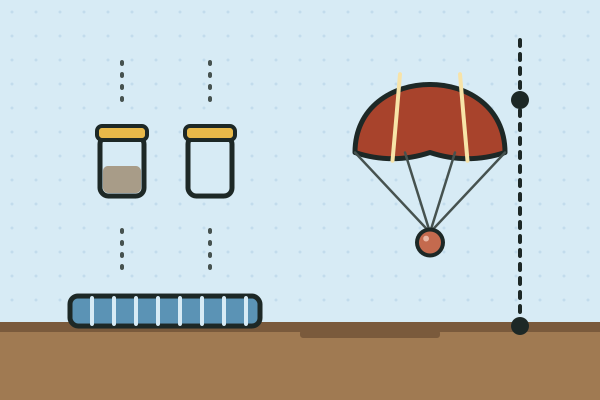 Lesson 1 · 60–70 minDo heavy things really fall faster?Teams drop a light and a heavy container side by side and find that they land together, then add parachutes of three sizes and time the fall. They calibrate a rubber-band force meter in newtons and explain what gravity and air each do.
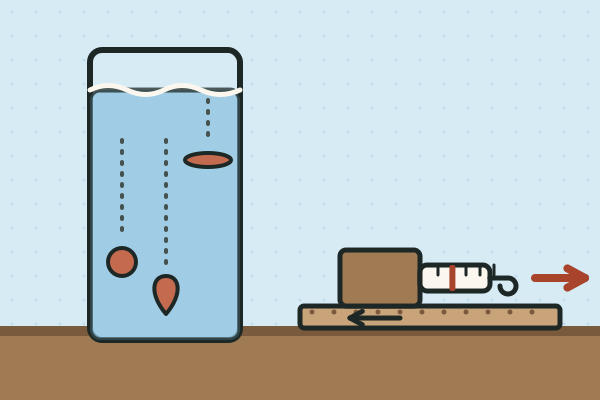 Lesson 2 · 55–65 minWhat pushes back on a moving thing?Teams time clay shapes sinking through water to see which shape the water holds back least, then drag a block over four surfaces with a force meter. They find that water resistance and friction both push against motion, and that friction is a help as well as a nuisance.
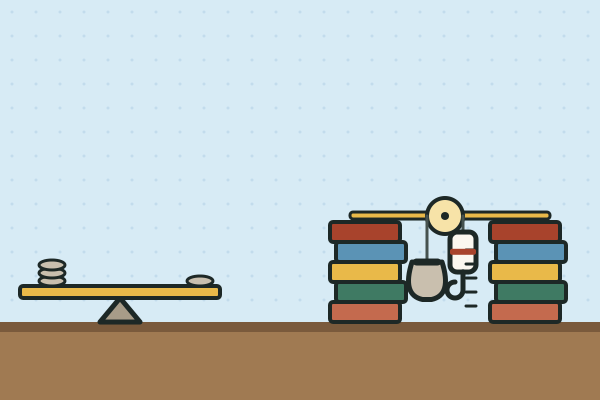 Lesson 3 · 60–70 minHow can a small push lift a big load?Teams balance coins on a ruler lever and find the rule for balancing, then lift a 300 g load with a fixed pulley and a moving pulley, measuring the pull and the length of string each time. They find that machines can make a force smaller, but only by making the distance longer.
Materials for the whole unit · one list, lesson by lesson
Lesson 1: Do heavy things really fall faster?
- Small lidded containers, identical, one filled to about 100 g and taped shut, one empty and taped shut1 pair per team
- Folded towel or cushion (landing pad)1 per team
- Washer or nut on a 40 cm string (plumb line)1 per team
- Thin plastic bag squares, 20 cm, 30 cm and 40 cm1 of each per team
- Thread, cut in 30 cm lengths12 per team
- Lump of clay, about 10 g1 per team
- Stopwatch or phone timer1 per team
- Tape, ruler, blunt scissors1 each per team
- Wide rubber band (about 6 mm), card strip 30 cm x 4 cm, 2 paper clips1 set per team
- 100 g bags of sand or rice, with a hook of thread3 per team
- Mystery bag, 250 g, and a kitchen scale (teacher only)1 for the class
About $15 for a class of 30, mostly sand, rubber bands and a thin plastic bag
Lesson 2: What pushes back on a moving thing?
- Tall clear container (2 L bottle with the top cut off) filled with water1 per team
- Tray or baking sheet to catch spills, and a cloth1 per team
- Modelling clay, three 15 g pieces1 set per team
- Stopwatch or phone timer1 per team
- Block or box loaded to 300 g, with a thread loop1 per team
- Force meter (rubber-band meter from lesson 1, or 0 to 5 N spring scale)1 per team
- Surface samples: fine sandpaper, towel, plastic or waxed paper1 of each per team
- Three round pencils (rollers)3 per team
- Kitchen scale (teacher only)1 for the class
About $15 for a class of 30, mostly clay, sandpaper and a few tall bottles
Lesson 3: How can a small push lift a big load?
- Identical coins (all the same kind)10 per team
- 30 cm plastic ruler and a hexagonal pencil or small eraser (pivot)1 each per team
- Cotton reels (empty thread spools)2 per team
- Pencils, to be axles2 per team
- Heavy books, for two stacks about 30 cm high8 to 10 per team
- Strong thread or thin string, 1.5 m1 per team
- Load bag of sand or rice, 300 g, with a thread loop1 per team
- Force meter (rubber-band meter or 0 to 5 N spring scale)1 per team
- Ruler or tape measure, masking tape, marker1 each per team
About $15 for a class of 30, mostly cotton reels, thread and sand for the load bags
Students drop two containers of very different mass side by side and find that they land together, then add parachutes of three sizes and time the fall to see what air does. They make a rubber-band force meter and calibrate it in newtons with known masses, so they can tell mass from weight. They time clay shapes sinking through water, drag a block over four surfaces with a force meter, and find where friction helps and where it gets in the way. Finally they balance coins on a ruler lever and lift a load with fixed and moving pulleys, measuring the pull each time.
By the end, students can explain that Earth pulls every unsupported object down, that mass and weight are different things, that air and water push back on anything moving through them and that a streamlined shape feels less of that push, that friction depends on the surfaces and is useful as well as annoying, and that a lever or pulley lets a smaller force lift a bigger load but never saves effort overall: you move the effort farther. Nobody stands on furniture to drop anything, loads stay under 300 g and below waist height, and everything uses everyday materials in any climate.