 Preview · the opening mission
Read this to the class:
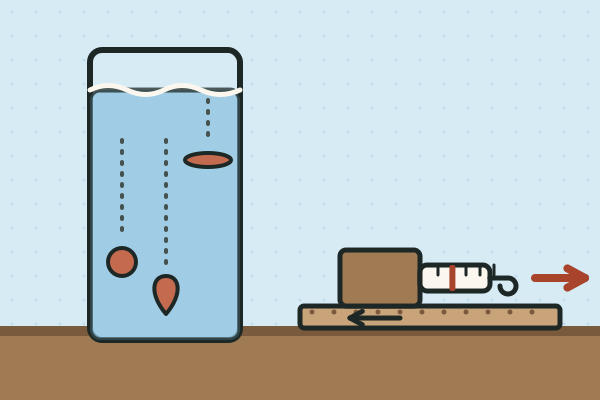
Mei is helping her grandfather at the fish market in Hong Kong. A fisherman tips a bucket of water on the floor, and everyone slips. "Water is slippery," says her grandfather, "but try pushing your hand through a bucket of it, and it holds you back." Mei wonders why a fish slides through water so easily, and why her shoes grip the floor when it is dry. Your team's job: find what shape the water holds back least, and measure how much different surfaces grip.
Teams of three, with rotating jobs: Dropper (releases the shape), Timer (starts and stops the stopwatch), Recorder (writes down every result).
Look inside the PDF
Sample pages, stamped “preview”. The download is the clean, full lesson.
In the full lesson PDF
- Predict (5–10 min)
- Hunt (25 min)
- Reveal (10–15 min)
- Act (10 min)
- Background for the teacher
- Assessment
- Student sheet
- Worksheet: Label it
- Worksheet: Try it at home
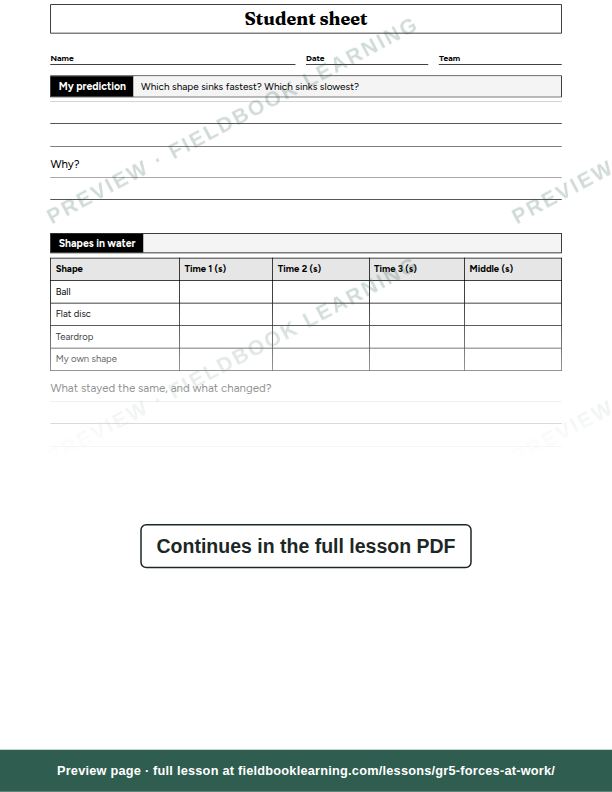
On the student sheet
- My prediction
- Shapes in water
- Friction on four surfaces
- Advice
- Exit ticket
- Label it
- Try it at home
US Letter, prints cleanly in black and white. The student sheet is on its own page, ready to photocopy.
Free with an account (any 3 lessons), or US$19 / C$25 for all 3 lessons in this unit.
What students show by the end
- Fair test
- Explains resistance
- Explains friction
From the lesson’s rubric, which scores each one as not yet, getting there or got it.
Questions teachers ask
How long does “What pushes back on a moving thing?” take?
55–65 min. Group size: teams of 3.
How much prep does it need?
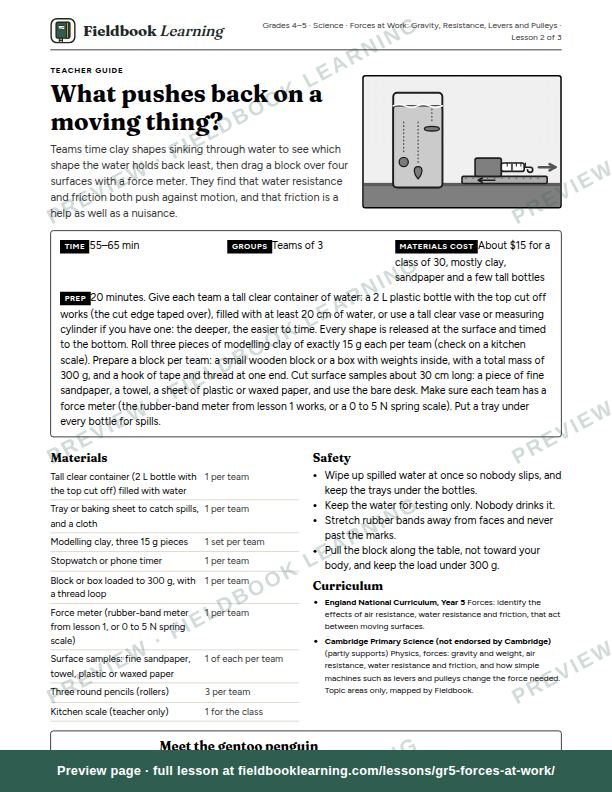
20 minutes. Give each team a tall clear container of water: a 2 L plastic bottle with the top cut off works (the cut edge taped over), filled with at least 20 cm of water, or use a tall clear vase or measuring cylinder if you have one: the deeper, the easier to time. Every shape is released at the surface and timed to the bottom. Roll three pieces of modelling clay of exactly 15 g each per team (check on a kitchen scale). Prepare a block per team: a small wooden block or a box with weights inside, with a total mass of 300 g, and a hook of tape and thread at one end. Cut surface samples about 30 cm long: a piece of fine sandpaper, a towel, a sheet of plastic or waxed paper, and use the bare desk. Make sure each team has a force meter (the rubber-band meter from lesson 1 works, or a 0 to 5 N spring scale). Put a tray under every bottle for spills.
What materials do I need?
Tall clear container (2 L bottle with the top cut off) filled with water; tray or baking sheet to catch spills, and a cloth; modelling clay, three 15 g pieces; stopwatch or phone timer; block or box loaded to 300 g, with a thread loop; force meter (rubber-band meter from lesson 1, or 0 to 5 N spring scale); and 3 more. Cost: about $15 for a class of 30, mostly clay, sandpaper and a few tall bottles.
Which curriculum standards does it cover?
It matches England National Curriculum, Year 5 and Cambridge Primary Science (not endorsed by Cambridge).
What’s in the lesson PDF?
A teacher guide that walks you through predict, hunt, reveal, act, background for the teacher and assessment, then a student sheet (“My prediction”, “Shapes in water”, “Friction on four surfaces”, “Advice”, “Exit ticket”, “Label it” and “Try it at home”) on its own page, ready to photocopy. It’s US Letter and prints cleanly in black and white.
Can I try it for free?
Yes. A free account includes any 3 full lessons of your choice, and this can be one of them. After that, this unit is US$19 (C$25) for all 3 lessons, yours to keep, or every lesson is US$79 (C$109) a year.