 Preview · the opening mission
Read this to the class:
At the market in Kumasi, Kofi's aunt tips two sacks off a stall: a heavy sack of maize and a light sack of leaves. Kofi says the heavy one always lands first. His cousin Efua says the leaves just catch the air. "Then what does gravity do?" asks Kofi. Your team's job: test whether mass changes how fast things fall, then find out what the air does to the fall.
Teams of three, with rotating jobs: Dropper, Timer (works the stopwatch and watches the landing) and Recorder.
Look inside the PDF
Sample pages, stamped “preview”. The download is the clean, full lesson.
In the full lesson PDF
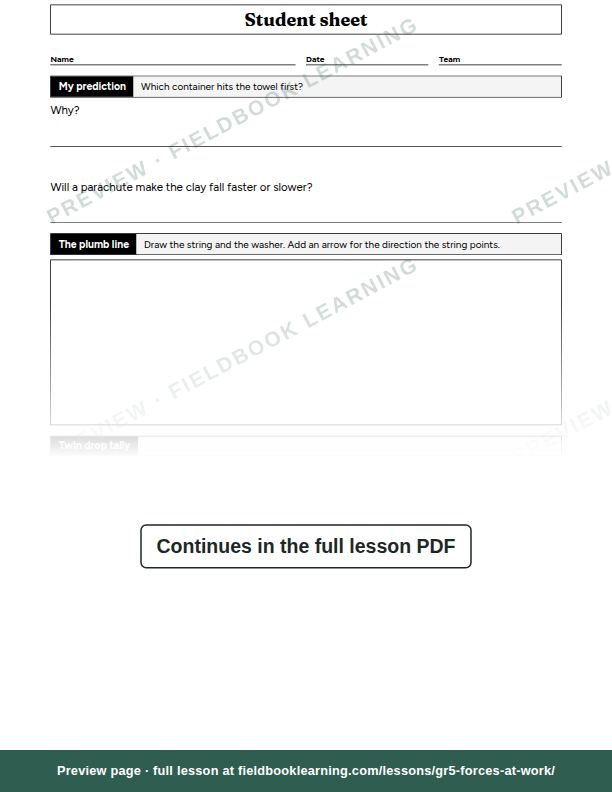
- Predict (5–10 min)
- Hunt (25 min)
- Reveal (10–15 min)
- Act (10–15 min)
- Background for the teacher
- Assessment
- Student sheet
- Worksheet: Label it
- Worksheet: Try it at home
On the student sheet
- My prediction
- The plumb line
- Twin drop tally
- Parachute times
- My force meter
- Argument
- Exit ticket
- Label it
- Try it at home
US Letter, prints cleanly in black and white. The student sheet is on its own page, ready to photocopy.
Free with an account (any 3 lessons), or US$19 / C$25 for all 3 lessons in this unit.
What students show by the end
- Fair test
- Explains falling
- Mass and weight
From the lesson’s rubric, which scores each one as not yet, getting there or got it.
Questions teachers ask
How long does “Do heavy things really fall faster?” take?
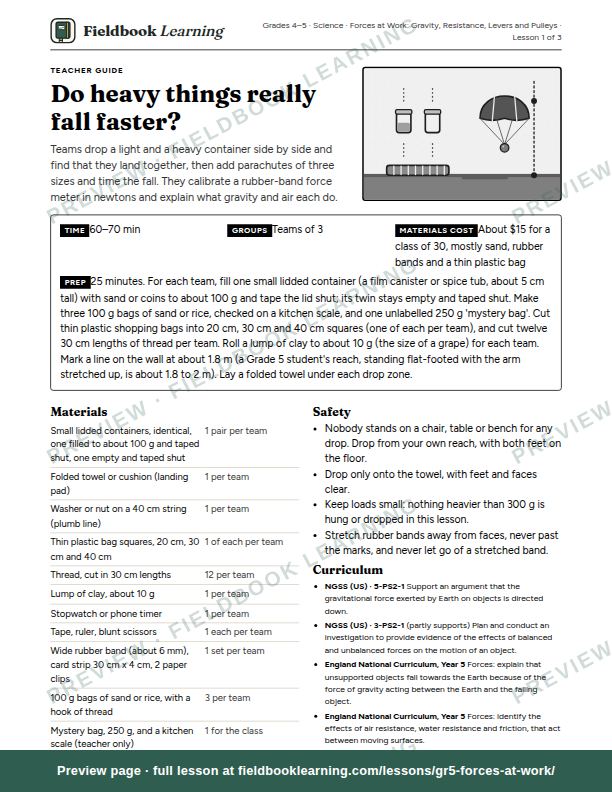
60–70 min. Group size: teams of 3.
How much prep does it need?
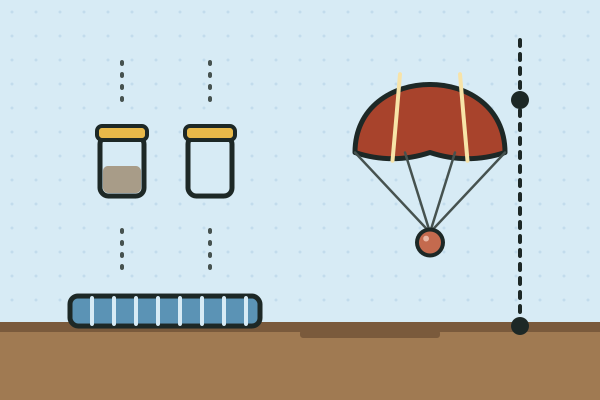
25 minutes. For each team, fill one small lidded container (a film canister or spice tub, about 5 cm tall) with sand or coins to about 100 g and tape the lid shut; its twin stays empty and taped shut. Make three 100 g bags of sand or rice, checked on a kitchen scale, and one unlabelled 250 g 'mystery bag'. Cut thin plastic shopping bags into 20 cm, 30 cm and 40 cm squares (one of each per team), and cut twelve 30 cm lengths of thread per team. Roll a lump of clay to about 10 g (the size of a grape) for each team. Mark a line on the wall at about 1.8 m (a Grade 5 student's reach, standing flat-footed with the arm stretched up, is about 1.8 to 2 m). Lay a folded towel under each drop zone.
What materials do I need?
Small lidded containers, identical, one filled to about 100 g and taped shut, one empty and taped shut; folded towel or cushion (landing pad); washer or nut on a 40 cm string (plumb line); thin plastic bag squares, 20 cm, 30 cm and 40 cm; thread, cut in 30 cm lengths; lump of clay, about 10 g; and 5 more. Cost: about $15 for a class of 30, mostly sand, rubber bands and a thin plastic bag.
Which curriculum standards does it cover?
NGSS (US): 5-PS2-1 and 3-PS2-1 (partly). It also matches England National Curriculum, Year 5 and Cambridge Primary Science (not endorsed by Cambridge).
What’s in the lesson PDF?
A teacher guide that walks you through predict, hunt, reveal, act, background for the teacher and assessment, then a student sheet (“My prediction”, “The plumb line”, “Twin drop tally”, “Parachute times”, “My force meter”, “Argument”, “Exit ticket”, “Label it” and “Try it at home”) on its own page, ready to photocopy. It’s US Letter and prints cleanly in black and white.
Can I try it for free?
Yes. A free account includes any 3 full lessons of your choice, and this can be one of them. After that, this unit is US$19 (C$25) for all 3 lessons, yours to keep, or every lesson is US$79 (C$109) a year.