 Preview · the opening mission
Read this to the class:
Tomás helps his family on a ranch in Patagonia. A heavy tyre has to go onto a high rail, and it's far too heavy for him. His sister lays a plank across a rock and presses down on the long end. His father pulls a rope over a beam. "That's cheating," says Tomás. "No," says his sister, "it's physics. But there's a catch." Your team's job: find the rule for balancing a lever and measure how a pulley changes the pull, and find the catch.
Teams of three, with rotating jobs: Builder, Measurer (reads the force meter and the ruler) and Recorder.
Look inside the PDF
Sample pages, stamped “preview”. The download is the clean, full lesson.
In the full lesson PDF
- Predict (5–10 min)
- Hunt (25 min)
- Reveal (10–15 min)
- Act (10–15 min)
- Background for the teacher
- Assessment
- Student sheet
- Worksheet: Label it
- Worksheet: Try it at home
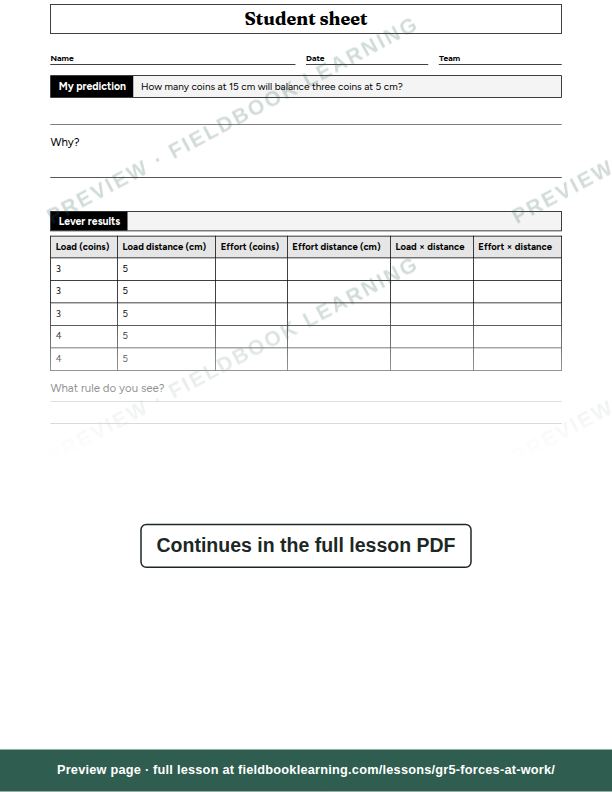
On the student sheet
- My prediction
- Lever results
- Pulley results
- Recommendation to the farmer
- Exit ticket
- Label it
- Try it at home
US Letter, prints cleanly in black and white. The student sheet is on its own page, ready to photocopy.
Free with an account (any 3 lessons), or US$19 / C$25 for all 3 lessons in this unit.
What students show by the end
- Finds the lever rule
- Measures the pulley
- Explains the trade-off
From the lesson’s rubric, which scores each one as not yet, getting there or got it.
Questions teachers ask
How long does “How can a small push lift a big load?” take?
60–70 min. Group size: teams of 3.
How much prep does it need?
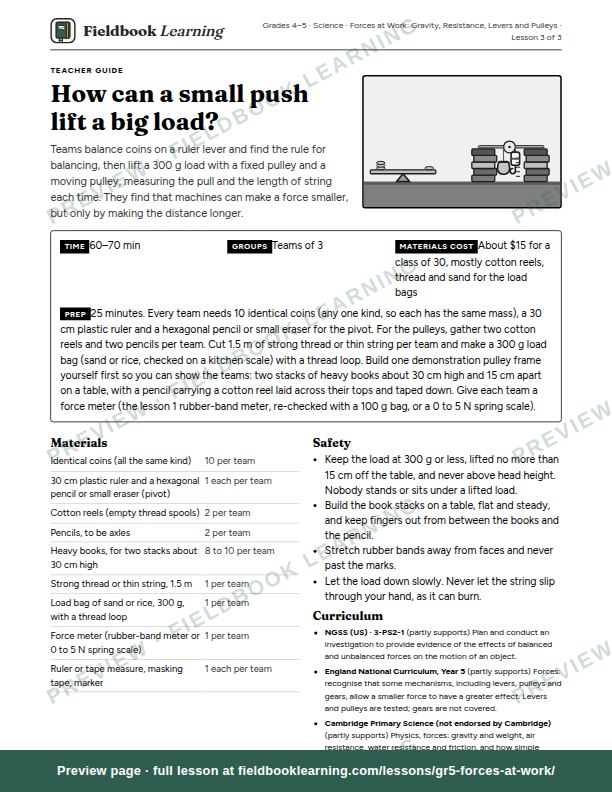
25 minutes. Every team needs 10 identical coins (any one kind, so each has the same mass), a 30 cm plastic ruler and a hexagonal pencil or small eraser for the pivot. For the pulleys, gather two cotton reels and two pencils per team. Cut 1.5 m of strong thread or thin string per team and make a 300 g load bag (sand or rice, checked on a kitchen scale) with a thread loop. Build one demonstration pulley frame yourself first so you can show the teams: two stacks of heavy books about 30 cm high and 15 cm apart on a table, with a pencil carrying a cotton reel laid across their tops and taped down. Give each team a force meter (the lesson 1 rubber-band meter, re-checked with a 100 g bag, or a 0 to 5 N spring scale).
What materials do I need?
Identical coins (all the same kind); 30 cm plastic ruler and a hexagonal pencil or small eraser (pivot); cotton reels (empty thread spools); pencils, to be axles; heavy books, for two stacks about 30 cm high; strong thread or thin string, 1.5 m; and 3 more. Cost: about $15 for a class of 30, mostly cotton reels, thread and sand for the load bags.
Which curriculum standards does it cover?
NGSS (US): 3-PS2-1 (partly). It also matches England National Curriculum, Year 5 and Cambridge Primary Science (not endorsed by Cambridge).
What’s in the lesson PDF?
A teacher guide that walks you through predict, hunt, reveal, act, background for the teacher and assessment, then a student sheet (“My prediction”, “Lever results”, “Pulley results”, “Recommendation to the farmer”, “Exit ticket”, “Label it” and “Try it at home”) on its own page, ready to photocopy. It’s US Letter and prints cleanly in black and white.
Can I try it for free?
Yes. A free account includes any 3 full lessons of your choice, and this can be one of them. After that, this unit is US$19 (C$25) for all 3 lessons, yours to keep, or every lesson is US$79 (C$109) a year.