 Preview · the opening mission
Read this to the class:
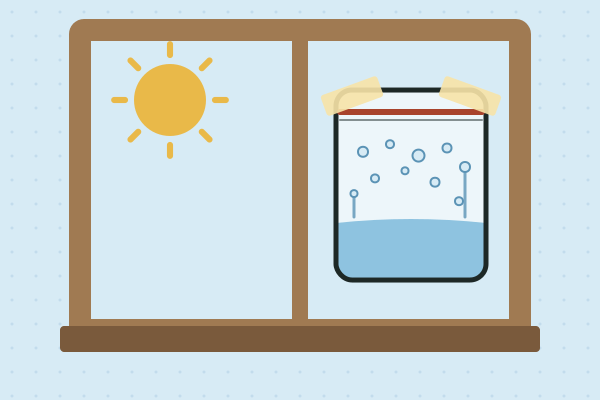
A Grade 4 class wants to show the water cycle to the little ones in Kindergarten. "We can't bring an ocean into school," says Sam. "Or the Sun." Their teacher holds up a sandwich bag. "You can bring a tiny ocean. And there is a window." Your team's job: build a water cycle in a bag, prove what makes it work, and explain it in a way a five-year-old understands.
Teams of three, with rotating jobs: Builder (fills, seals and tapes the bags), Observer (looks closely and describes), Recorder (writes the observations and times).
Look inside the PDF
Sample pages, stamped “preview”. The download is the clean, full lesson.
In the full lesson PDF
9 printable pages
- Predict (5–10 min)
- Hunt (20 min, then look-backs)
- Reveal (10–15 min)
- Act (10 min)
- Background for the teacher
- Assessment
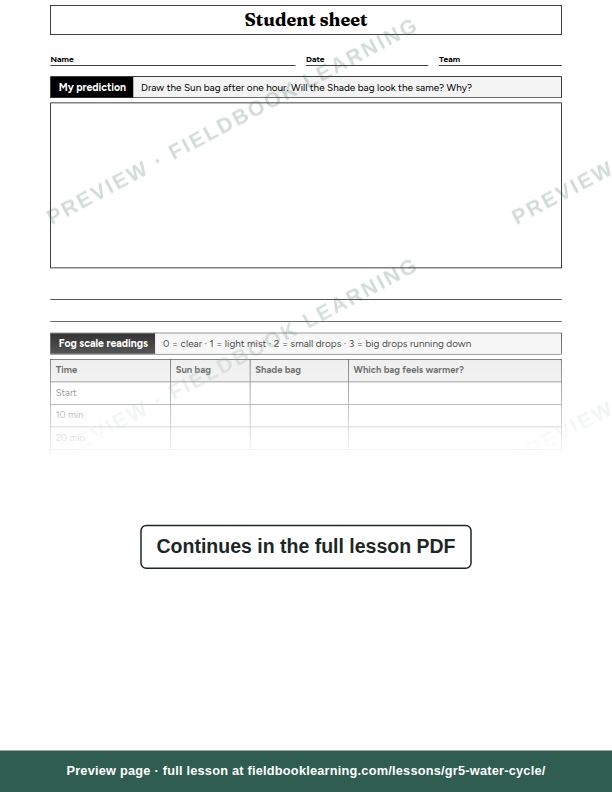
- Student sheet
- Worksheet: Label it
- Worksheet: Try it at home
On the student sheet
- My prediction
- Fog scale readings
- What colour are the drops? Why?
- What made the difference?
- My explanation for a five-year-old
- Label it
- Try it at home
US Letter, prints cleanly in black and white. The student sheet is on its own page, ready to photocopy.
Free with an account (any 3 lessons), or US$19 for all 3 lessons in this unit.
What students show by the end
- Observes and records
- Explains the bag
- Uses evidence about drivers
From the lesson’s rubric, which scores each one as not yet, getting there or got it.
Questions teachers ask
How long does “Can you make a mini water cycle?” take?
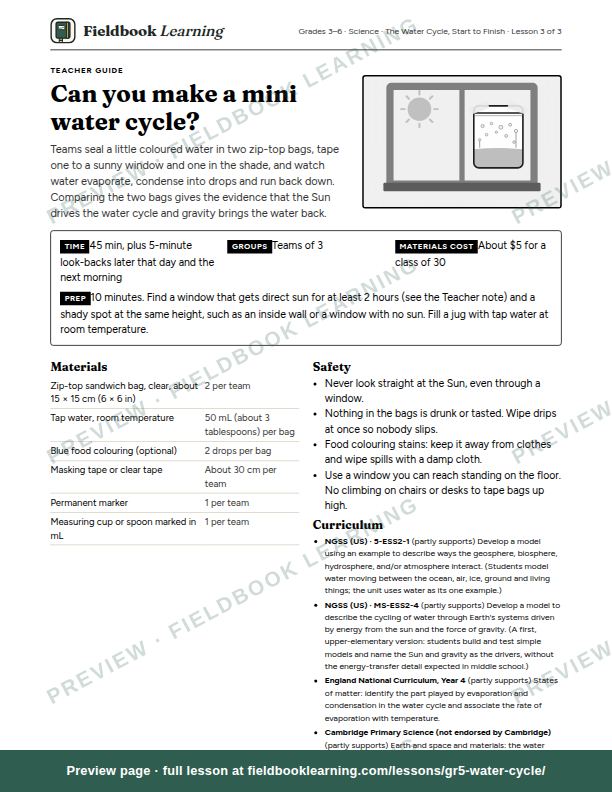
45 min, plus 5-minute look-backs later that day and the next morning. Group size: teams of 3.
How much prep does it need?
10 minutes. Find a window that gets direct sun for at least 2 hours (see the Teacher note) and a shady spot at the same height, such as an inside wall or a window with no sun. Fill a jug with tap water at room temperature.
What materials do I need?
Zip-top sandwich bag, clear, about 15 × 15 cm (6 × 6 in); tap water, room temperature; blue food colouring (optional); masking tape or clear tape; permanent marker; measuring cup or spoon marked in mL. Cost: about $5 for a class of 30.
Which curriculum standards does it cover?
NGSS (US): 5-ESS2-1 (partly) and MS-ESS2-4 (partly). It also matches England National Curriculum, Year 4 and Cambridge Primary Science (not endorsed by Cambridge).
What’s in the lesson PDF?
A teacher guide that walks you through predict, hunt, reveal, act, background for the teacher and assessment, then a student sheet (“My prediction”, “Fog scale readings”, “What colour are the drops? Why?”, “What made the difference?”, “My explanation for a five-year-old”, “Label it” and “Try it at home”) on its own page, ready to photocopy. It’s US Letter and prints cleanly in black and white.
Can I try it for free?
Yes. A free account includes any 3 full lessons of your choice, and this can be one of them. After that, this unit is US$19 for all 3 lessons, yours to keep, or every lesson is US$199 a year.