 Preview · the opening mission
Read this to the class:
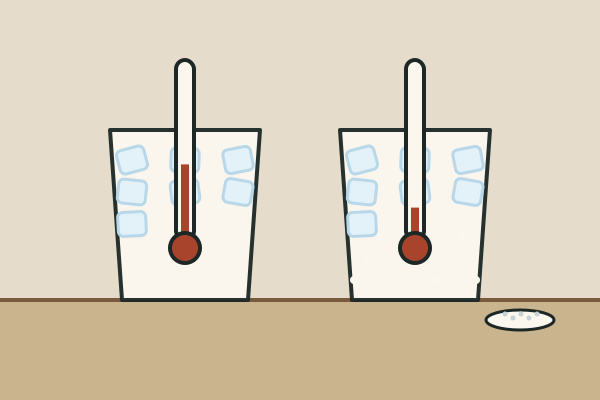
An ice cream shop is running a science fair stand. The owner says, "Ice is the coldest thing in my shop. It can't get any colder than 0 degrees, so my ice cream must be at 0." A customer says ice cream is kept much colder than that, and that salty ice can get colder still. Your team's job: measure how cold ice can really get, and put every temperature in order on a number line the owner can understand.
Teams of three, with jobs that rotate after each cup: Mixer (fills and stirs the cup), Reader (reads the thermometer at eye level), Recorder (writes the temperature and marks it on the number line).
Look inside the PDF
Sample pages, stamped “preview”. The download is the clean, full lesson.
In the full lesson PDF
8 printable pages
- Predict (5–10 min)
- Hunt (20 min)
- Reveal (10–15 min)
- Act (10 min)
- Background for the teacher
- Assessment
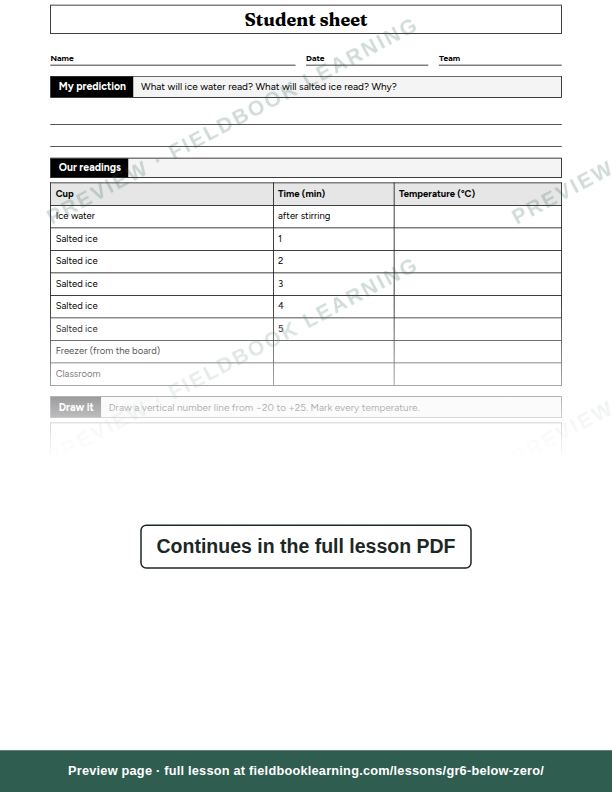
- Student sheet
- Worksheet: Label it
- Worksheet: Try it at home
On the student sheet
- My prediction
- Our readings
- Draw it
- What did we find?
- Our sign for the shop
- Exit ticket
- Label it
- Try it at home
US Letter, prints cleanly in black and white. The student sheet is on its own page, ready to photocopy.
Free with an account (any 3 lessons), or US$19 for all 4 lessons in this unit.
What students show by the end
- Reads and records negative temperatures
- Orders integers
- Explains opposites and absolute value
From the lesson’s rubric, which scores each one as not yet, getting there or got it.
Questions teachers ask
How long does “How cold can ice get?” take?
50–60 min. Group size: teams of 3.
How much prep does it need?
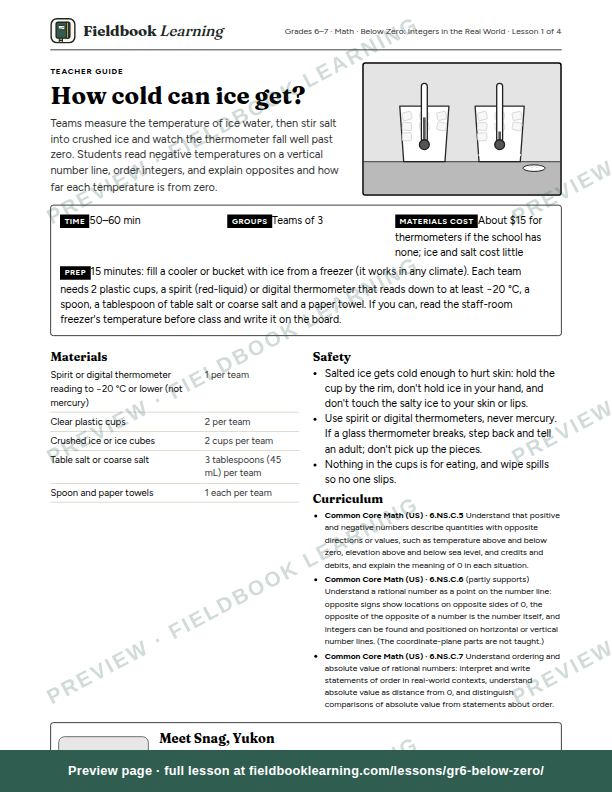
15 minutes: fill a cooler or bucket with ice from a freezer (it works in any climate). Each team needs 2 plastic cups, a spirit (red-liquid) or digital thermometer that reads down to at least −20 °C, a spoon, a tablespoon of table salt or coarse salt and a paper towel. If you can, read the staff-room freezer's temperature before class and write it on the board.
What materials do I need?
Spirit or digital thermometer reading to −20 °C or lower (not mercury); clear plastic cups; crushed ice or ice cubes; table salt or coarse salt; spoon and paper towels. Cost: about $15 for thermometers if the school has none; ice and salt cost little.
Which curriculum standards does it cover?
Common Core Math (US): 6.NS.C.5, 6.NS.C.6 (partly) and 6.NS.C.7.
What’s in the lesson PDF?
A teacher guide that walks you through predict, hunt, reveal, act, background for the teacher and assessment, then a student sheet (“My prediction”, “Our readings”, “Draw it”, “What did we find?”, “Our sign for the shop”, “Exit ticket”, “Label it” and “Try it at home”) on its own page, ready to photocopy. It’s US Letter and prints cleanly in black and white.
Can I try it for free?
Yes. A free account includes any 3 full lessons of your choice, and this can be one of them. After that, this unit is US$19 for all 4 lessons, yours to keep, or every lesson is US$199 a year.