 Preview · the opening mission
Read this to the class:
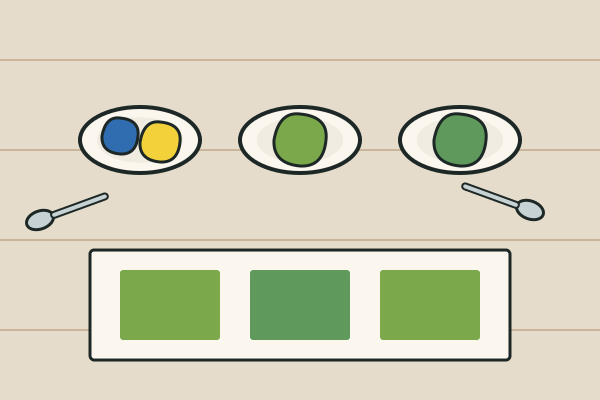
The class is painting a mural of a forest, and Leo mixed the perfect leaf green: 2 spoons of blue and 3 spoons of yellow. Then the paint ran out halfway up the first tree. Leo said, "Easy. I'll add 2 more spoons of each colour to make a bigger batch." Maya said, "That won't match." Your team's job: find out how to make a bigger batch that matches the first green exactly, and write the rule so anyone can scale the recipe.
Teams of three, with jobs that rotate after each batch: Mixer (scoops and stirs), Counter (counts every level spoonful out loud), Recorder (writes the recipe and paints a swatch).
Look inside the PDF
Sample pages, stamped “preview”. The download is the clean, full lesson.
In the full lesson PDF
8 printable pages
- Predict (5–10 min)
- Hunt (20 min)
- Reveal (10–15 min)
- Act (10 min)
- Background for the teacher
- Assessment
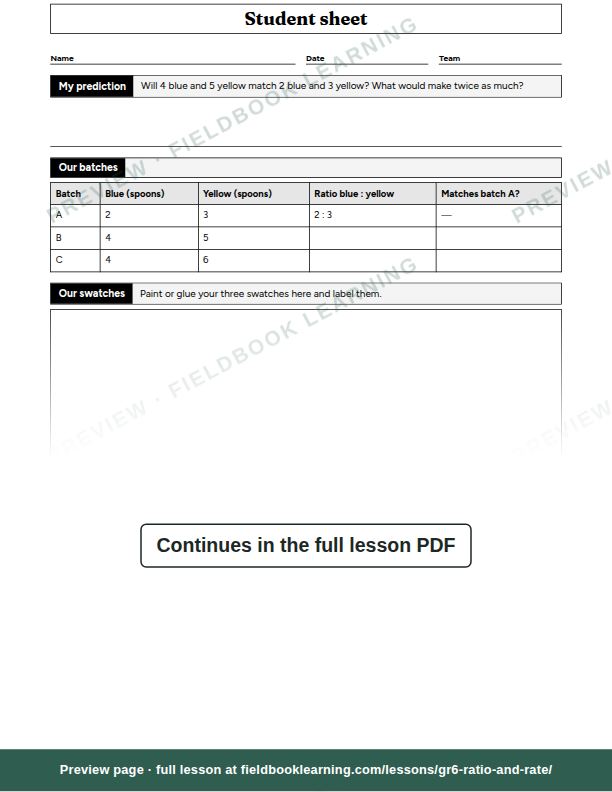
- Student sheet
- Worksheet: Label it
- Worksheet: Try it at home
On the student sheet
- My prediction
- Our batches
- Our swatches
- Ratio table for our green
- Our recipe card
- Exit ticket
- Label it
- Try it at home
US Letter, prints cleanly in black and white. The student sheet is on its own page, ready to photocopy.
Free with an account (any 3 lessons), or US$19 for all 4 lessons in this unit.
What students show by the end
- Writes and reads ratios
- Finds equivalent ratios
- Uses evidence
From the lesson’s rubric, which scores each one as not yet, getting there or got it.
Questions teachers ask
How long does “Why doesn't the big batch match?” take?
50–60 min. Group size: teams of 3.
How much prep does it need?
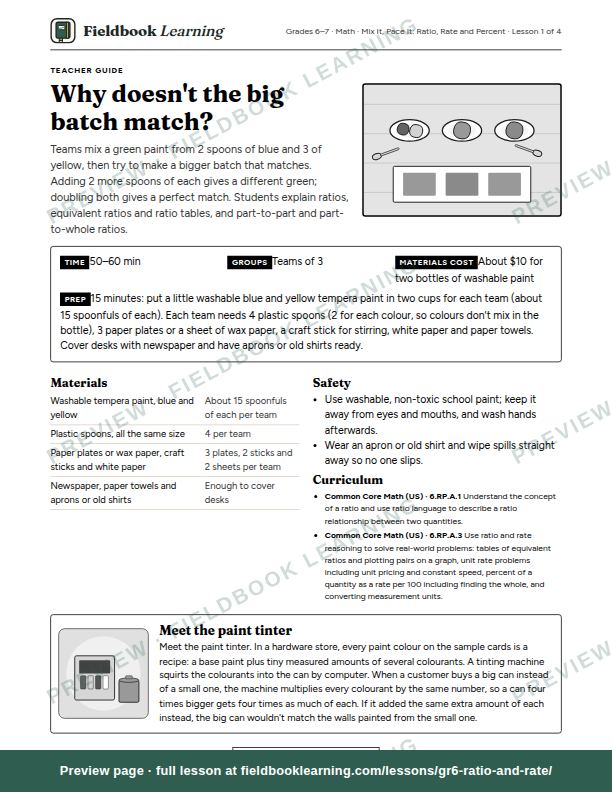
15 minutes: put a little washable blue and yellow tempera paint in two cups for each team (about 15 spoonfuls of each). Each team needs 4 plastic spoons (2 for each colour, so colours don't mix in the bottle), 3 paper plates or a sheet of wax paper, a craft stick for stirring, white paper and paper towels. Cover desks with newspaper and have aprons or old shirts ready.
What materials do I need?
Washable tempera paint, blue and yellow; plastic spoons, all the same size; paper plates or wax paper, craft sticks and white paper; newspaper, paper towels and aprons or old shirts. Cost: about $10 for two bottles of washable paint.
Which curriculum standards does it cover?
Common Core Math (US): 6.RP.A.1 and 6.RP.A.3.
What’s in the lesson PDF?
A teacher guide that walks you through predict, hunt, reveal, act, background for the teacher and assessment, then a student sheet (“My prediction”, “Our batches”, “Our swatches”, “Ratio table for our green”, “Our recipe card”, “Exit ticket”, “Label it” and “Try it at home”) on its own page, ready to photocopy. It’s US Letter and prints cleanly in black and white.
Can I try it for free?
Yes. A free account includes any 3 full lessons of your choice, and this can be one of them. After that, this unit is US$19 for all 4 lessons, yours to keep, or every lesson is US$199 a year.