 Preview · the opening mission
Read this to the class:
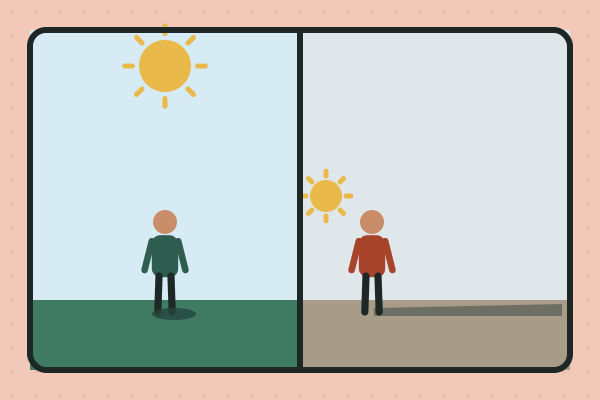
In Toronto, Aisha measured her shadow at lunchtime on a sunny day in June: about a third of her height. On a sunny day in December, at the same time, it stretched to more than twice her height, and the sunshine on her face felt weak even though the sky was clear. She messaged her cousin Ravi in Mumbai. "Our warmest month isn't December or July," Ravi wrote back. "It's May. Then the monsoon rain comes." Your team's job: find out why the same Sun feels stronger in summer, and why Mumbai's year works differently.
Teams of three: Counter (counts squares), Pointer (shows the Sun height with an arm) and Recorder (writes the results).
Look inside the PDF
Sample pages, stamped “preview”. The download is the clean, full lesson.
In the full lesson PDF
9 printable pages
- Predict (5–10 min)
- Hunt (20 min)
- Reveal (10–15 min)
- Act (10 min)
- Background for the teacher
- Assessment
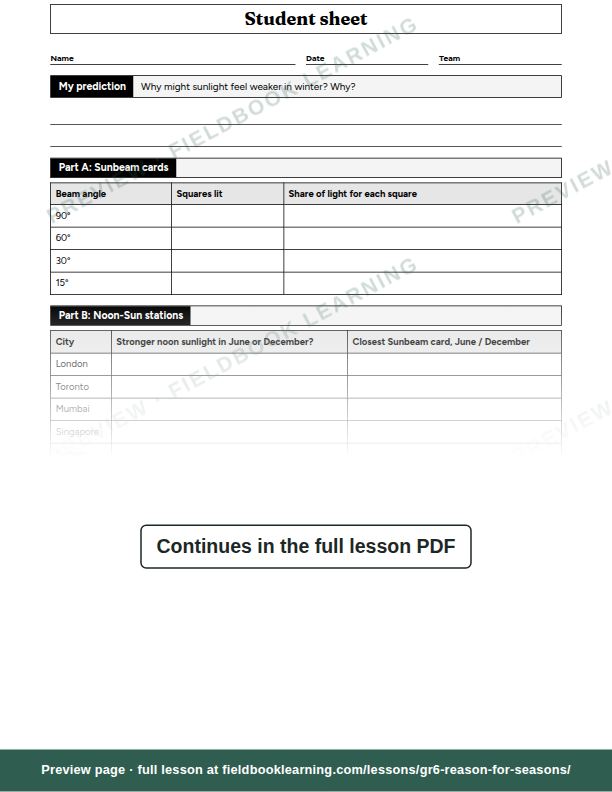
- Student sheet
- Worksheet: Sunbeam cards and stations
- Worksheet: Label it
- Worksheet: Try it at home
On the student sheet
- My prediction
- Part A: Sunbeam cards
- Part B: Noon-Sun stations
- December solstice explained
- Exit ticket
- Sunbeam cards and stations
- Label it
- Try it at home
US Letter, prints cleanly in black and white. The student sheet is on its own page, ready to photocopy.
Free with an account (any 3 lessons), or US$19 for all 3 lessons in this unit.
What students show by the end
- Uses the Sunbeam cards
- Reads the station data
- Explains summer heating
From the lesson’s rubric, which scores each one as not yet, getting there or got it.
Questions teachers ask
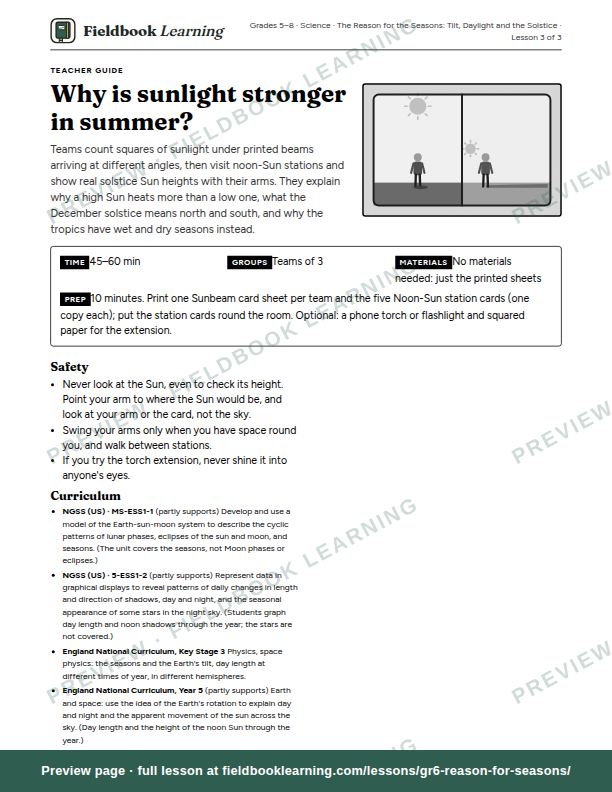
How long does “Why is sunlight stronger in summer?” take?
45–60 min. Group size: teams of 3.
How much prep does it need?
10 minutes. Print one Sunbeam card sheet per team and the five Noon-Sun station cards (one copy each); put the station cards round the room. Optional: a phone torch or flashlight and squared paper for the extension.
What materials do I need?
None. No materials needed: just the printed sheets.
Which curriculum standards does it cover?
NGSS (US): MS-ESS1-1 (partly) and 5-ESS1-2 (partly). It also matches England National Curriculum, Key Stage 3; England National Curriculum, Year 5 and Cambridge Primary and Lower Secondary Science (not endorsed by Cambridge).
What’s in the lesson PDF?
A teacher guide that walks you through predict, hunt, reveal, act, background for the teacher and assessment, then a student sheet (“My prediction”, “Part A: Sunbeam cards”, “Part B: Noon-Sun stations”, “December solstice explained”, “Exit ticket”, “Sunbeam cards and stations”, “Label it” and “Try it at home”) on its own page, ready to photocopy. It’s US Letter and prints cleanly in black and white.
Can I try it for free?
Yes. A free account includes any 3 full lessons of your choice, and this can be one of them. After that, this unit is US$19 for all 3 lessons, yours to keep, or every lesson is US$199 a year.