 Preview · the opening mission
Read this to the class:
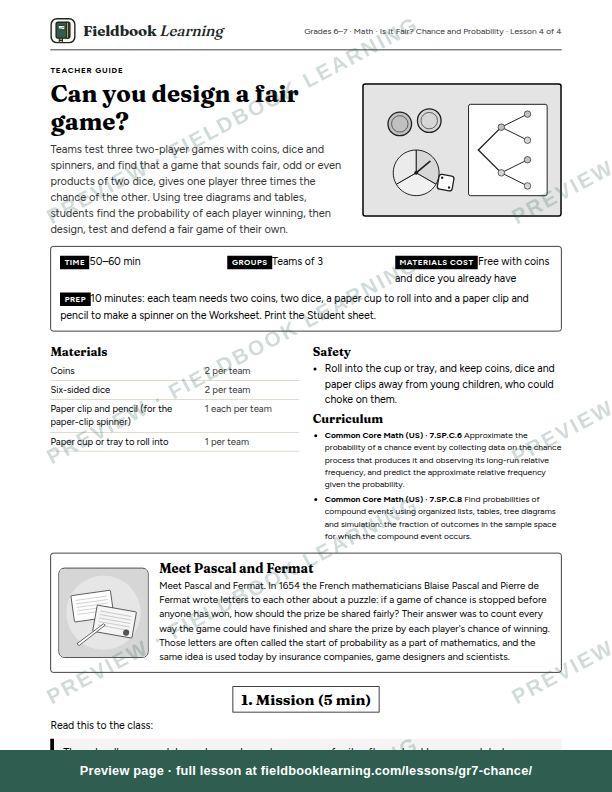
The school's games club wants new two-player games for its after-school tournament, but every game has to be fair: both players must have the same chance of winning. Three games were sent in. The club leader thinks they all look fair. Your team's job: test the three games, work out each player's real chance of winning, and design a fair game of your own that the club can use.
Teams of three, with jobs that rotate after each game: Player A, Player B, and the Referee, who runs the coins or dice and records each round.
Look inside the PDF
Sample pages, stamped “preview”. The download is the clean, full lesson.
In the full lesson PDF
9 printable pages
- Predict (5–10 min)
- Hunt (20 min)
- Reveal (10–15 min)
- Act (10 min)
- Background for the teacher
- Assessment
- Student sheet
- Worksheet: Paper-clip spinner
- Worksheet: Label it
- Worksheet: Try it at home
On the student sheet
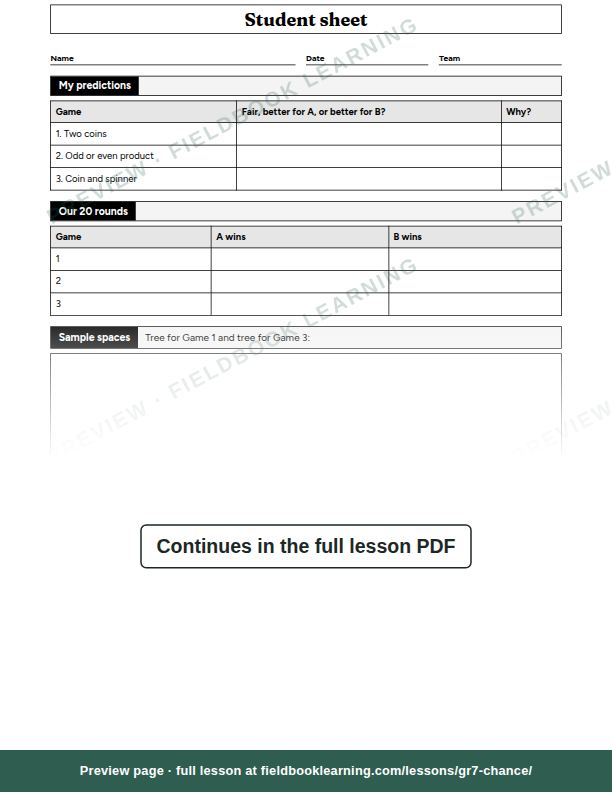
- My predictions
- Our 20 rounds
- Sample spaces
- Our fair game
- Exit ticket
- Paper-clip spinner
- Label it
- Try it at home
US Letter, prints cleanly in black and white. The student sheet is on its own page, ready to photocopy.
Free with an account (any 3 lessons), or US$19 for all 4 lessons in this unit.
What students show by the end
- Builds the sample space
- Finds probabilities of compound events
- Designs a fair game
From the lesson’s rubric, which scores each one as not yet, getting there or got it.
Questions teachers ask
How long does “Can you design a fair game?” take?
50–60 min. Group size: teams of 3.
How much prep does it need?
10 minutes: each team needs two coins, two dice, a paper cup to roll into and a paper clip and pencil to make a spinner on the Worksheet. Print the Student sheet.
What materials do I need?
Coins; six-sided dice; paper clip and pencil (for the paper-clip spinner); paper cup or tray to roll into. Cost: free with coins and dice you already have.
Which curriculum standards does it cover?
Common Core Math (US): 7.SP.C.6 and 7.SP.C.8.
What’s in the lesson PDF?
A teacher guide that walks you through predict, hunt, reveal, act, background for the teacher and assessment, then a student sheet (“My predictions”, “Our 20 rounds”, “Sample spaces”, “Our fair game”, “Exit ticket”, “Paper-clip spinner”, “Label it” and “Try it at home”) on its own page, ready to photocopy. It’s US Letter and prints cleanly in black and white.
Can I try it for free?
Yes. A free account includes any 3 full lessons of your choice, and this can be one of them. After that, this unit is US$19 for all 4 lessons, yours to keep, or every lesson is US$199 a year.