 Preview · the opening mission
Read this to the class:
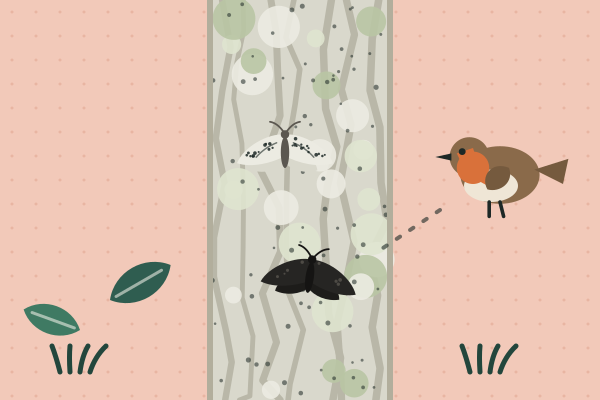
In the 1800s, factories in northern England burned so much coal that soot blackened the tree trunks and killed the pale lichen on them. Collectors noticed that a moth that had always been pale with black speckles was now nearly all black. Did the moths change colour to hide? Did the soot dye them? Or did something else happen, one generation at a time? Your team's job: play the hungry birds for four generations, and work out why one kind of moth survived and the other didn't.
Teams of three, with three jobs that rotate every generation: Bird (hunts the moths), Keeper (scatters the moths and adds the young ones), Recorder (counts and writes).
Look inside the PDF
Sample pages, stamped “preview”. The download is the clean, full lesson.
In the full lesson PDF
14 printable pages
- Predict (5–10 min)
- Hunt (20 min)
- Reveal (10–15 min)
- Act (10 min)
- Background for the teacher
- Assessment
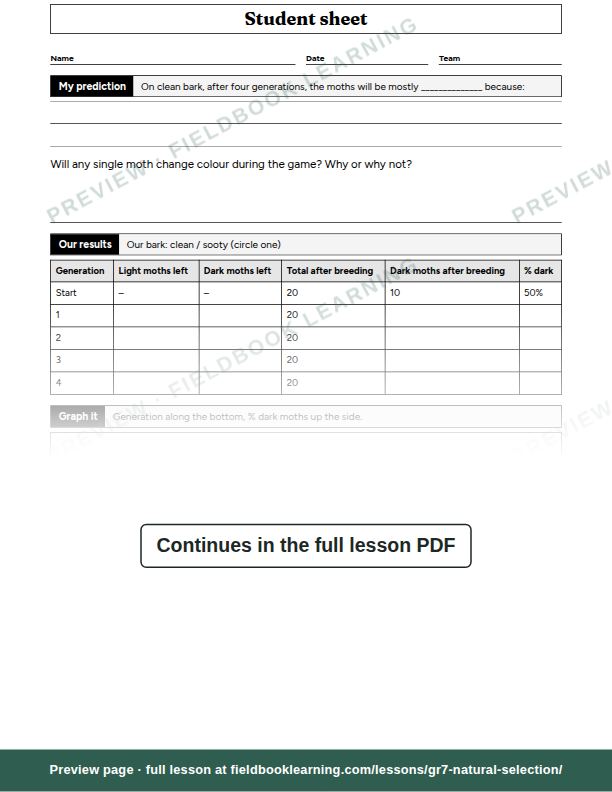
- Student sheet
- Worksheet: Moth cards
- Worksheet: Clean bark board
- Worksheet: Sooty bark board
- Worksheet: Label it
- Worksheet: Try it at home
On the student sheet
- My prediction
- Our results
- Graph it
- What made it fair, and what could make it unfair?
- Museum label
- Exit ticket
- Moth cards
- Clean bark board
- Sooty bark board
- Label it
- Try it at home
US Letter, prints cleanly in black and white. The student sheet is on its own page, ready to photocopy.
Free with an account (any 3 lessons), or US$19 for all 4 lessons in this unit.
What students show by the end
- Uses the data
- Explains selection
- Applies it
From the lesson’s rubric, which scores each one as not yet, getting there or got it.
Questions teachers ask
How long does “Why do some animals survive and others don't?” take?
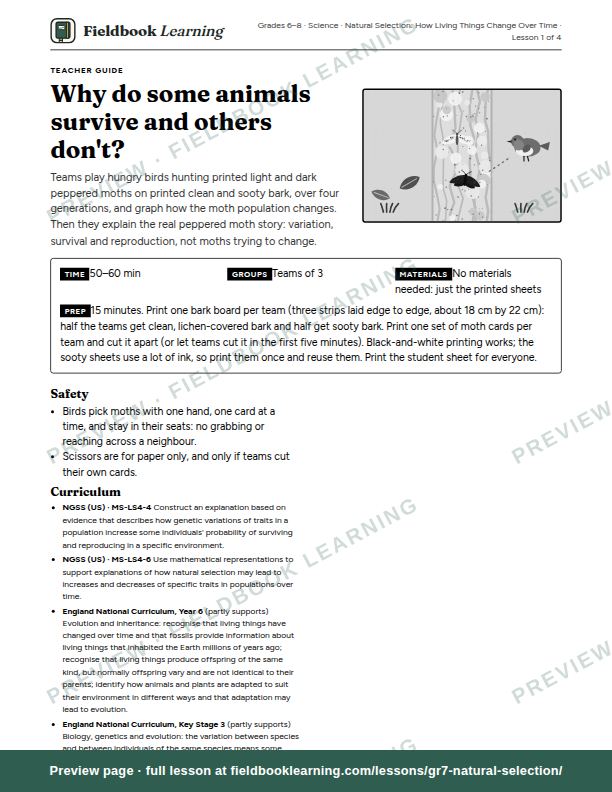
50–60 min. Group size: teams of 3.
How much prep does it need?
15 minutes. Print one bark board per team (three strips laid edge to edge, about 18 cm by 22 cm): half the teams get clean, lichen-covered bark and half get sooty bark. Print one set of moth cards per team and cut it apart (or let teams cut it in the first five minutes). Black-and-white printing works; the sooty sheets use a lot of ink, so print them once and reuse them. Print the student sheet for everyone.
What materials do I need?
None. No materials needed: just the printed sheets.
Which curriculum standards does it cover?
NGSS (US): MS-LS4-4 and MS-LS4-6. It also matches England National Curriculum, Year 6; England National Curriculum, Key Stage 3 and Cambridge Lower Secondary Science (not endorsed by Cambridge).
What’s in the lesson PDF?
A teacher guide that walks you through predict, hunt, reveal, act, background for the teacher and assessment, then a student sheet (“My prediction”; “Our results”; “Graph it”; “What made it fair, and what could make it unfair?”; “Museum label”; “Exit ticket”; “Moth cards”; “Clean bark board”; “Sooty bark board”; “Label it” and “Try it at home”) on its own page, ready to photocopy. It’s US Letter and prints cleanly in black and white.
Can I try it for free?
Yes. A free account includes any 3 full lessons of your choice, and this can be one of them. After that, this unit is US$19 for all 4 lessons, yours to keep, or every lesson is US$199 a year.