 Preview · the opening mission
Read this to the class:
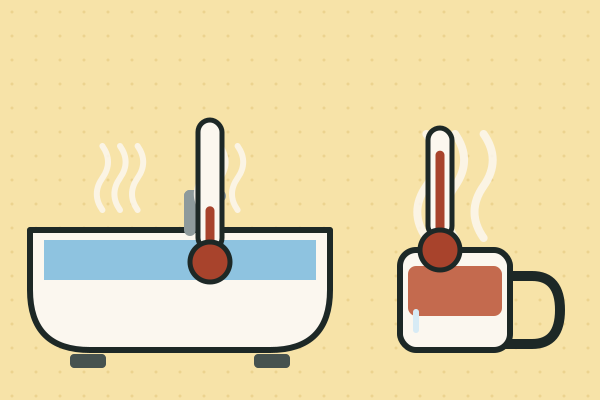
Mei makes tea in a small mug: 300 g of water at 55 °C. Her brother has run a bath: 150 kg of water at only 35 °C. "Hotter means more heat," says her brother, "so your mug has more heat in it than my whole bath." Mei isn't sure. Your team's job: find a rule that predicts the temperature when hot and cold water are mixed, test it with a thermometer, and use it to settle the argument.
Teams of three, with rotating jobs: Pourer (weighs and pours), Reader (stirs and reads the thermometer), Analyst (does the calculations).
Look inside the PDF
Sample pages, stamped “preview”. The download is the clean, full lesson.
In the full lesson PDF
- Predict (5–10 min)
- Hunt (30 min)
- Reveal (15 min)
- Act (10 min)
- Background for the teacher
- Assessment
- Student sheet
- Worksheet: Label it
- Worksheet: Try it at home
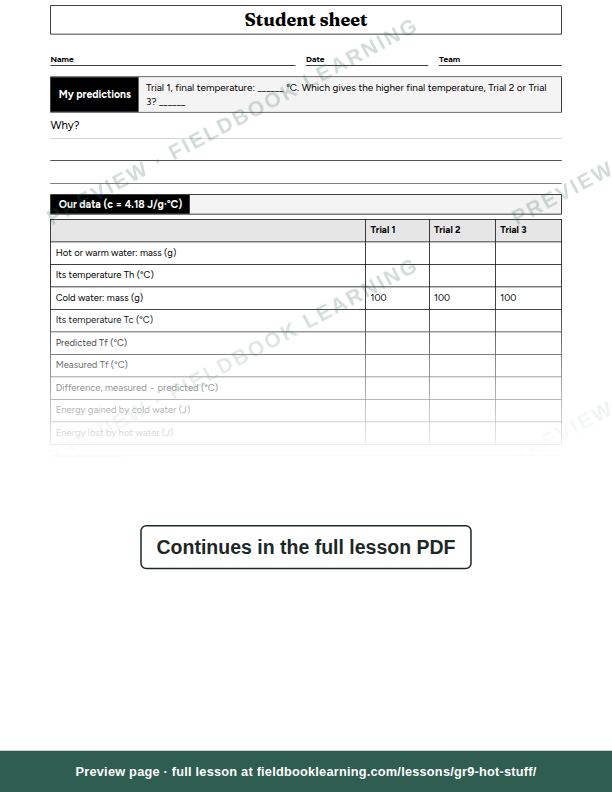
On the student sheet
- My predictions
- Our data (c = 4.18 J/g·°C)
- Uncertainty
- Reply to Mei's brother
- Exit ticket
- Label it
- Try it at home
US Letter, prints cleanly in black and white. The student sheet is on its own page, ready to photocopy.
Free with an account (any 3 lessons), or US$19 / C$25 for all 4 lessons in this unit.
What students show by the end
- Predicts and calculates
- Handles uncertainty
- Separates temperature from energy
From the lesson’s rubric, which scores each one as not yet, getting there or got it.
Questions teachers ask
How long does “Does hotter always mean more heat?” take?
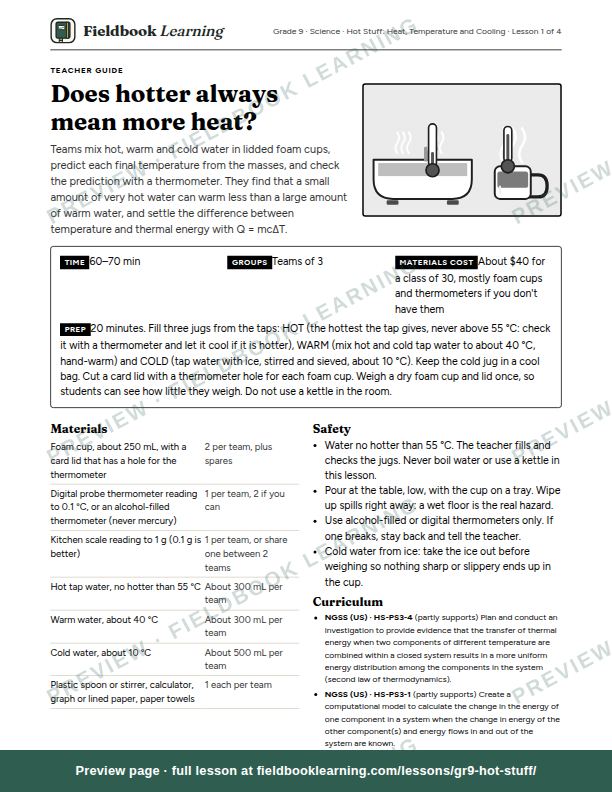
60–70 min. Group size: teams of 3.
How much prep does it need?
20 minutes. Fill three jugs from the taps: HOT (the hottest the tap gives, never above 55 °C: check it with a thermometer and let it cool if it is hotter), WARM (mix hot and cold tap water to about 40 °C, hand-warm) and COLD (tap water with ice, stirred and sieved, about 10 °C). Keep the cold jug in a cool bag. Cut a card lid with a thermometer hole for each foam cup. Weigh a dry foam cup and lid once, so students can see how little they weigh. Do not use a kettle in the room.
What materials do I need?
Foam cup, about 250 mL, with a card lid that has a hole for the thermometer; digital probe thermometer reading to 0.1 °C, or an alcohol-filled thermometer (never mercury); kitchen scale reading to 1 g (0.1 g is better); hot tap water, no hotter than 55 °C; warm water, about 40 °C; cold water, about 10 °C; and 1 more. Cost: about $40 for a class of 30, mostly foam cups and thermometers if you don't have them.
Which curriculum standards does it cover?
NGSS (US): HS-PS3-4 (partly), HS-PS3-1 (partly) and MS-PS3-4 (partly). It also matches Cambridge Lower Secondary Science, Stage 9 (not endorsed by Cambridge); England National Curriculum, Key Stage 3 and England National Curriculum, Key Stage 4.
What’s in the lesson PDF?
A teacher guide that walks you through predict, hunt, reveal, act, background for the teacher and assessment, then a student sheet (“My predictions”, “Our data (c = 4.18 J/g·°C)”, “Uncertainty”, “Reply to Mei's brother”, “Exit ticket”, “Label it” and “Try it at home”) on its own page, ready to photocopy. It’s US Letter and prints cleanly in black and white.
Can I try it for free?
Yes. A free account includes any 3 full lessons of your choice, and this can be one of them. After that, this unit is US$19 (C$25) for all 4 lessons, yours to keep, or every lesson is US$79 (C$109) a year.