 Preview · the opening mission
Read this to the class:
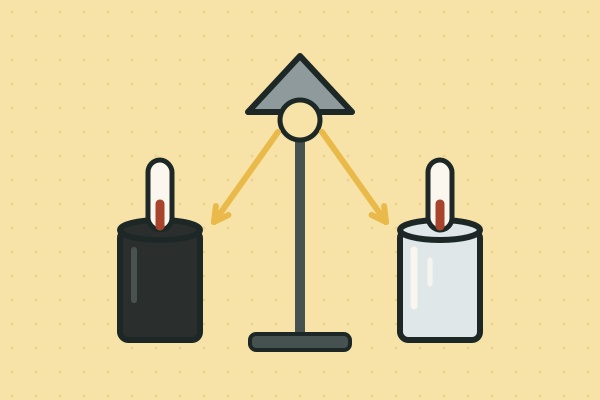
A bus company wants a cheap travel mug that keeps tea hot on a long drive. You are on the design team, and you also wonder why a black car is hotter than a white one in the Sun. Your team's job: test black against shiny under a lamp, then build the best drink keeper you can for 6 credits and prove with data which parts matter.
Teams of three, rotating jobs: Builder, Reader (thermometer, timer) and Analyst (calculations, graph).
Look inside the PDF
Sample pages, stamped “preview”. The download is the clean, full lesson.
In the full lesson PDF
- Predict (5–10 min)
- Hunt (50 min, with a 30-minute cooling run)
- Reveal (20 min)
- Act (10 min)
- Background for the teacher
- Assessment
- Student sheet
- Worksheet: Label it
- Worksheet: Try it at home
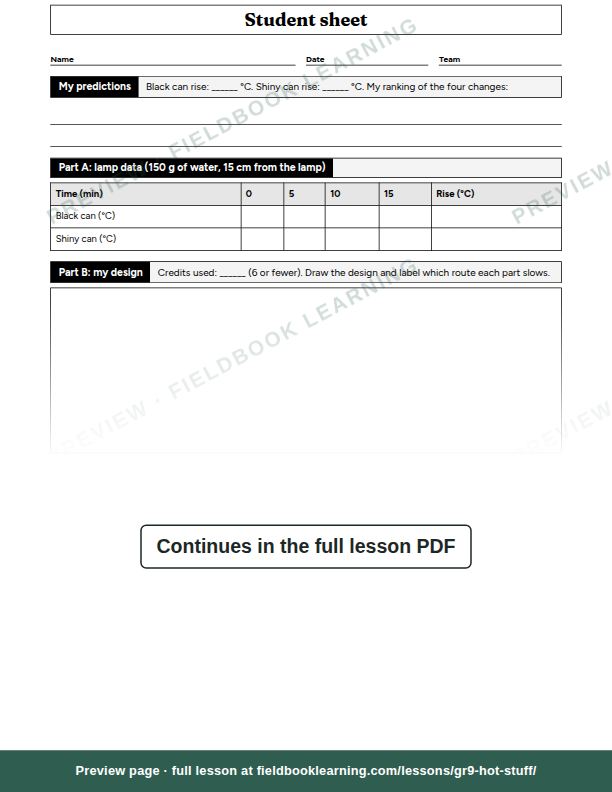
On the student sheet
- My predictions
- Part A: lamp data (150 g of water, 15 cm from the lamp)
- Part B: my design
- Uncertainty and next test
- Recommendation
- Exit ticket
- Label it
- Try it at home
US Letter, prints cleanly in black and white. The student sheet is on its own page, ready to photocopy.
Free with an account (any 3 lessons), or US$19 / C$25 for all 4 lessons in this unit.
What students show by the end
- Names the heat routes
- Fair-test analysis
- Calculates and decides
From the lesson’s rubric, which scores each one as not yet, getting there or got it.
Questions teachers ask
How long does “How do you keep a drink hot for the longest?” take?
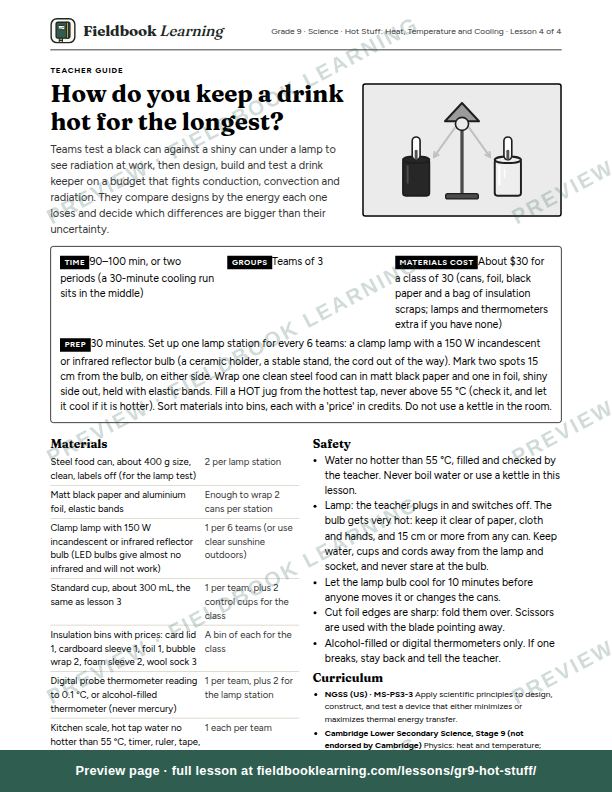
90–100 min, or two periods (a 30-minute cooling run sits in the middle). Group size: teams of 3.
How much prep does it need?
30 minutes. Set up one lamp station for every 6 teams: a clamp lamp with a 150 W incandescent or infrared reflector bulb (a ceramic holder, a stable stand, the cord out of the way). Mark two spots 15 cm from the bulb, on either side. Wrap one clean steel food can in matt black paper and one in foil, shiny side out, held with elastic bands. Fill a HOT jug from the hottest tap, never above 55 °C (check it, and let it cool if it is hotter). Sort materials into bins, each with a 'price' in credits. Do not use a kettle in the room.
What materials do I need?
Steel food can, about 400 g size, clean, labels off (for the lamp test); matt black paper and aluminium foil, elastic bands; clamp lamp with 150 W incandescent or infrared reflector bulb (LED bulbs give almost no infrared and will not work); standard cup, about 300 mL, the same as lesson 3; insulation bins with prices; digital probe thermometer reading to 0.1 °C, or alcohol-filled thermometer (never mercury); and 1 more. Cost: about $30 for a class of 30 (cans, foil, black paper and a bag of insulation scraps; lamps and thermometers extra if you have none).
Which curriculum standards does it cover?
NGSS (US): MS-PS3-3. It also matches Cambridge Lower Secondary Science, Stage 9 (not endorsed by Cambridge); England National Curriculum, Key Stage 3 and England National Curriculum, Key Stage 4.
What’s in the lesson PDF?
A teacher guide that walks you through predict, hunt, reveal, act, background for the teacher and assessment, then a student sheet (“My predictions”; “Part A: lamp data (150 g of water, 15 cm from the lamp)”; “Part B: my design”; “Uncertainty and next test”; “Recommendation”; “Exit ticket”; “Label it” and “Try it at home”) on its own page, ready to photocopy. It’s US Letter and prints cleanly in black and white.
Can I try it for free?
Yes. A free account includes any 3 full lessons of your choice, and this can be one of them. After that, this unit is US$19 (C$25) for all 4 lessons, yours to keep, or every lesson is US$79 (C$109) a year.