 Preview · the opening mission
Read this to the class:
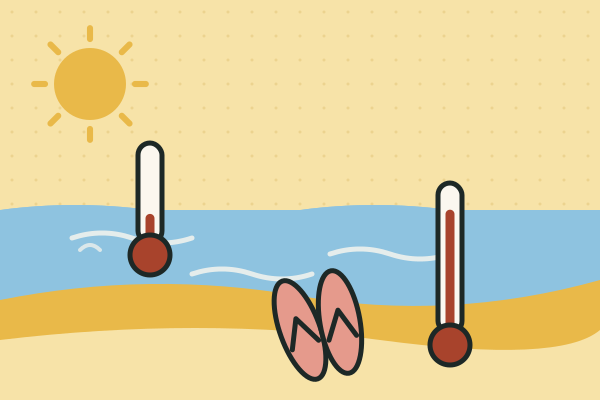
At 2 pm, Noor runs across the beach and has to hop: the dry sand is far too hot for bare feet. A minute later she wades into the sea and it feels cool. The same Sun has shone on both for hours. "The sand must be soaking up more heat," she says. Your team's job: measure how much energy a gram of sand needs for each degree, compare it with water, and decide whether Noor is right.
Teams of three, with rotating jobs: Pourer (weighs and transfers), Reader (reads both thermometers and times the bath), Analyst (does the calculations).
Look inside the PDF
Sample pages, stamped “preview”. The download is the clean, full lesson.
In the full lesson PDF
- Predict (5–10 min)
- Hunt (30 min)
- Reveal (15 min)
- Act (10 min)
- Background for the teacher
- Assessment
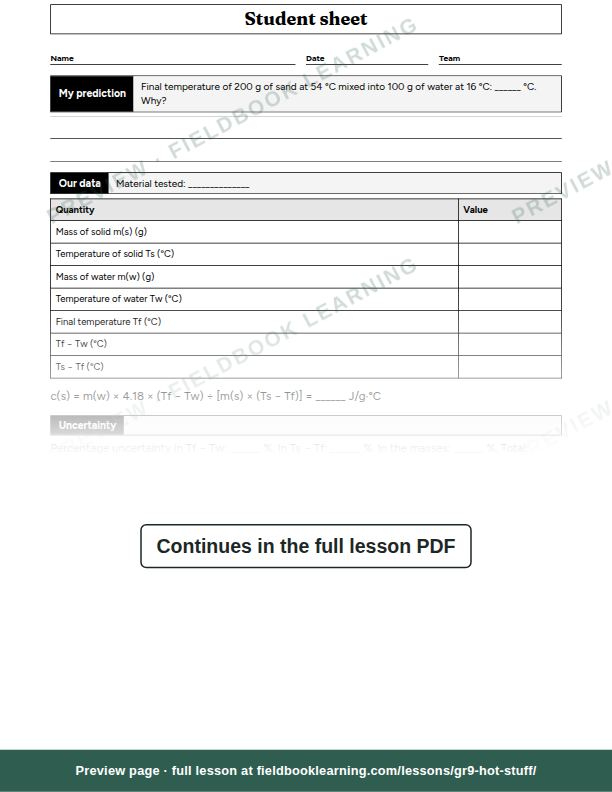
- Student sheet
- Worksheet: Label it
- Worksheet: Try it at home
On the student sheet
- My prediction
- Our data
- Uncertainty
- Note for Noor
- Exit ticket
- Label it
- Try it at home
US Letter, prints cleanly in black and white. The student sheet is on its own page, ready to photocopy.
Free with an account (any 3 lessons), or US$19 / C$25 for all 4 lessons in this unit.
What students show by the end
- Energy balance
- Uncertainty
- Explains land and sea
From the lesson’s rubric, which scores each one as not yet, getting there or got it.
Questions teachers ask
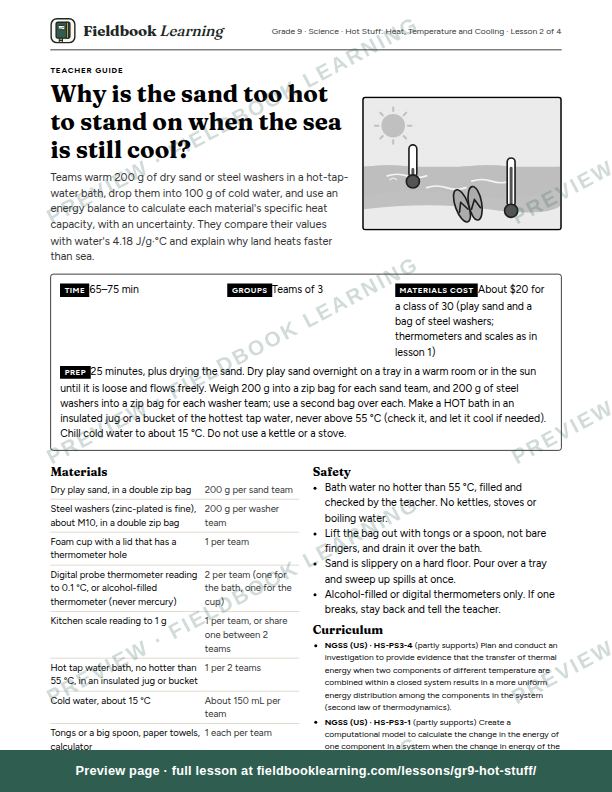
How long does “Why is the sand too hot to stand on when the sea is still cool?” take?
65–75 min. Group size: teams of 3.
How much prep does it need?
25 minutes, plus drying the sand. Dry play sand overnight on a tray in a warm room or in the sun until it is loose and flows freely. Weigh 200 g into a zip bag for each sand team, and 200 g of steel washers into a zip bag for each washer team; use a second bag over each. Make a HOT bath in an insulated jug or a bucket of the hottest tap water, never above 55 °C (check it, and let it cool if needed). Chill cold water to about 15 °C. Do not use a kettle or a stove.
What materials do I need?
Dry play sand, in a double zip bag; steel washers (zinc-plated is fine), about M10, in a double zip bag; foam cup with a lid that has a thermometer hole; digital probe thermometer reading to 0.1 °C, or alcohol-filled thermometer (never mercury); kitchen scale reading to 1 g; hot tap water bath, no hotter than 55 °C, in an insulated jug or bucket; and 2 more. Cost: about $20 for a class of 30 (play sand and a bag of steel washers; thermometers and scales as in lesson 1).
Which curriculum standards does it cover?
NGSS (US): HS-PS3-4 (partly), HS-PS3-1 (partly) and MS-PS3-4 (partly). It also matches Cambridge Lower Secondary Science, Stage 9 (not endorsed by Cambridge) and England National Curriculum, Key Stage 4.
What’s in the lesson PDF?
A teacher guide that walks you through predict, hunt, reveal, act, background for the teacher and assessment, then a student sheet (“My prediction”, “Our data”, “Uncertainty”, “Note for Noor”, “Exit ticket”, “Label it” and “Try it at home”) on its own page, ready to photocopy. It’s US Letter and prints cleanly in black and white.
Can I try it for free?
Yes. A free account includes any 3 full lessons of your choice, and this can be one of them. After that, this unit is US$19 (C$25) for all 4 lessons, yours to keep, or every lesson is US$79 (C$109) a year.