Hot Stuff: Heat, Temperature and Cooling
Does hotter always mean more heat? Why is sand too hot to stand on while the sea is cool? Why does a drink cool fastest at the start? How do you keep it hot? Four quantitative lessons with thermometers and a kitchen scale: Q = mcΔT, specific heat capacity, Newton's law of cooling and a drink-keeper design problem, with uncertainty throughout.
Or try any 3 lessons free with an account.
Already bought it? Download the whole unit as one printable workbook: cover, contents, curriculum connections, every lesson, readings, practice pages, a unit test and an answer key, in black and white.
4 lessons in this unit
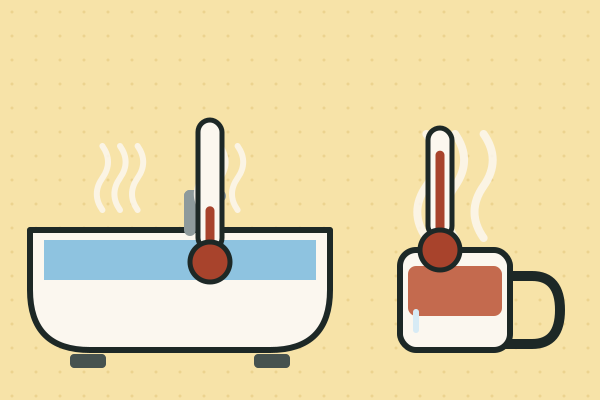 Lesson 1 · 60–70 minDoes hotter always mean more heat?Teams mix hot, warm and cold water in lidded foam cups, predict each final temperature from the masses, and check the prediction with a thermometer. They find that a small amount of very hot water can warm less than a large amount of warm water, and settle the difference between temperature and thermal energy with Q = mcΔT.
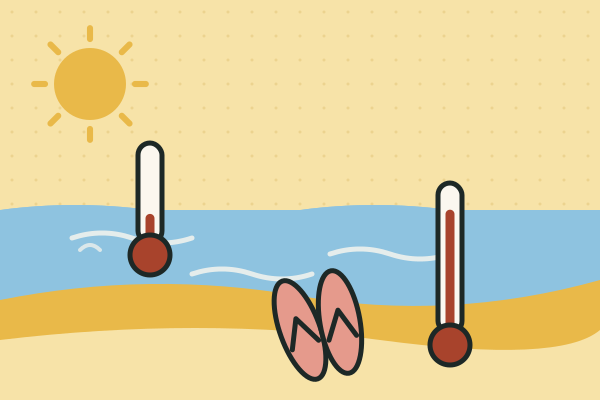 Lesson 2 · 65–75 minWhy is the sand too hot to stand on when the sea is still cool?Teams warm 200 g of dry sand or steel washers in a hot-tap-water bath, drop them into 100 g of cold water, and use an energy balance to calculate each material's specific heat capacity, with an uncertainty. They compare their values with water's 4.18 J/g·°C and explain why land heats faster than sea.
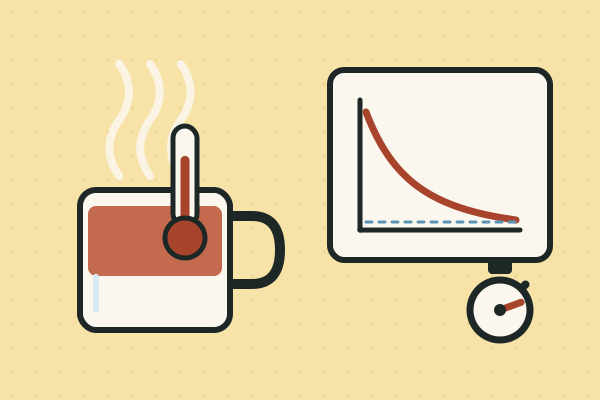 Lesson 3 · 75–90 min, or two periods (the cups need 30 minutes to cool, so graph the first data while you wait)Why does a hot drink cool fastest at the start?Teams record cooling curves for three cups of warm water (open, lidded, and lidded in wool), graph temperature against time, and test Newton's law of cooling on their own data. They weigh the open cup to estimate how much of the energy loss was evaporation.
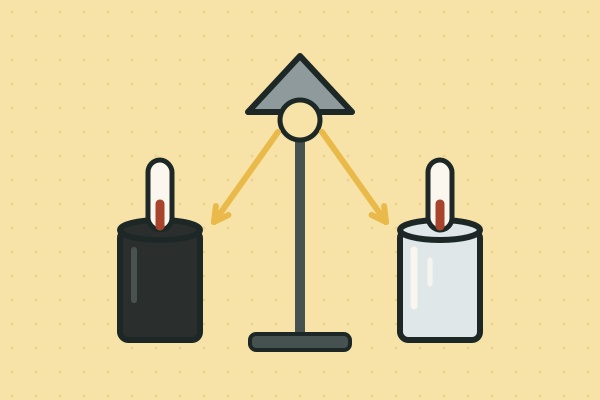 Lesson 4 · 90–100 min, or two periods (a 30-minute cooling run sits in the middle)How do you keep a drink hot for the longest?Teams test a black can against a shiny can under a lamp to see radiation at work, then design, build and test a drink keeper on a budget that fights conduction, convection and radiation. They compare designs by the energy each one loses and decide which differences are bigger than their uncertainty.
Materials for the whole unit · one list, lesson by lesson
Lesson 1: Does hotter always mean more heat?
- Foam cup, about 250 mL, with a card lid that has a hole for the thermometer2 per team, plus spares
- Digital probe thermometer reading to 0.1 °C, or an alcohol-filled thermometer (never mercury)1 per team, 2 if you can
- Kitchen scale reading to 1 g (0.1 g is better)1 per team, or share one between 2 teams
- Hot tap water, no hotter than 55 °CAbout 300 mL per team
- Warm water, about 40 °CAbout 300 mL per team
- Cold water, about 10 °CAbout 500 mL per team
- Plastic spoon or stirrer, calculator, graph or lined paper, paper towels1 each per team
About $40 for a class of 30, mostly foam cups and thermometers if you don't have them
Lesson 2: Why is the sand too hot to stand on when the sea is still cool?
- Dry play sand, in a double zip bag200 g per sand team
- Steel washers (zinc-plated is fine), about M10, in a double zip bag200 g per washer team
- Foam cup with a lid that has a thermometer hole1 per team
- Digital probe thermometer reading to 0.1 °C, or alcohol-filled thermometer (never mercury)2 per team (one for the bath, one for the cup)
- Kitchen scale reading to 1 g1 per team, or share one between 2 teams
- Hot tap water bath, no hotter than 55 °C, in an insulated jug or bucket1 per 2 teams
- Cold water, about 15 °CAbout 150 mL per team
- Tongs or a big spoon, paper towels, calculator1 each per team
About $20 for a class of 30 (play sand and a bag of steel washers; thermometers and scales as in lesson 1)
Lesson 3: Why does a hot drink cool fastest at the start?
- Identical plastic or steel cups, about 300 mL3 per team
- Card lids with a thermometer hole2 per team
- Wool sock or foam sleeve that fits a cup1 per team
- Digital probe thermometer reading to 0.1 °C, or alcohol-filled thermometer (never mercury)3 per team, or 1 shared by timing
- Kitchen scale reading to 1 g (0.1 g is much better)1 per team, or share one between 2 teams
- Hot tap water, no hotter than 55 °CAbout 700 mL per team
- Timer, graph paper, ruler, calculator, a small fan and a paper towel for the evaporation demo1 each per team; 1 fan for the class
About $25 for a class of 30 if you need thermometers and cups; the scales and wool socks are from lesson 1 and home
Lesson 4: How do you keep a drink hot for the longest?
- Steel food can, about 400 g size, clean, labels off (for the lamp test)2 per lamp station
- Matt black paper and aluminium foil, elastic bandsEnough to wrap 2 cans per station
- Clamp lamp with 150 W incandescent or infrared reflector bulb (LED bulbs give almost no infrared and will not work)1 per 6 teams (or use clear sunshine outdoors)
- Standard cup, about 300 mL, the same as lesson 31 per team, plus 2 control cups for the class
- Insulation bins with prices: card lid 1, cardboard sleeve 1, foil 1, bubble wrap 2, foam sleeve 2, wool sock 3A bin of each for the class
- Digital probe thermometer reading to 0.1 °C, or alcohol-filled thermometer (never mercury)1 per team, plus 2 for the lamp station
- Kitchen scale, hot tap water no hotter than 55 °C, timer, ruler, tape, scissors, calculator1 each per team
About $30 for a class of 30 (cans, foil, black paper and a bag of insulation scraps; lamps and thermometers extra if you have none)
Students start with a puzzle: a bath of warm water against a mug of hot tea. They mix hot, warm and cold water in lidded foam cups, predict each final temperature from the masses, and check with a thermometer. Then they warm sand and steel washers in a hot-tap-water bath, drop them into cold water and use an energy balance to measure specific heat capacity, with an uncertainty. They record cooling curves for open, lidded and wrapped cups of warm water, test Newton’s law of cooling on their own data and weigh the water an open cup loses. Last, they test a black can against a shiny one under a lamp and design a drink keeper on a budget.
By the end, students can separate temperature from thermal energy, use Q = mcΔT and the conservation of energy to predict and calculate, read a cooling curve, tell conduction, convection, radiation and evaporation apart, and say honestly which of their differences are bigger than the uncertainty. It follows Hot and Cold (Grade 6) and Forces and Motion (Grade 8): the measuring is the same, but here the answers are numbers with error bars. No hot water is hotter than the hot tap (never above 55 °C), and nothing is boiled.