Lesson library
A growing library of hands-on units
42 complete units and 140 lessons from Kindergarten to Grade 12, each a printable teacher guide with a student sheet. Aligned to NGSS and the Common Core in the US and to provincial curricula in Canada, with Cambridge mapping on request for international schools. Start with any 3 lessons free.
You're in. Open any lesson and press Unlock with a free lesson. We ask before using one of your 3.









 Grades K–2 · Light and Shadows · Lesson 1Why does my shadow follow me?Children go outside on a sunny day and try everything to escape their shadow: running, jumping, spinning and hiding in the shade. They find out that a shadow is the dark shape where their body blocks the sunlight, so it has to go wherever they go.30–40 min
 Grades K–2 · Light and Shadows · Lesson 2Why is my shadow long in the morning?Pairs stand a bottle on a chalk X and trace its shadow three times in one sunny day, measuring each shadow with a piece of yarn. Back inside, a flashlight held low and then high shows them why shadows are long when the Sun is low in the sky and short when it is high.About 40 min in total, split across one sunny day: 15 min in the morning, two 4 min visits outside, and 15 min at the end of the day
 Grades K–2 · Light and Shadows · Lesson 3What can light go through?Pairs shine a flashlight through everyday materials, from plastic wrap and wax paper to foil and cardboard, and sort them into 'lots of light', 'a little light' and 'no light'. Then they use what they found to choose the right material for a window, a lamp shade and a curtain for a sleepy bear.35–40 min
 Grade 1 · Plants and Seeds: What Does a Seed Need? · Lesson 1What's inside a seed?Children compare a hard dry lima bean with one soaked overnight, then gently peel and open the soaked bean to find the tiny baby plant and its food store. They draw and label what they find and explain it with "I think… because I saw…"35–45 min
 Grade 1 · Plants and Seeds: What Does a Seed Need? · Lesson 2What does a seed need to grow?Each team puts beans in three zip bags: wet in the light, wet in a dark cupboard, and dry. Over 7 to 10 days children keep a picture journal and find out that a seed needs water to start growing, and that light matters once the little plant is up.Day 1: 40 min. Then 5–10 min check-ins for 7 to 10 days, and a 25 min wrap-up
 Grade 1 · Plants and Seeds: What Does a Seed Need? · Lesson 3Why do plants grow toward the window?Children turn young bean plants away from a window and watch them bend back toward the light, and they set a seedling inside a shoebox maze to see if it can find its way out. They explain that plants need light and grow toward it.Day 1: 40 min. Then 5 min check-ins for 1 to 2 weeks, and a 20 min wrap-up
 Grades K–2 · Sound: Can You See a Sound? · Lesson 1Can you see a sound?Children make grains of rice jump on a plastic-wrap drum, pluck rubber bands on a box and twang rulers on the edge of a table. They find out that every sound they make comes from something shaking back and forth very fast.40–45 min
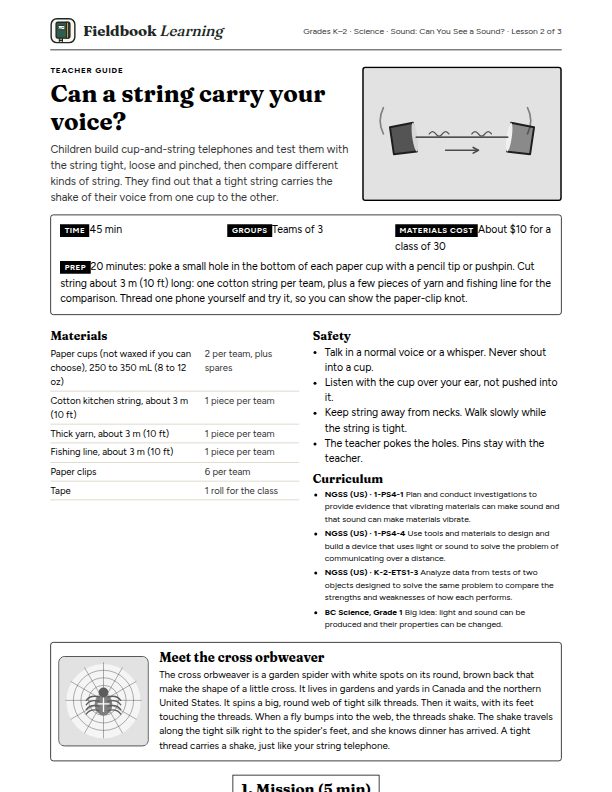 Grades K–2 · Sound: Can You See a Sound? · Lesson 2Can a string carry your voice?Children build cup-and-string telephones and test them with the string tight, loose and pinched, then compare different kinds of string. They find out that a tight string carries the shake of their voice from one cup to the other.45 min
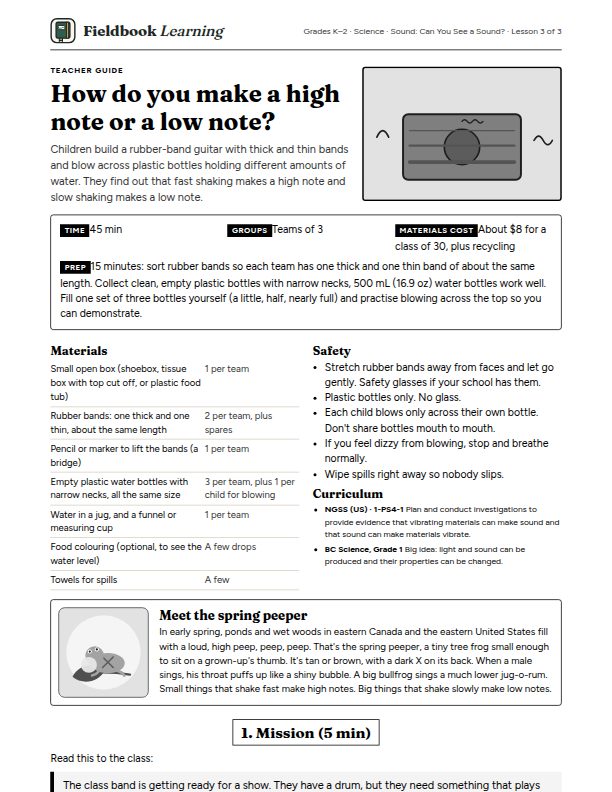 Grades K–2 · Sound: Can You See a Sound? · Lesson 3How do you make a high note or a low note?Children build a rubber-band guitar with thick and thin bands and blow across plastic bottles holding different amounts of water. They find out that fast shaking makes a high note and slow shaking makes a low note.45 min
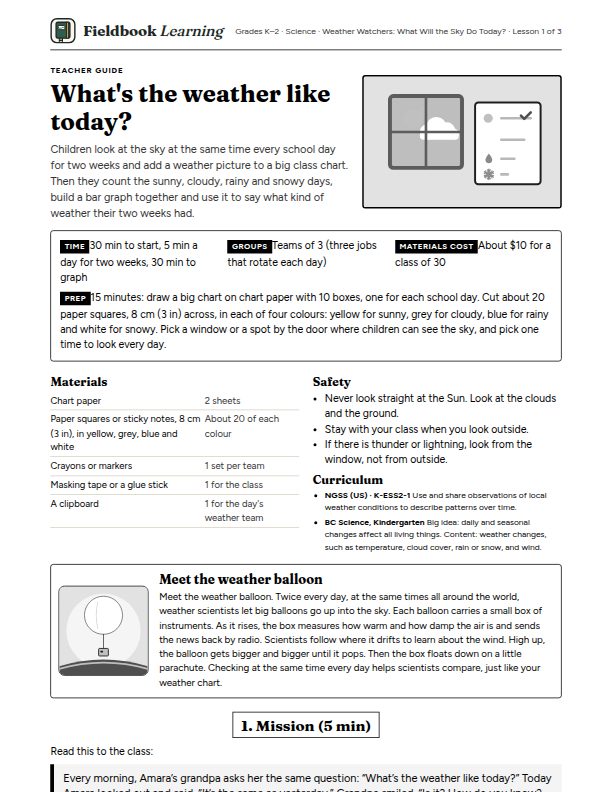 Grades K–2 · Weather Watchers: What Will the Sky Do Today? · Lesson 1What's the weather like today?Children look at the sky at the same time every school day for two weeks and add a weather picture to a big class chart. Then they count the sunny, cloudy, rainy and snowy days, build a bar graph together and use it to say what kind of weather their two weeks had.30 min to start, 5 min a day for two weeks, 30 min to graph
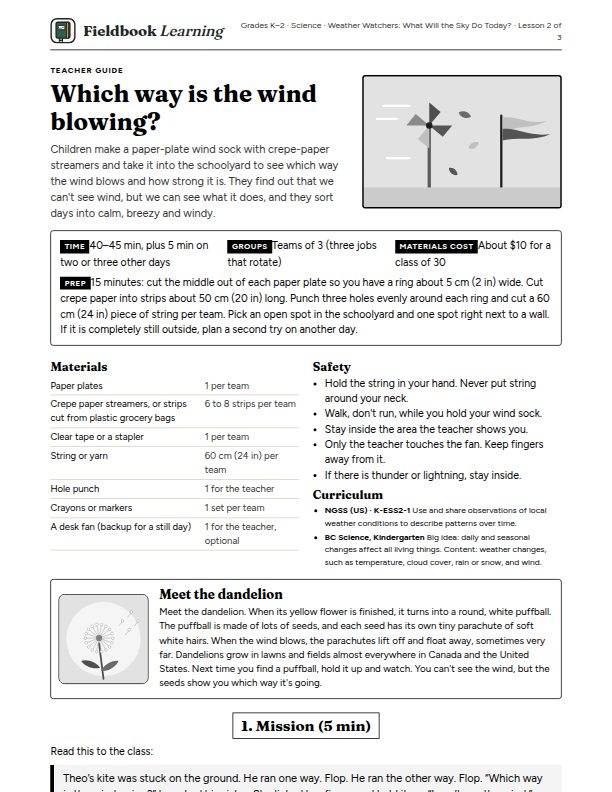 Grades K–2 · Weather Watchers: What Will the Sky Do Today? · Lesson 2Which way is the wind blowing?Children make a paper-plate wind sock with crepe-paper streamers and take it into the schoolyard to see which way the wind blows and how strong it is. They find out that we can't see wind, but we can see what it does, and they sort days into calm, breezy and windy.40–45 min, plus 5 min on two or three other days
 Grades K–2 · Weather Watchers: What Will the Sky Do Today? · Lesson 3How much rain fell?Teams build a rain gauge from a clear, straight-sided bottle with a ruler taped on, set it outside and measure the rain each day for a week. On a dry week they make a watering-can 'storm' instead, and test what happens when rain lands on grass, soil and pavement.40 min, plus 5 min a day for a week
 Grades K–5 · Kitchen Chemistry for Families · Lesson 1Why do the blobs in a lava lamp go up and down?Kids layer oil and water in a glass, add food colouring and a piece of fizzy tablet, and watch coloured blobs rise and sink. Then they explain it with floating, sinking and gas bubbles, and test whether warm water changes the show.45 min
 Grades K–5 · Kitchen Chemistry for Families · Lesson 2Is oobleck a solid or a liquid?Kids mix cornstarch and water into oobleck, then poke, squeeze, slap and drip it to find out when it acts like a solid and when it acts like a liquid. They finish able to explain why speed and force change the way it behaves.45 min
 Grades K–5 · Kitchen Chemistry for Families · Lesson 3What makes a volcano erupt?Kids test baking soda and vinegar to find out where the fizz comes from, build the classic kitchen volcano, then open bottles of sparkling water to see what really drives an eruption: gas trapped under pressure. They finish able to explain how the model is like a real volcano, and how it isn't.45 min
 Grades K–5 · Kitchen Chemistry for Families · Lesson 4How do spies write secret messages?Kids write invisible messages in baking soda, then reveal them by painting on grape juice or turmeric water, which change colour where the baking soda is. They finish able to explain that acids and bases make some colours change, and why a plain-water message stays hidden.45–60 min
 Grades K–5 · Build It, Launch It · Lesson 1Can you drop an egg without breaking it?Kids design an egg protector on a materials budget, test it from a low height first and work up, and fix what fails. They finish able to explain why a soft, slow stop saves the egg.60 min
 Grades K–5 · Build It, Launch It · Lesson 2What makes a paper plane fly farthest?Kids fold two different paper planes and run a fair test, changing one thing at a time: first the design, then the throw. They measure three throws each and explain the flight using lift, drag, thrust and gravity.45 min
 Grades K–5 · Build It, Launch It · Lesson 3How does a rocket push itself into space?Kids build a balloon rocket that zooms along a string between two chairs, then run a fair test on how much air goes in the balloon. They finish able to explain action and reaction: the balloon pushes air back, and the air pushes the balloon forward.45 min
 Grades K–5 · Earth and Sky at Home · Lesson 1Where do rainbows come from?Children split sunlight into colours with a glass of water, test whether the water is what makes the rainbow, and make their own rainbow with a hose mist. They finish able to explain that white light is a mix of colours that water bends apart.45 min, plus 10 min outside on a sunny day
 Grades K–5 · Earth and Sky at Home · Lesson 2How do crystals grow?Children watch the grown-up make strong salt, Epsom salt and sugar solutions, set out dishes and a string, then check them every day for a week. They finish able to explain that crystals form when dissolved particles line up as the water leaves.40 min to set up, then 5 min a day for 5 to 7 days
 Grades K–5 · Earth and Sky at Home · Lesson 3How does a cloud form?Children watch the grown-up set up two jars of hot water with ice on top, add a wisp of smoke to one, and compare the clouds. They finish able to explain that clouds form when moist air cools and water collects on tiny specks.40 min
 Grades K–5 · Winter Science at Home · Lesson 1Can you make frost in a can?Children crush ice, pack it into two cans, add salt to one, and watch water and then frost appear on the outside. They finish able to explain that the water and frost came out of the air, not through the can.40 min
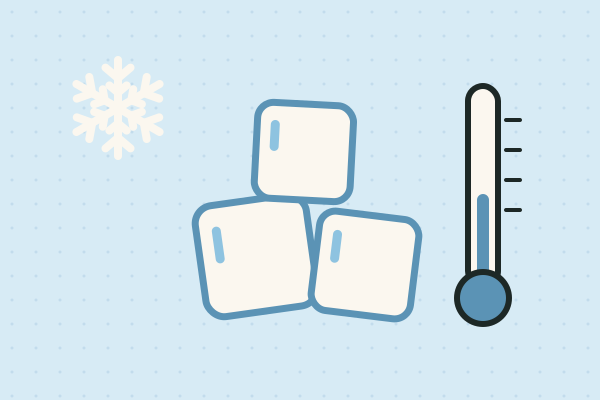
 Grades K–5 · Winter Science at Home · Lesson 2Why does salt melt ice?Children race three ice cubes covered in salt, sugar and nothing, then use a pinch of salt to lift an ice cube out of a glass with a piece of string. They finish able to explain that salt melts ice by mixing into the water, and that it makes the ice colder, not warmer.40 min
 Grades K–5 · Winter Science at Home · Lesson 3What's inside a snowflake?Children catch falling snowflakes on a chilled dark cloth and look at them with a magnifier, or, with no snow, look at freezer frost and grow crystals on a pipe-cleaner snowflake overnight. They finish able to explain that a snowflake is an ice crystal grown from water vapour, and why it has six sides.45 min on a snowy day, or 40 min plus overnight without snow
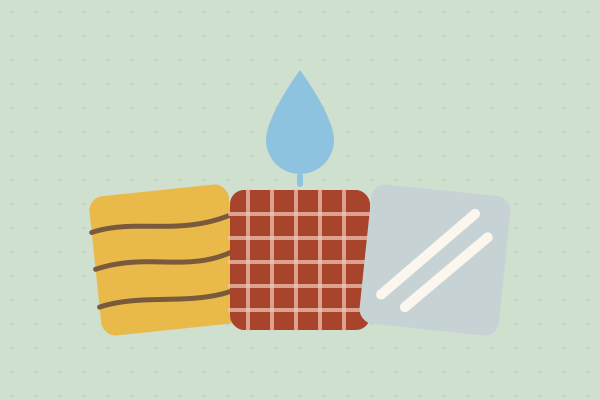
 Grades K–2 · Test It, Choose It: Materials · Lesson 1What is it made of?Children reach into a feely bag, describe what they touch and guess what it is made of, then sort a tray of everyday objects into wood, metal, plastic, glass, paper, fabric, rubber and rock. They learn to tell an object from its material and to describe materials with property words.40–50 min
 Grades K–2 · Test It, Choose It: Materials · Lesson 2Which material keeps the rain out?Children stretch squares of cloth, paper, foil, plastic and cardboard over cups, drip ten drops of water on each and look inside to see which ones let the water through. Then they choose a material and build a roof that keeps a toy dry.45–55 min
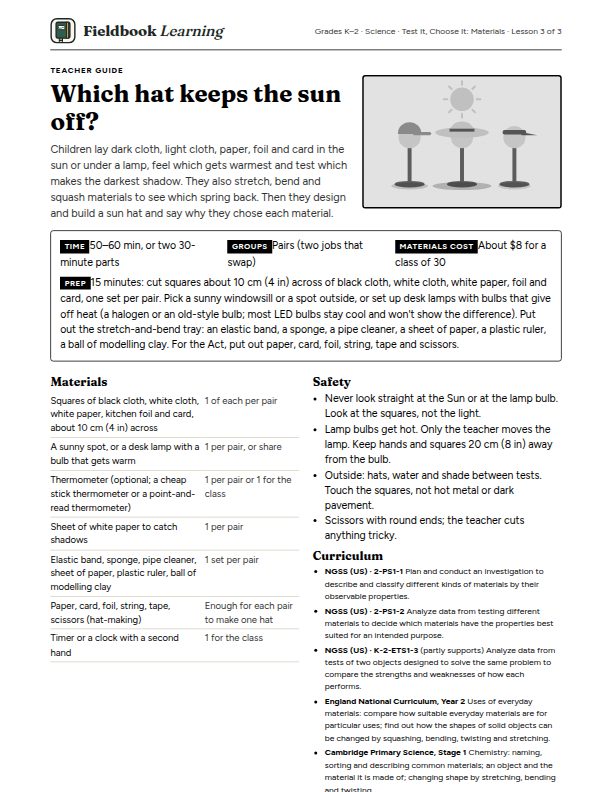 Grades K–2 · Test It, Choose It: Materials · Lesson 3Which hat keeps the sun off?Children lay dark cloth, light cloth, paper, foil and card in the sun or under a lamp, feel which gets warmest and test which makes the darkest shadow. They also stretch, bend and squash materials to see which spring back. Then they design and build a sun hat and say why they chose each material.50–60 min, or two 30-minute parts
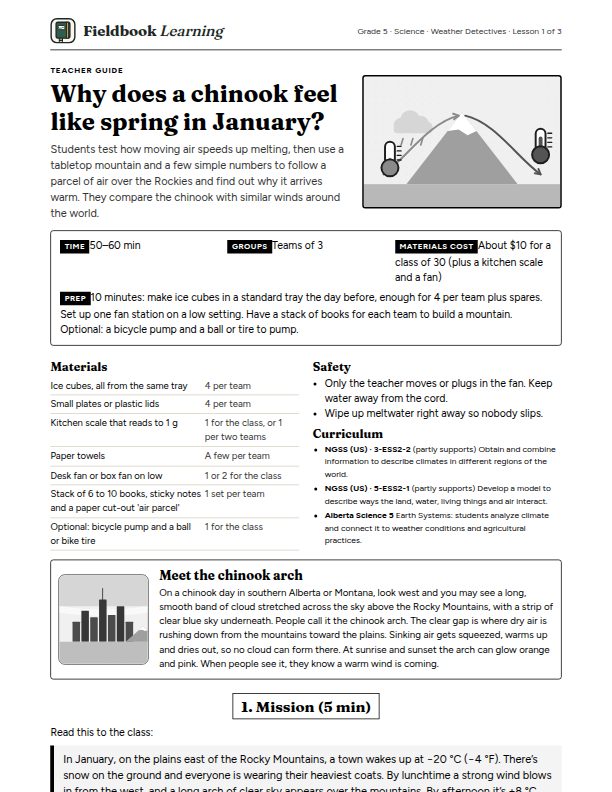 Grade 5 · Weather Detectives · Lesson 1Why does a chinook feel like spring in January?Students test how moving air speeds up melting, then use a tabletop mountain and a few simple numbers to follow a parcel of air over the Rockies and find out why it arrives warm. They compare the chinook with similar winds around the world.50–60 min
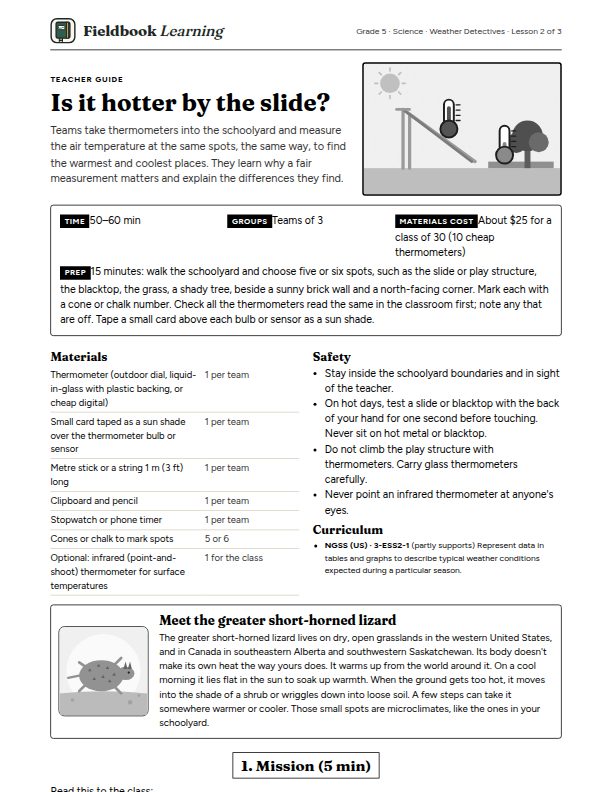 Grade 5 · Weather Detectives · Lesson 2Is it hotter by the slide?Teams take thermometers into the schoolyard and measure the air temperature at the same spots, the same way, to find the warmest and coolest places. They learn why a fair measurement matters and explain the differences they find.50–60 min
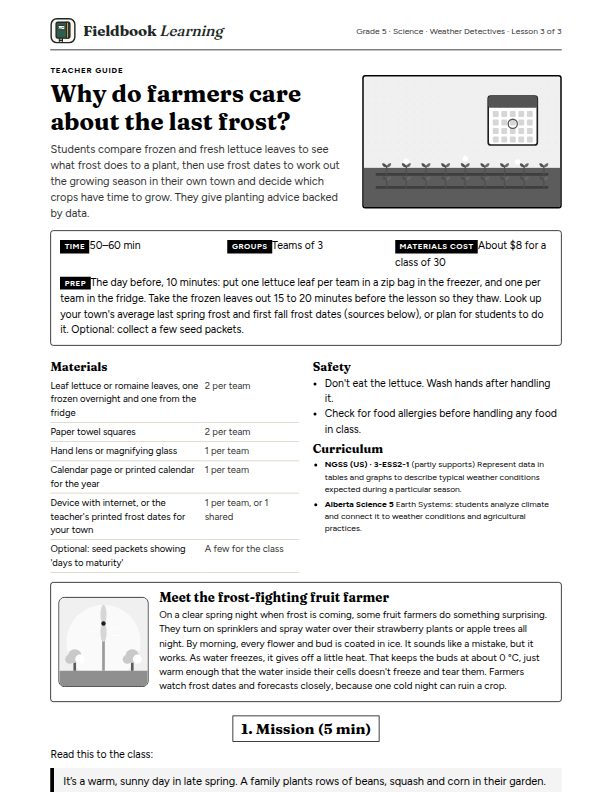 Grade 5 · Weather Detectives · Lesson 3Why do farmers care about the last frost?Students compare frozen and fresh lettuce leaves to see what frost does to a plant, then use frost dates to work out the growing season in their own town and decide which crops have time to grow. They give planting advice backed by data.50–60 min
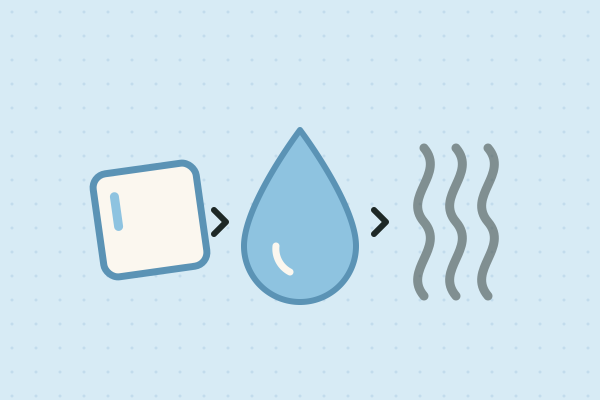
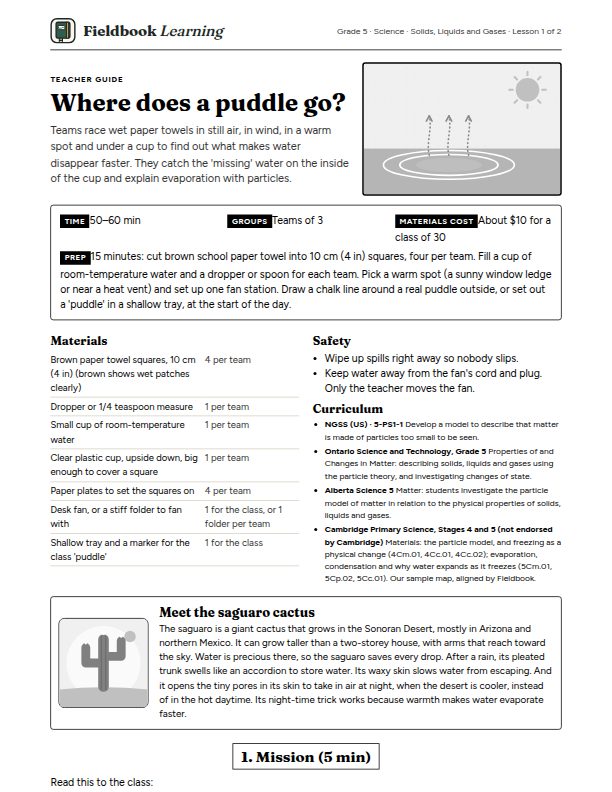 Grade 5 · Solids, Liquids and Gases · Lesson 1Where does a puddle go?Teams race wet paper towels in still air, in wind, in a warm spot and under a cup to find out what makes water disappear faster. They catch the 'missing' water on the inside of the cup and explain evaporation with particles.50–60 min
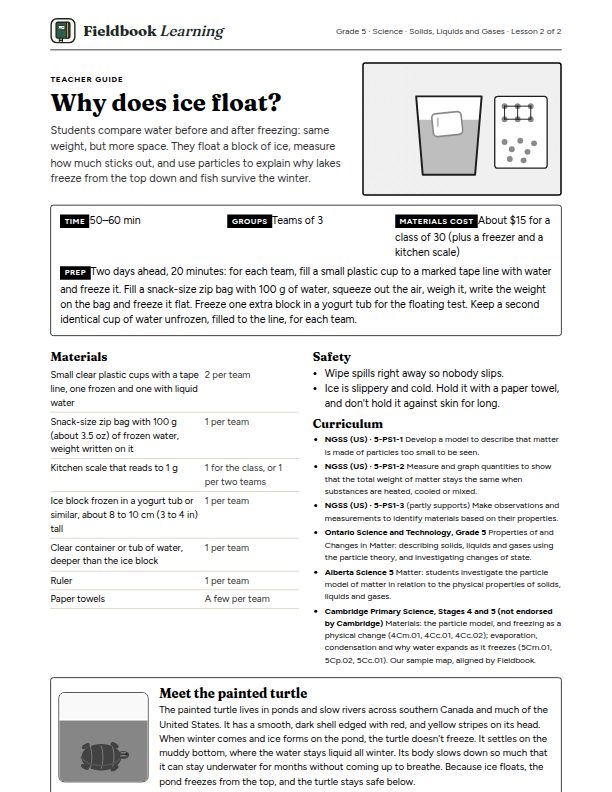 Grade 5 · Solids, Liquids and Gases · Lesson 2Why does ice float?Students compare water before and after freezing: same weight, but more space. They float a block of ice, measure how much sticks out, and use particles to explain why lakes freeze from the top down and fish survive the winter.50–60 min
 Grade 4 · Evidence Lab · Lesson 1How do you know a fact is true?Students test an internet 'fact', that your arm span is exactly the same as your height, by measuring themselves and pooling the whole class's data. Then they rank different kinds of evidence from strong to weak and decide how true the claim really is.45–60 min
 Grade 4 · Evidence Lab · Lesson 2Why do scientists repeat their tests?Students build two paper helicopters, one with long wings and one with short wings, and time each one falling five times. They find that the same drop never gives exactly the same time, and use their repeated trials to decide whether the wing change really made a difference.45–60 min
 Grade 4 · Our Living Planet · Lesson 1Can a jar keep itself alive?Each team builds a small world of soil, water, air and plants inside a clear jar, seals it, and keeps an observation log for four weeks beside an open jar built the same way. Students explain how water and air are used again and again inside the sealed jar, and why it still needs light from outside.50–60 min to build, then 5 min check-ins twice a week for 4 weeks, and a 30 min Reveal and Act
 Grade 4 · Our Living Planet · Lesson 2Where does rain come from?Students tape a zip-top bag of blue water to a sunny window and another to a shady wall, and catch a cold cup 'sweating' in the room. They follow the water from the bottom of the bag to the clear drops at the top, and explain how the Sun, air and clouds bring rain back down.45–60 min, plus a 5 min look later the same day or the next morning
 Grade 3 · Pushes, Pulls and Magnets · Lesson 1Why does a ball stop rolling?Teams roll the same ball down the same ramp onto a hard floor, a carpet and a towel, and measure how far it goes each time. They find out that a rolling ball doesn't just run out of go: something rubs against it and slows it down.45–60 min
 Grade 3 · Pushes, Pulls and Magnets · Lesson 2Can a magnet work through a table?Teams test whether a magnet can pull a paper clip through paper, foil, plastic, cloth and wood, then count how many cards it can pull through before it lets go. They find out that most materials don't block a magnet at all: distance is what weakens the pull.45–60 min
 Grade 3 · Pushes, Pulls and Magnets · Lesson 3How far will a paper clip jump?Teams slide a magnet slowly toward a paper clip along a ruler and measure the gap at the moment the clip jumps. They repeat it, use the pattern to predict what two and three magnets will do, and then design a magnet gadget that works without touching.45–60 min
 Grade 5 · Data Detectives · Lesson 1How fast are our reaction times?Partners drop a ruler and catch it, five times with their writing hand and five times with the other hand. Students find the mean, median and range of their own catches and the class's, then decide whether our writing hand really is quicker.50–60 min
 Grade 5 · Data Detectives · Lesson 2Which graph tells the truth?Teams take the class's reaction-time results and draw two bar graphs of exactly the same numbers: one honest, one built to exaggerate. Then they hunt for the same tricks in a set of sneaky graphs and fix an advertisement's chart.50–60 min
 Grade 5 · Data Detectives · Lesson 3Do taller people have bigger hands?Students measure height and hand span, plot every person as one point on a scatter plot, and draw a trend line by eye. They decide whether taller people tend to have bigger hands, and learn the difference between a trend and a rule.50–60 min
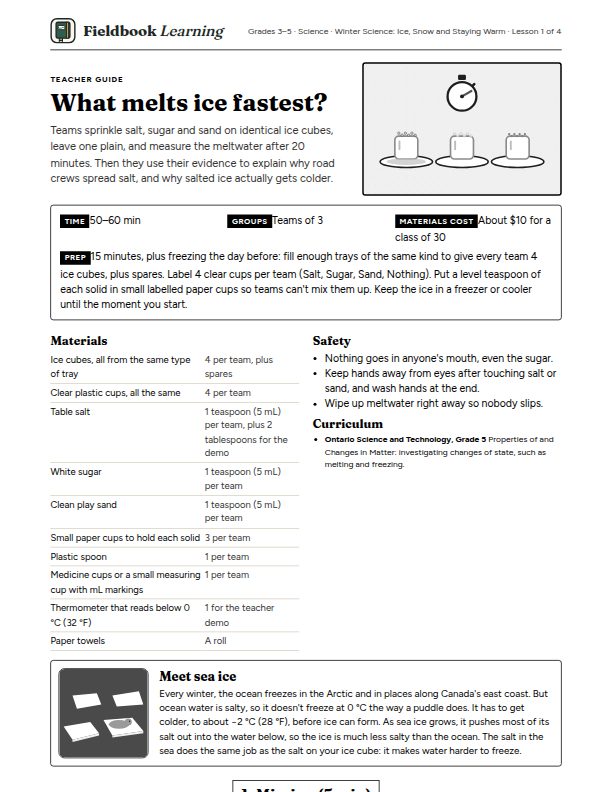 Grades 3–5 · Winter Science: Ice, Snow and Staying Warm · Lesson 1What melts ice fastest?Teams sprinkle salt, sugar and sand on identical ice cubes, leave one plain, and measure the meltwater after 20 minutes. Then they use their evidence to explain why road crews spread salt, and why salted ice actually gets colder.50–60 min
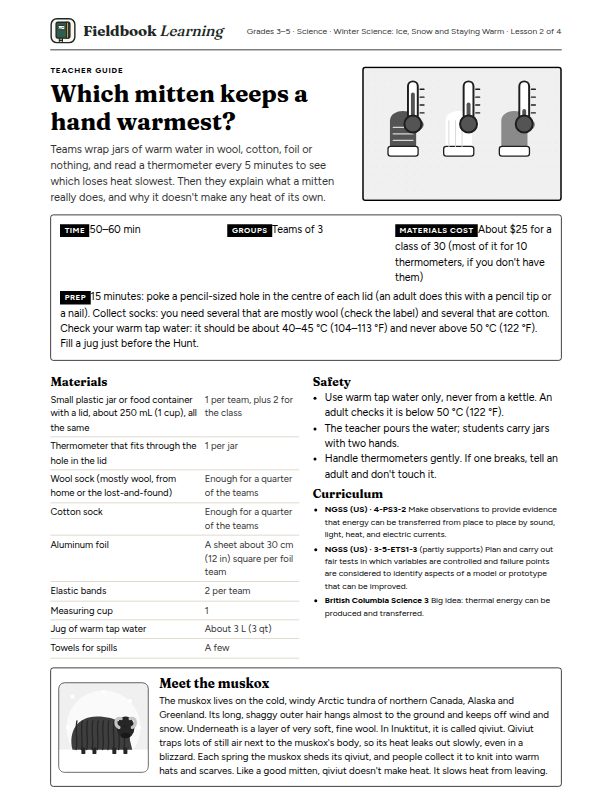 Grades 3–5 · Winter Science: Ice, Snow and Staying Warm · Lesson 2Which mitten keeps a hand warmest?Teams wrap jars of warm water in wool, cotton, foil or nothing, and read a thermometer every 5 minutes to see which loses heat slowest. Then they explain what a mitten really does, and why it doesn't make any heat of its own.50–60 min
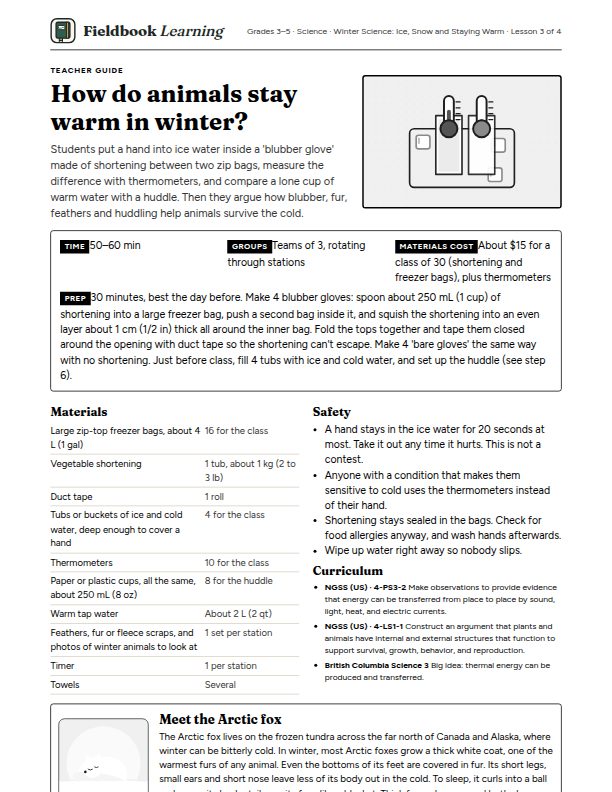 Grades 3–5 · Winter Science: Ice, Snow and Staying Warm · Lesson 3How do animals stay warm in winter?Students put a hand into ice water inside a 'blubber glove' made of shortening between two zip bags, measure the difference with thermometers, and compare a lone cup of warm water with a huddle. Then they argue how blubber, fur, feathers and huddling help animals survive the cold.50–60 min
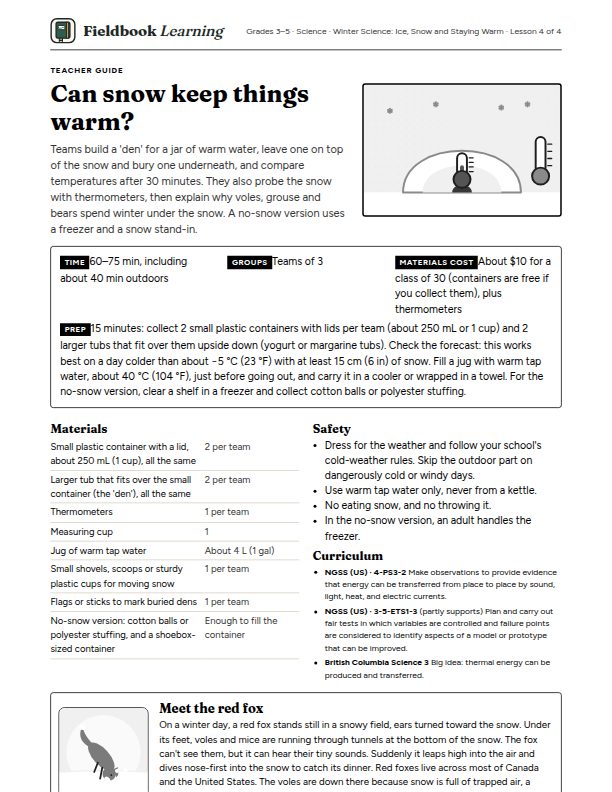 Grades 3–5 · Winter Science: Ice, Snow and Staying Warm · Lesson 4Can snow keep things warm?Teams build a 'den' for a jar of warm water, leave one on top of the snow and bury one underneath, and compare temperatures after 30 minutes. They also probe the snow with thermometers, then explain why voles, grouse and bears spend winter under the snow. A no-snow version uses a freezer and a snow stand-in.60–75 min, including about 40 min outdoors
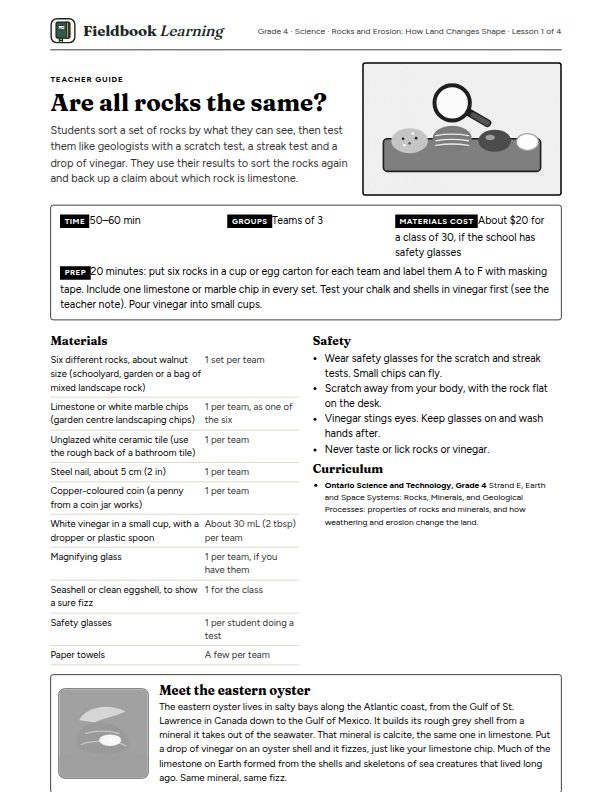 Grade 4 · Rocks and Erosion: How Land Changes Shape · Lesson 1Are all rocks the same?Students sort a set of rocks by what they can see, then test them like geologists with a scratch test, a streak test and a drop of vinegar. They use their results to sort the rocks again and back up a claim about which rock is limestone.50–60 min
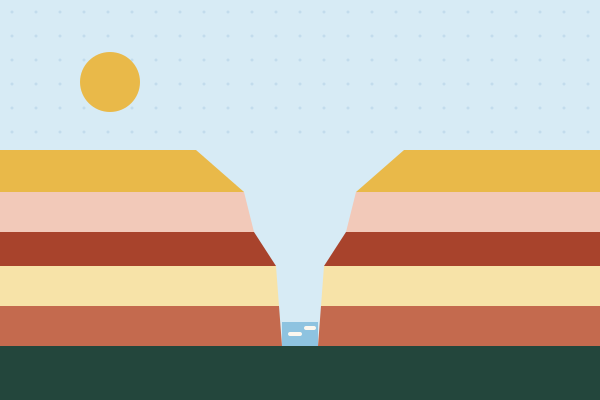
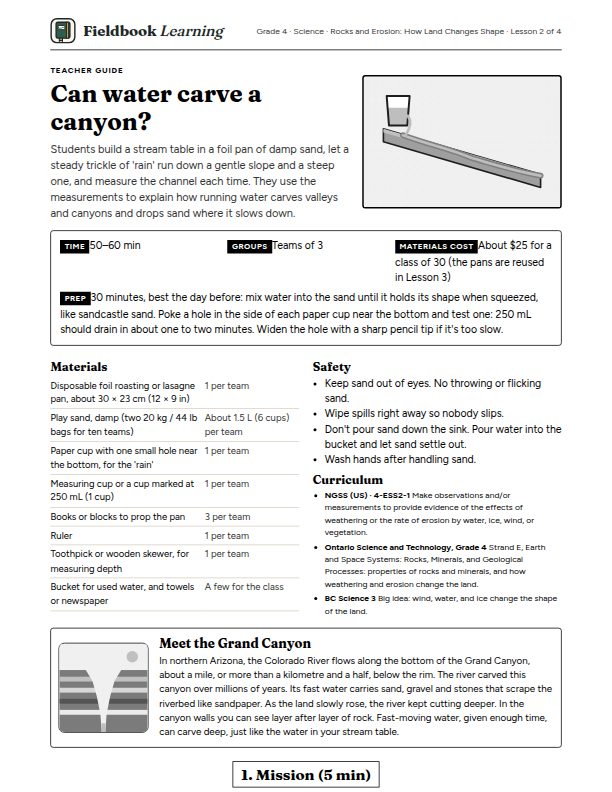 Grade 4 · Rocks and Erosion: How Land Changes Shape · Lesson 2Can water carve a canyon?Students build a stream table in a foil pan of damp sand, let a steady trickle of 'rain' run down a gentle slope and a steep one, and measure the channel each time. They use the measurements to explain how running water carves valleys and canyons and drops sand where it slows down.50–60 min
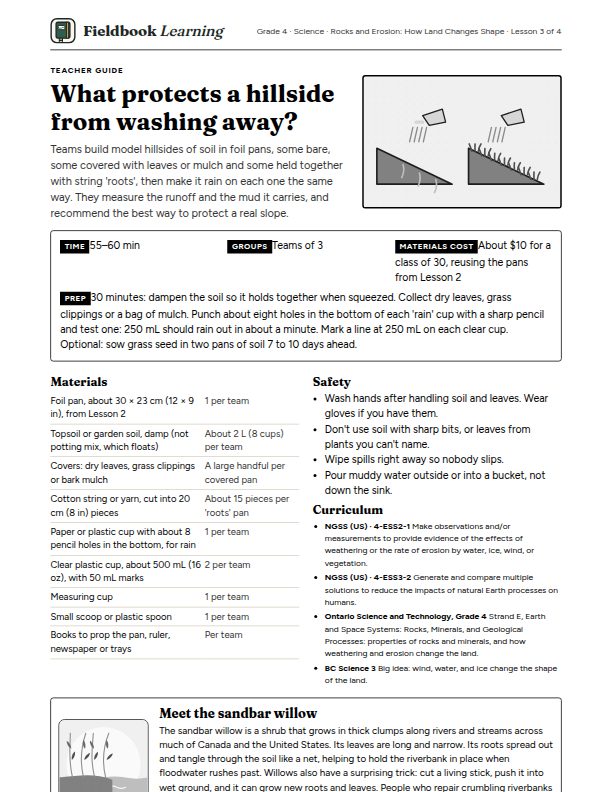 Grade 4 · Rocks and Erosion: How Land Changes Shape · Lesson 3What protects a hillside from washing away?Teams build model hillsides of soil in foil pans, some bare, some covered with leaves or mulch and some held together with string 'roots', then make it rain on each one the same way. They measure the runoff and the mud it carries, and recommend the best way to protect a real slope.55–60 min
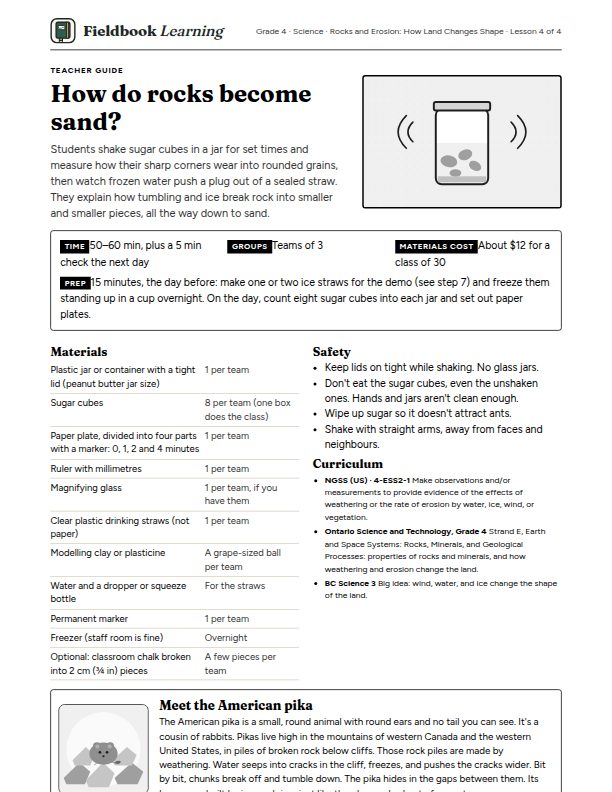 Grade 4 · Rocks and Erosion: How Land Changes Shape · Lesson 4How do rocks become sand?Students shake sugar cubes in a jar for set times and measure how their sharp corners wear into rounded grains, then watch frozen water push a plug out of a sealed straw. They explain how tumbling and ice break rock into smaller and smaller pieces, all the way down to sand.50–60 min, plus a 5 min check the next day
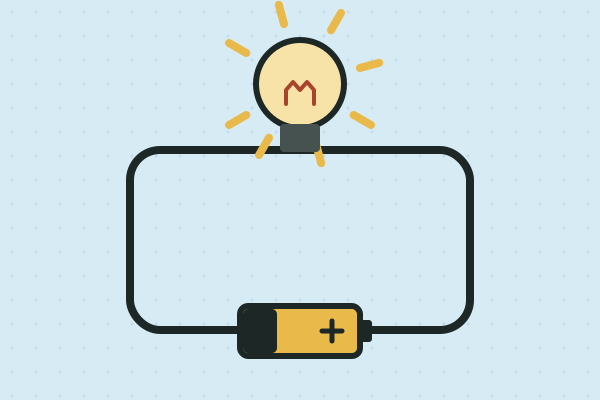
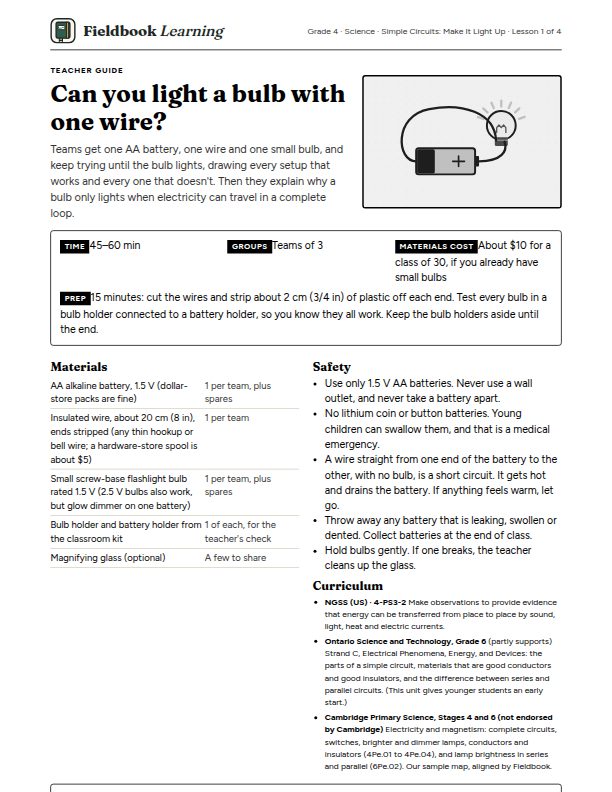 Grade 4 · Simple Circuits: Make It Light Up · Lesson 1Can you light a bulb with one wire?Teams get one AA battery, one wire and one small bulb, and keep trying until the bulb lights, drawing every setup that works and every one that doesn't. Then they explain why a bulb only lights when electricity can travel in a complete loop.45–60 min
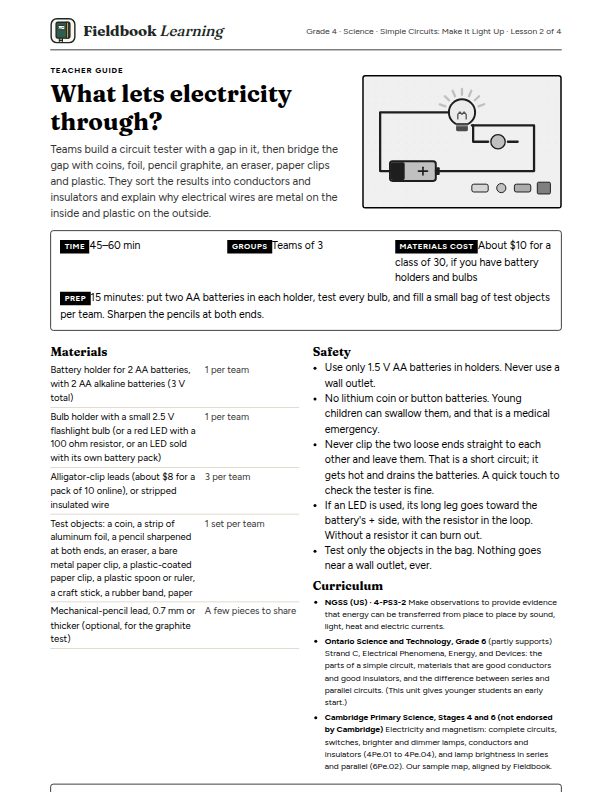 Grade 4 · Simple Circuits: Make It Light Up · Lesson 2What lets electricity through?Teams build a circuit tester with a gap in it, then bridge the gap with coins, foil, pencil graphite, an eraser, paper clips and plastic. They sort the results into conductors and insulators and explain why electrical wires are metal on the inside and plastic on the outside.45–60 min
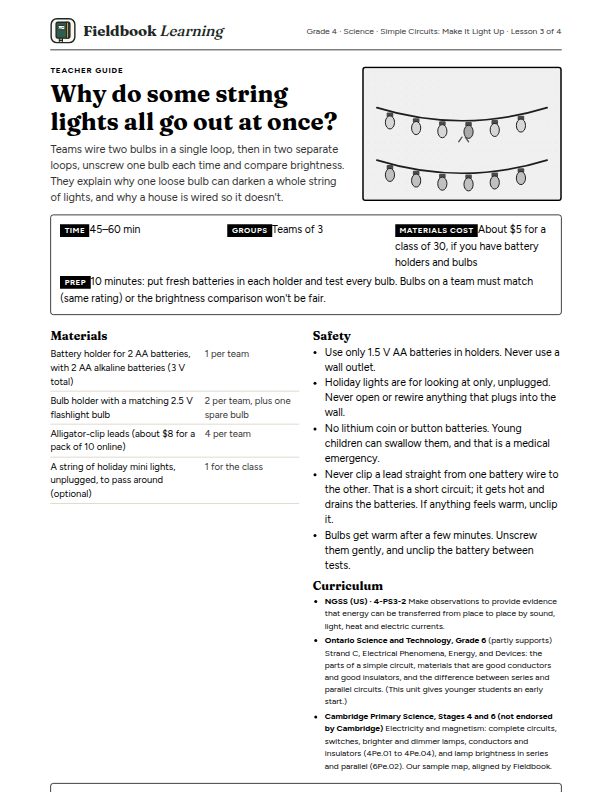 Grade 4 · Simple Circuits: Make It Light Up · Lesson 3Why do some string lights all go out at once?Teams wire two bulbs in a single loop, then in two separate loops, unscrew one bulb each time and compare brightness. They explain why one loose bulb can darken a whole string of lights, and why a house is wired so it doesn't.45–60 min
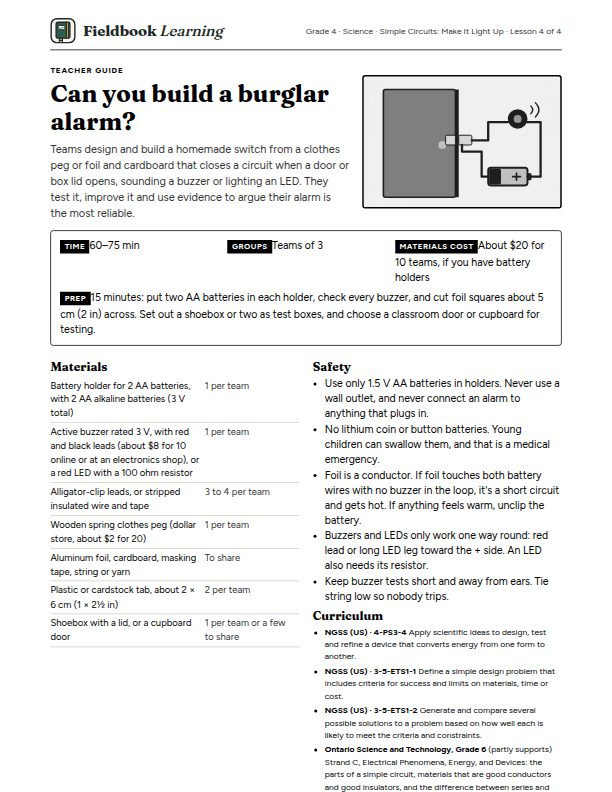 Grade 4 · Simple Circuits: Make It Light Up · Lesson 4Can you build a burglar alarm?Teams design and build a homemade switch from a clothes peg or foil and cardboard that closes a circuit when a door or box lid opens, sounding a buzzer or lighting an LED. They test it, improve it and use evidence to argue their alarm is the most reliable.60–75 min
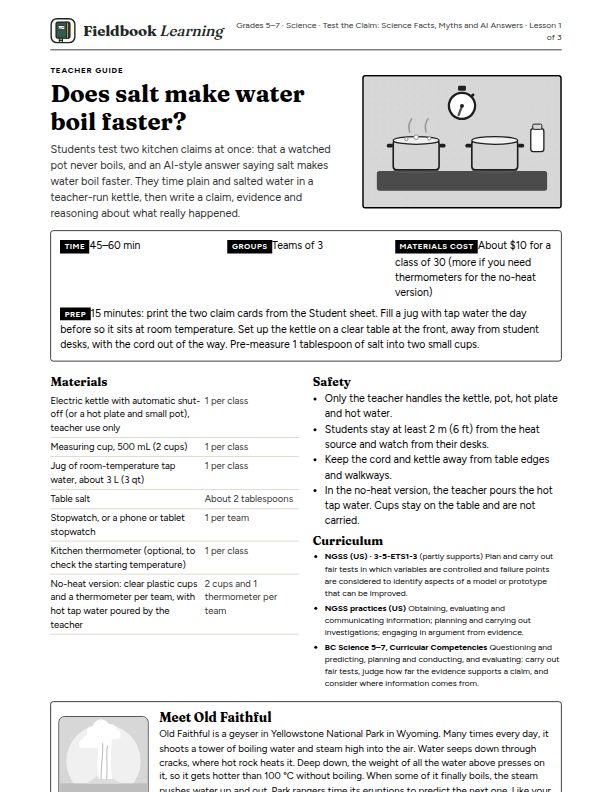 Grades 5–7 · Test the Claim: Science Facts, Myths and AI Answers · Lesson 1Does salt make water boil faster?Students test two kitchen claims at once: that a watched pot never boils, and an AI-style answer saying salt makes water boil faster. They time plain and salted water in a teacher-run kettle, then write a claim, evidence and reasoning about what really happened.45–60 min
 Grades 5–7 · Test the Claim: Science Facts, Myths and AI Answers · Lesson 2Is that AI answer true?Students get three printed AI chatbot answers to science questions, write a test for each, and run the two that fit in one class: dropping a full and an empty bottle, and melting ice in fresh and salty water. They grade each answer and explain why a confident answer still has to be checked.50–60 min
 Grades 5–7 · Test the Claim: Science Facts, Myths and AI Answers · Lesson 3Which source should we trust?Students compare four sources making the same claim about a paper towel: a study summary, an ad, a forum post and an AI chatbot answer. They rate the evidence behind each, then run a fair absorbency test to settle the question with their own data.50–60 min
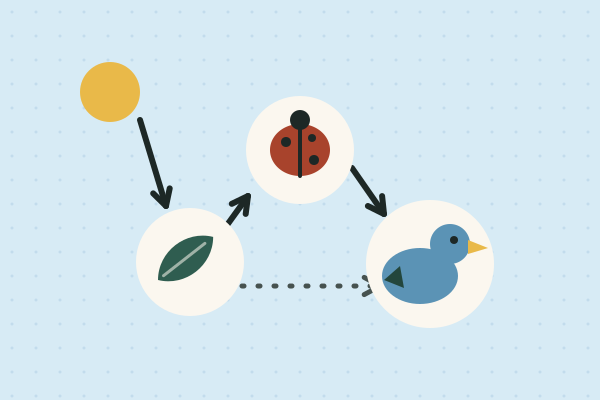
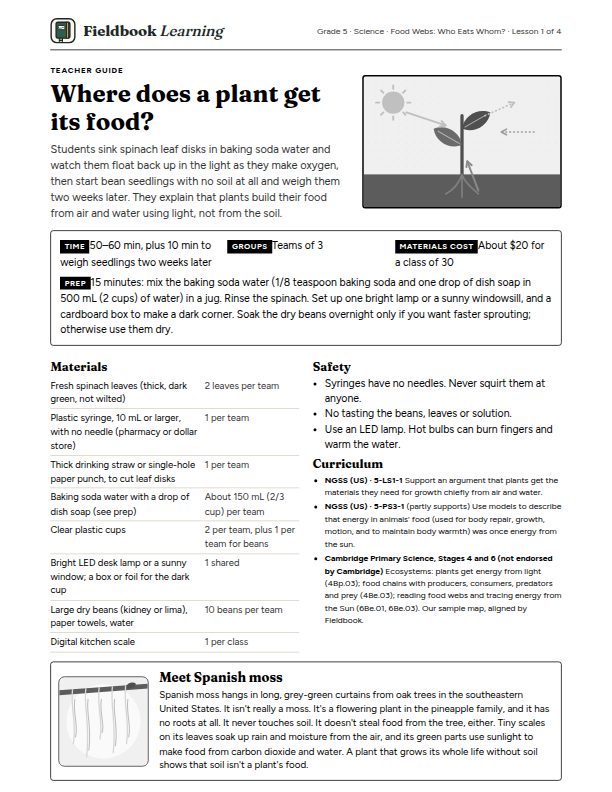 Grade 5 · Food Webs: Who Eats Whom? · Lesson 1Where does a plant get its food?Students sink spinach leaf disks in baking soda water and watch them float back up in the light as they make oxygen, then start bean seedlings with no soil at all and weigh them two weeks later. They explain that plants build their food from air and water using light, not from the soil.50–60 min, plus 10 min to weigh seedlings two weeks later
 Grade 5 · Food Webs: Who Eats Whom? · Lesson 2What would happen if the wolves disappeared?Students become species in a northern forest or a prairie and connect themselves with yarn into a living food web. When one species is removed, everyone who feels the yarn tug finds out how far the change spreads, and students explain why no species lives on its own.45–60 min
 Grade 5 · Food Webs: Who Eats Whom? · Lesson 3Who cleans up?Students seal bread and fruit in taped zip bags to watch mould grow without ever opening them, and bury mesh bags of dry leaves in soil to weigh what's left weeks later. They explain how decomposers break down dead things and return matter to the soil for plants to use again.45 min to set up, 5 min check-ins twice a week, then 30 min after 2 weeks (bread) and 20 min after 4 to 6 weeks (leaves)
 Grade 5 · Food Webs: Who Eats Whom? · Lesson 4Can we count the life under a log?Teams mark out a 1 m square in two different parts of the schoolyard, tally every kind of living thing they find, and compare the two sites. They explain which place supports more life and why, using the food webs and decomposers from earlier lessons.50–60 min
 Grade 4 · Your Senses: How Does Your Body Know? · Lesson 1Where is your skin most sensitive?Students use a bent paper clip to touch the skin with one point or two, and find the smallest gap they can feel as two on the fingertip, palm, back of the hand and forearm. Then they explain why fingertips are built for reading the world.45–60 min
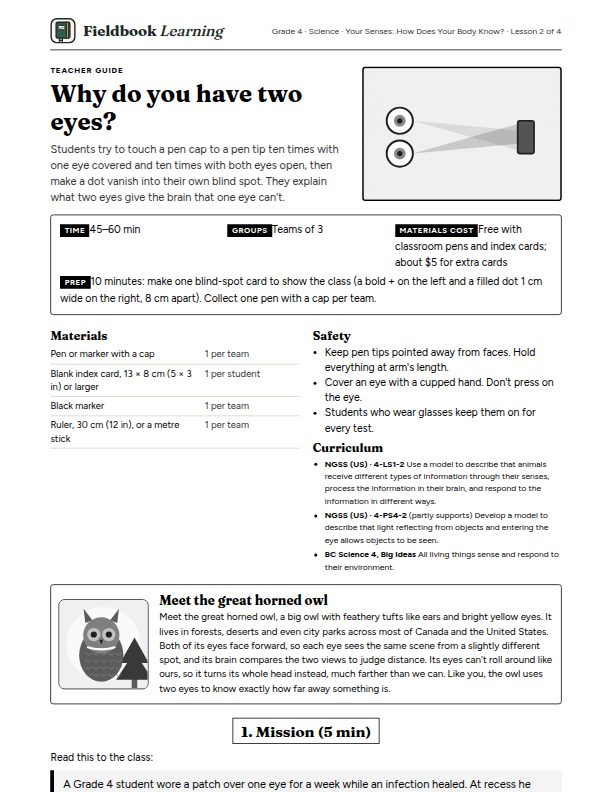 Grade 4 · Your Senses: How Does Your Body Know? · Lesson 2Why do you have two eyes?Students try to touch a pen cap to a pen tip ten times with one eye covered and ten times with both eyes open, then make a dot vanish into their own blind spot. They explain what two eyes give the brain that one eye can't.45–60 min
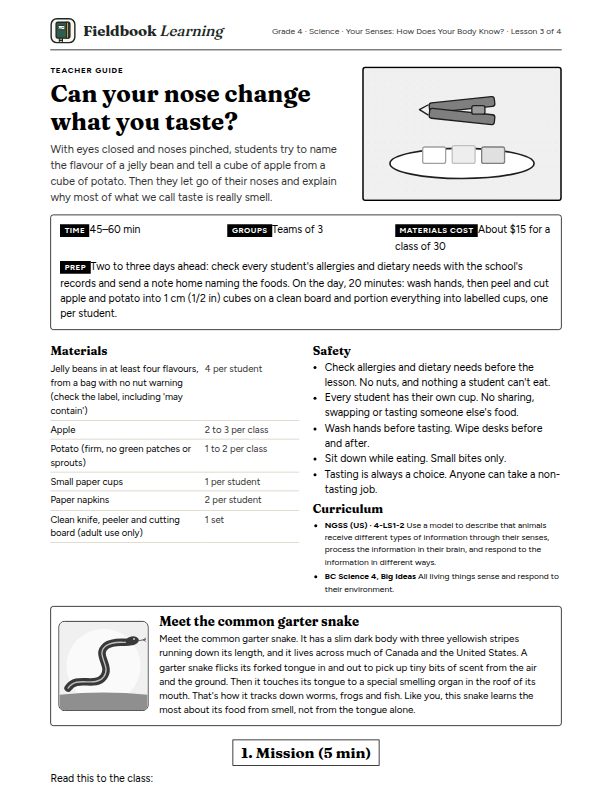 Grade 4 · Your Senses: How Does Your Body Know? · Lesson 3Can your nose change what you taste?With eyes closed and noses pinched, students try to name the flavour of a jelly bean and tell a cube of apple from a cube of potato. Then they let go of their noses and explain why most of what we call taste is really smell.45–60 min
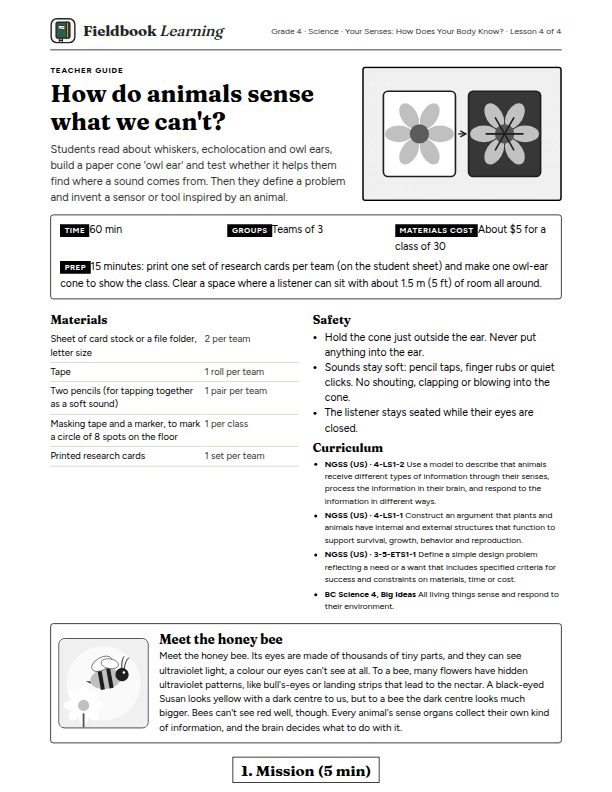 Grade 4 · Your Senses: How Does Your Body Know? · Lesson 4How do animals sense what we can't?Students read about whiskers, echolocation and owl ears, build a paper cone 'owl ear' and test whether it helps them find where a sound comes from. Then they define a problem and invent a sensor or tool inspired by an animal.60 min
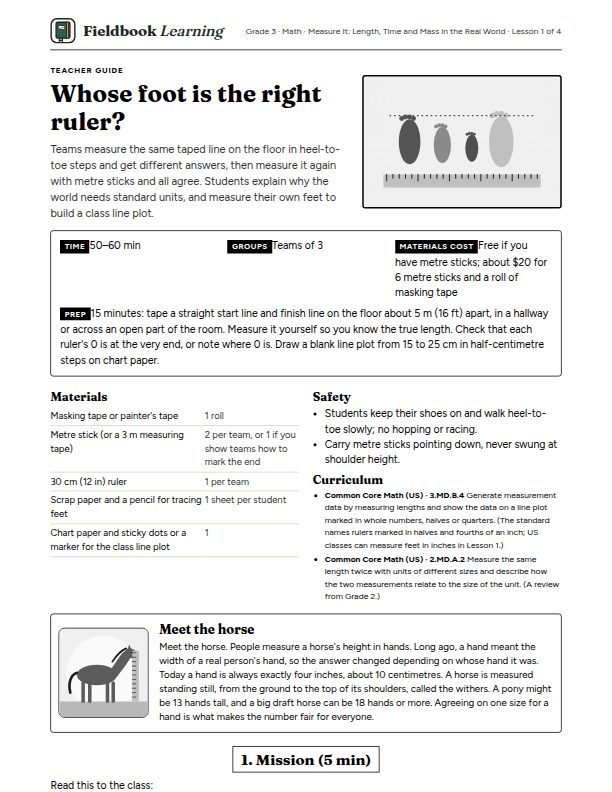 Grade 3 · Measure It: Length, Time and Mass in the Real World · Lesson 1Whose foot is the right ruler?Teams measure the same taped line on the floor in heel-to-toe steps and get different answers, then measure it again with metre sticks and all agree. Students explain why the world needs standard units, and measure their own feet to build a class line plot.50–60 min
 Grade 3 · Measure It: Length, Time and Mass in the Real World · Lesson 2How long is a minute, really?With eyes closed, students raise a hand when they think one minute has passed while a partner times them to the second. The class builds a line plot of its guesses, tries again with a counting strategy, then solves elapsed-time problems taken from its own school day.50–60 min
 Grade 3 · Measure It: Length, Time and Mass in the Real World · Lesson 3Which weighs more, a kilogram of feathers or a kilogram of rocks?Teams build a coat-hanger balance to compare classroom objects, estimate masses in grams and check them on a kitchen scale, then heft three bags that look very different but may or may not have the same mass. Students explain why size doesn't tell you mass.55–60 min
 Grade 3 · Measure It: Length, Time and Mass in the Real World · Lesson 4Can we design the best paper airplane?Teams fold a classic dart and their own design, fly each one five times from the same line, and measure every flight with a tape measure. Students find the middle value for each design, plot the class results, and use the data to argue which design really flies farther.55–60 min
 Grades 4–6 · Earth Day Investigations: Make Your School Better · Lesson 1What's in our garbage?Teams wear gloves to sort one day of classroom waste into landfill, recycling and compost, weigh each pile and graph the results. They use the numbers to recommend one change to the principal or caretaker.50–60 min
 Grades 4–6 · Earth Day Investigations: Make Your School Better · Lesson 2Where would a new tree help most?Teams measure air and ground temperature in sun and shade, on grass and on pavement, to see how much shade cools the schoolyard. They use their numbers to recommend where the school should plant a new tree.50–60 min
 Grades 4–6 · Earth Day Investigations: Make Your School Better · Lesson 3How much water does a dripping tap waste?The class counts drips per minute from a slow-dripping tap, catches and measures the water, then scales it up to a day and a year. Students use the math to recommend how the school should report and fix drips.45–60 min
 Grades 4–6 · Earth Day Investigations: Make Your School Better · Lesson 4Is our classroom wasting electricity?Students audit their classroom's lights and devices, check which are left on when nobody needs them, and read wattage labels to estimate the energy wasted in a school year. They finish with a poster or letter recommending one easy change.45–60 min
 Grades 4–5 · Sun, Earth and Moon · Lesson 1Why do we have day and night?Teams spin a ball in the beam of a flashlight and follow a sticker 'person' through sunrise, noon, sunset and midnight. They use the model to explain why it's breakfast time in Calgary while it's bedtime in Singapore.45–60 min
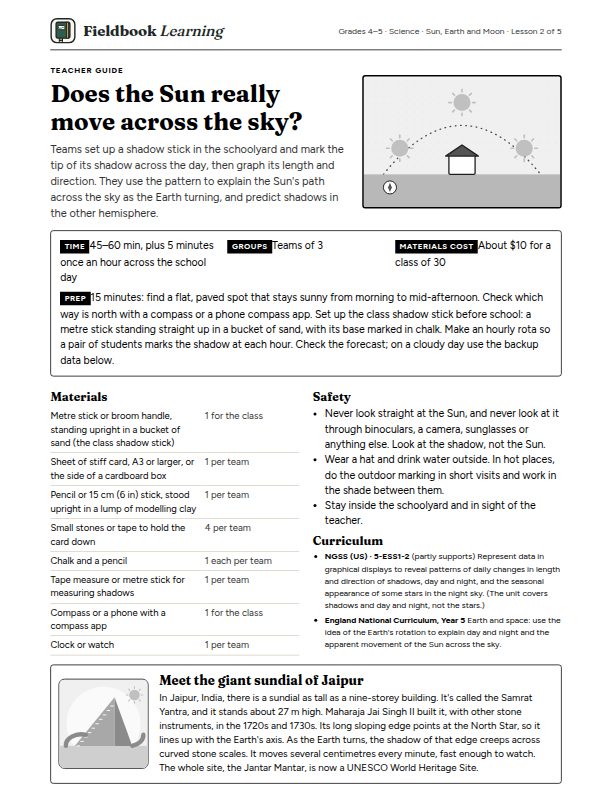 Grades 4–5 · Sun, Earth and Moon · Lesson 2Does the Sun really move across the sky?Teams set up a shadow stick in the schoolyard and mark the tip of its shadow across the day, then graph its length and direction. They use the pattern to explain the Sun's path across the sky as the Earth turning, and predict shadows in the other hemisphere.45–60 min, plus 5 minutes once an hour across the school day
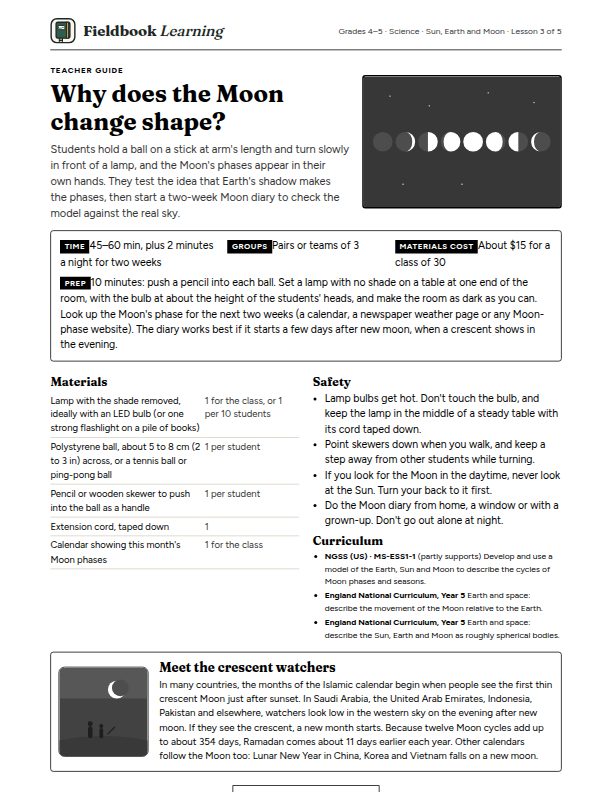 Grades 4–5 · Sun, Earth and Moon · Lesson 3Why does the Moon change shape?Students hold a ball on a stick at arm's length and turn slowly in front of a lamp, and the Moon's phases appear in their own hands. They test the idea that Earth's shadow makes the phases, then start a two-week Moon diary to check the model against the real sky.45–60 min, plus 2 minutes a night for two weeks
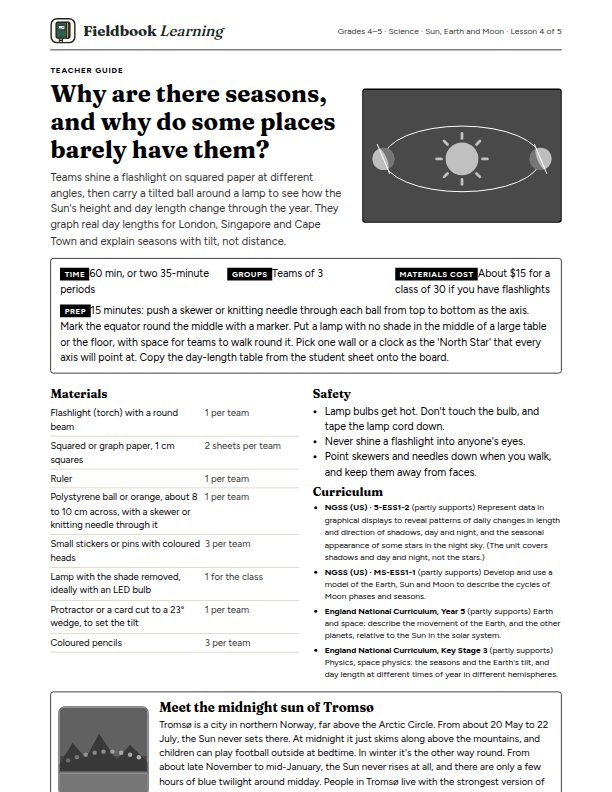 Grades 4–5 · Sun, Earth and Moon · Lesson 4Why are there seasons, and why do some places barely have them?Teams shine a flashlight on squared paper at different angles, then carry a tilted ball around a lamp to see how the Sun's height and day length change through the year. They graph real day lengths for London, Singapore and Cape Town and explain seasons with tilt, not distance.60 min, or two 35-minute periods
 Grades 4–5 · Sun, Earth and Moon · Lesson 5How far away is the Sun, really?Teams build the Sun, Earth and Moon to one scale, with an exercise ball, a peppercorn and a grain of salt, then pace out the real distances on the school field. They use the model and a flashlight test to argue why the Sun looks so much bigger and brighter than any other star.50–60 min
 Grades 3–5 · How Your Body Works · Lesson 1Why does your heart beat faster when you run?Students find their pulse, count it at rest, after a minute of star jumps and every minute while it comes back down, then graph the recovery. They use the pattern to explain the heart as a pump that sends oxygen and food to working muscles.45–60 min
 Grades 3–5 · How Your Body Works · Lesson 2What happens to your lunch?Teams build a working model of the gut: teeth (a fork), a stomach (a bag with water and vinegar) and an intestine (a stocking squeezed over a tray), and follow a cracker through it. They check their own teeth in a mirror and put the parts of the digestive system in order, with a job for each.45–60 min
 Grades 3–5 · How Your Body Works · Lesson 3How does your arm bend?Teams build an elbow from card, a paper fastener and two strings, and find that it will only bend if one string pulls while the other goes slack. They feel their own biceps and triceps swap jobs while lifting a bag of rice, and explain why muscles always work in pairs.45–60 min
 Grades 3–5 · How Your Body Works · Lesson 4Where do germs hide?Students put glitter gel 'germs' on one hand, shake hands down a line and count how far the glitter travels. Then they run a fair test of handwashing (water only, soap for 5 seconds, soap for 20 seconds) and score each hand by counting the glitter that is left, to find what really gets germs off.45–60 min
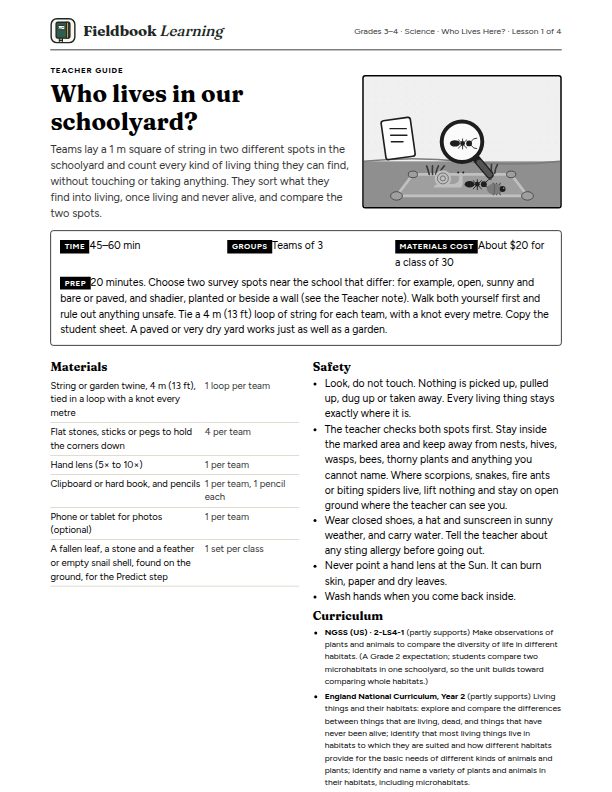 Grades 3–4 · Who Lives Here? · Lesson 1Who lives in our schoolyard?Teams lay a 1 m square of string in two different spots in the schoolyard and count every kind of living thing they can find, without touching or taking anything. They sort what they find into living, once living and never alive, and compare the two spots.45–60 min
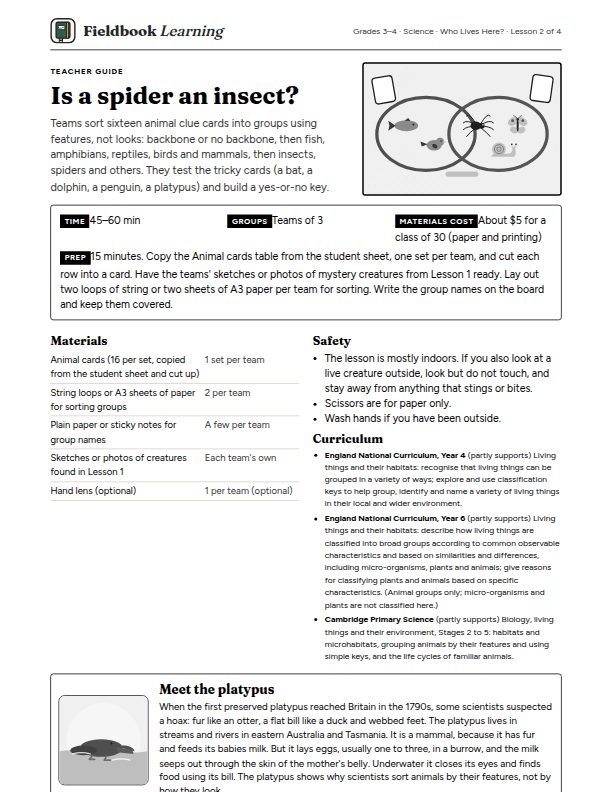 Grades 3–4 · Who Lives Here? · Lesson 2Is a spider an insect?Teams sort sixteen animal clue cards into groups using features, not looks: backbone or no backbone, then fish, amphibians, reptiles, birds and mammals, then insects, spiders and others. They test the tricky cards (a bat, a dolphin, a penguin, a platypus) and build a yes-or-no key.45–60 min
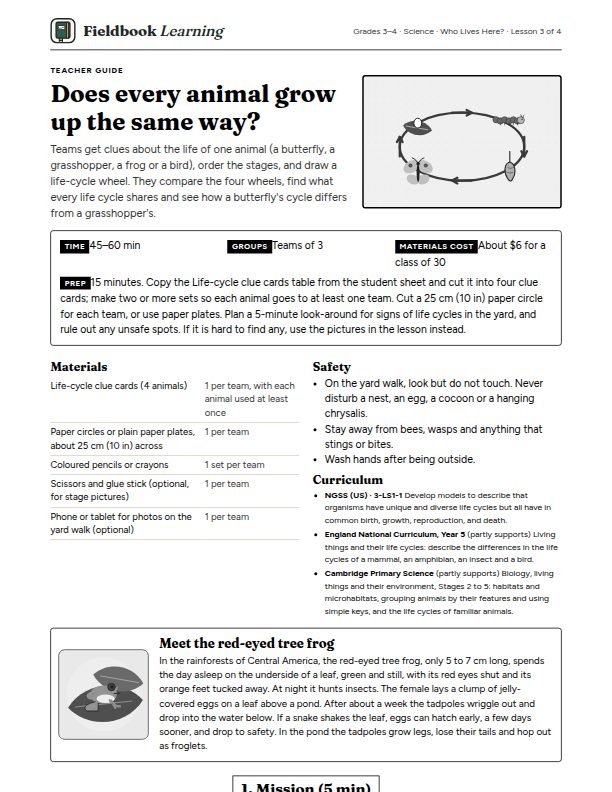 Grades 3–4 · Who Lives Here? · Lesson 3Does every animal grow up the same way?Teams get clues about the life of one animal (a butterfly, a grasshopper, a frog or a bird), order the stages, and draw a life-cycle wheel. They compare the four wheels, find what every life cycle shares and see how a butterfly's cycle differs from a grasshopper's.45–60 min
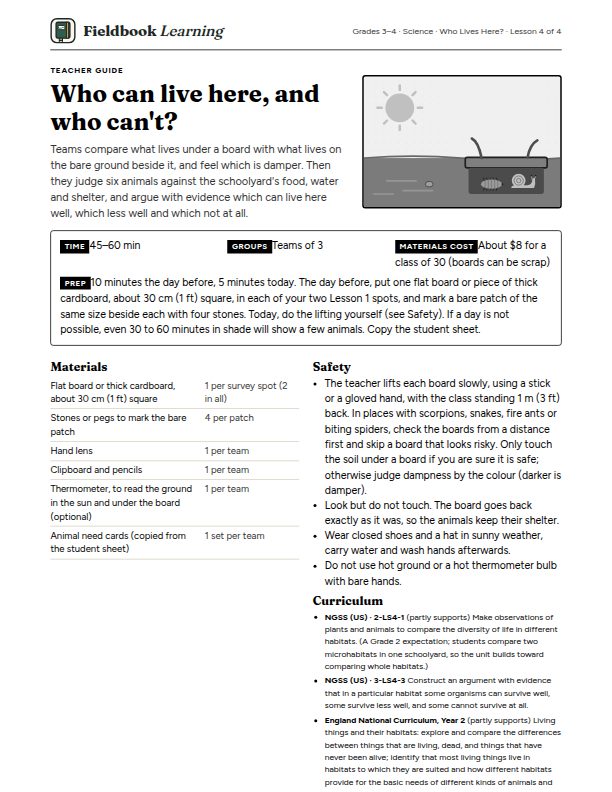 Grades 3–4 · Who Lives Here? · Lesson 4Who can live here, and who can't?Teams compare what lives under a board with what lives on the bare ground beside it, and feel which is damper. Then they judge six animals against the schoolyard's food, water and shelter, and argue with evidence which can live here well, which less well and which not at all.45–60 min
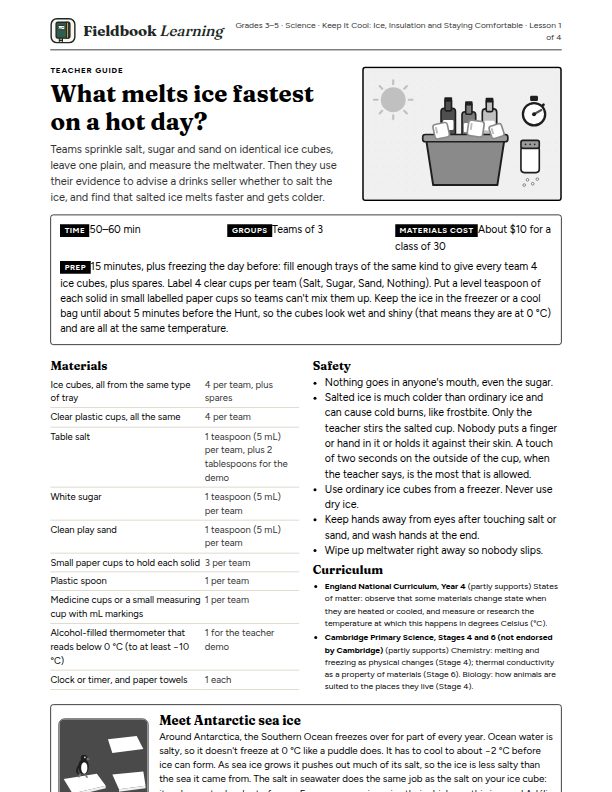 Grades 3–5 · Keep It Cool: Ice, Insulation and Staying Comfortable · Lesson 1What melts ice fastest on a hot day?Teams sprinkle salt, sugar and sand on identical ice cubes, leave one plain, and measure the meltwater. Then they use their evidence to advise a drinks seller whether to salt the ice, and find that salted ice melts faster and gets colder.50–60 min
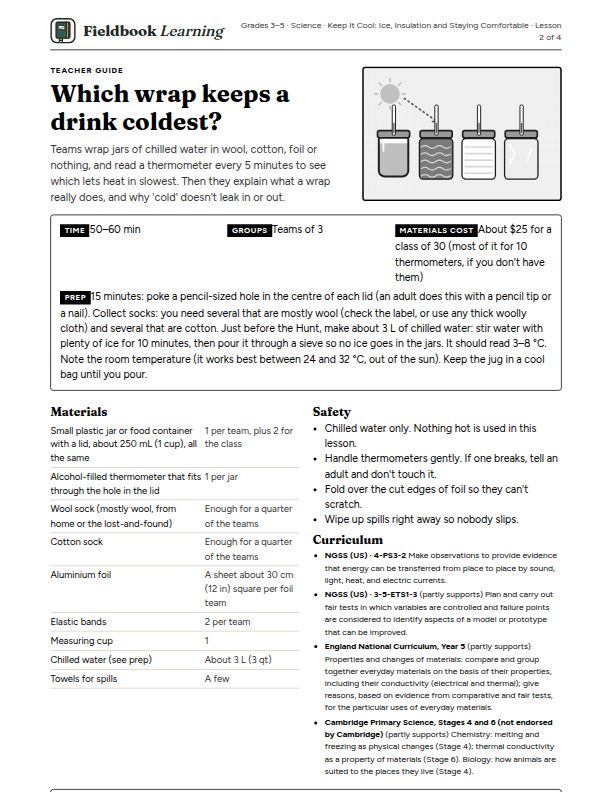 Grades 3–5 · Keep It Cool: Ice, Insulation and Staying Comfortable · Lesson 2Which wrap keeps a drink coldest?Teams wrap jars of chilled water in wool, cotton, foil or nothing, and read a thermometer every 5 minutes to see which lets heat in slowest. Then they explain what a wrap really does, and why 'cold' doesn't leak in or out.50–60 min
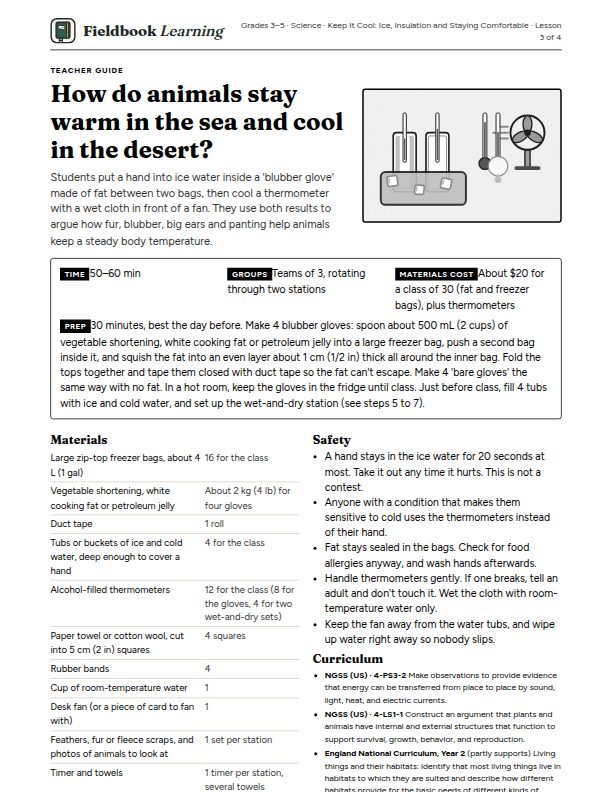 Grades 3–5 · Keep It Cool: Ice, Insulation and Staying Comfortable · Lesson 3How do animals stay warm in the sea and cool in the desert?Students put a hand into ice water inside a 'blubber glove' made of fat between two bags, then cool a thermometer with a wet cloth in front of a fan. They use both results to argue how fur, blubber, big ears and panting help animals keep a steady body temperature.50–60 min
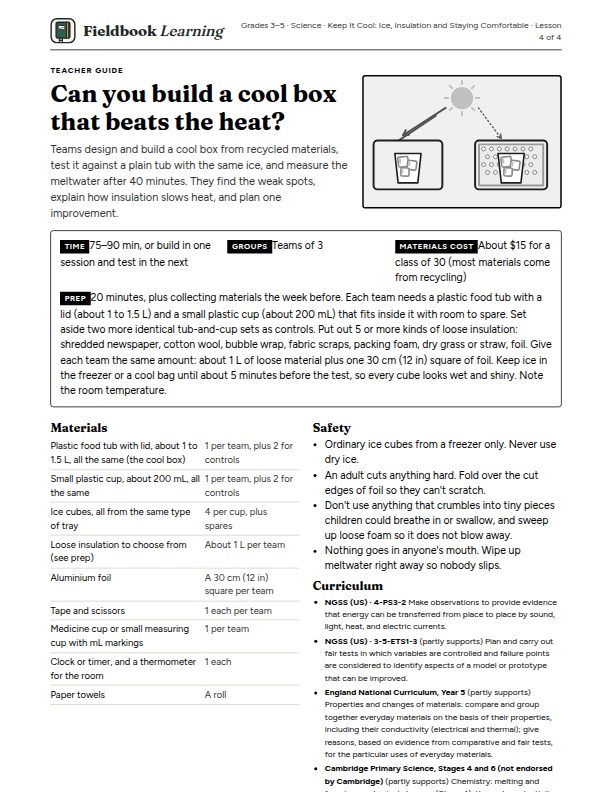 Grades 3–5 · Keep It Cool: Ice, Insulation and Staying Comfortable · Lesson 4Can you build a cool box that beats the heat?Teams design and build a cool box from recycled materials, test it against a plain tub with the same ice, and measure the meltwater after 40 minutes. They find the weak spots, explain how insulation slows heat, and plan one improvement.75–90 min, or build in one session and test in the next
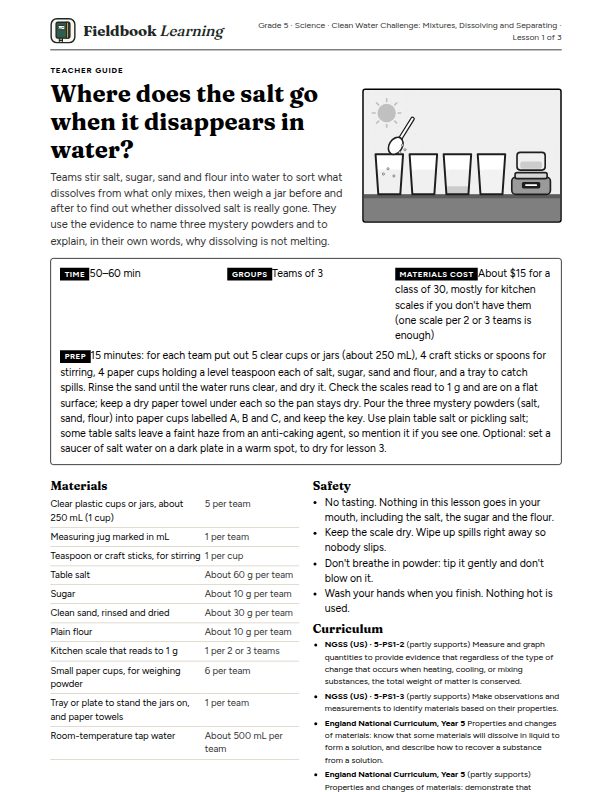 Grade 5 · Clean Water Challenge: Mixtures, Dissolving and Separating · Lesson 1Where does the salt go when it disappears in water?Teams stir salt, sugar, sand and flour into water to sort what dissolves from what only mixes, then weigh a jar before and after to find out whether dissolved salt is really gone. They use the evidence to name three mystery powders and to explain, in their own words, why dissolving is not melting.50–60 min
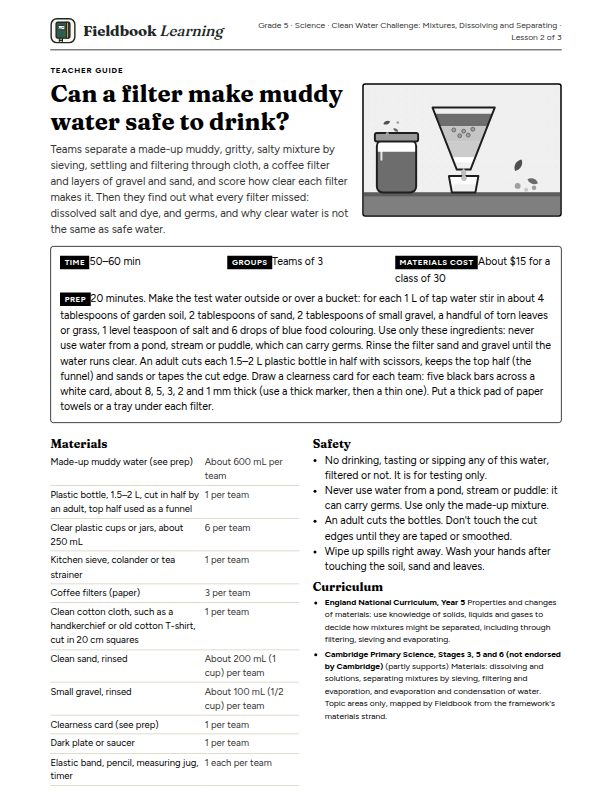 Grade 5 · Clean Water Challenge: Mixtures, Dissolving and Separating · Lesson 2Can a filter make muddy water safe to drink?Teams separate a made-up muddy, gritty, salty mixture by sieving, settling and filtering through cloth, a coffee filter and layers of gravel and sand, and score how clear each filter makes it. Then they find out what every filter missed: dissolved salt and dye, and germs, and why clear water is not the same as safe water.50–60 min
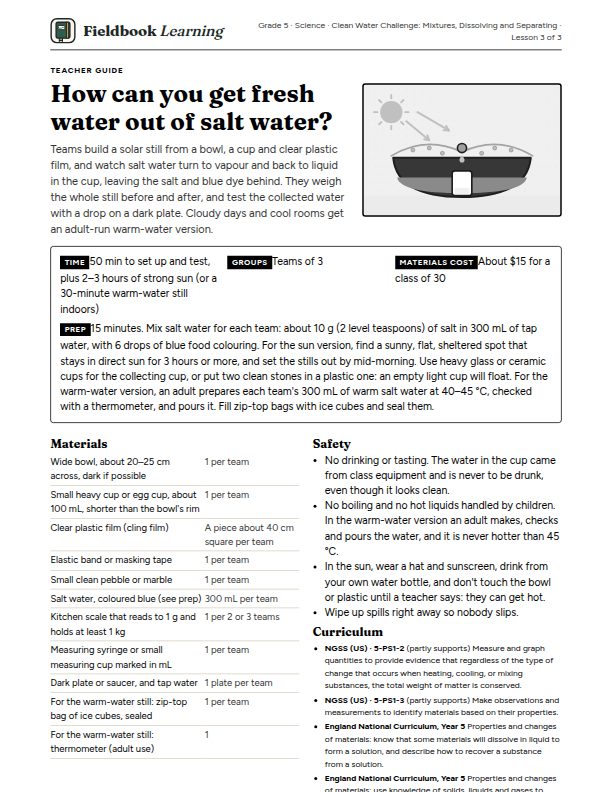 Grade 5 · Clean Water Challenge: Mixtures, Dissolving and Separating · Lesson 3How can you get fresh water out of salt water?Teams build a solar still from a bowl, a cup and clear plastic film, and watch salt water turn to vapour and back to liquid in the cup, leaving the salt and blue dye behind. They weigh the whole still before and after, and test the collected water with a drop on a dark plate. Cloudy days and cool rooms get an adult-run warm-water version.50 min to set up and test, plus 2–3 hours of strong sun (or a 30-minute warm-water still indoors)
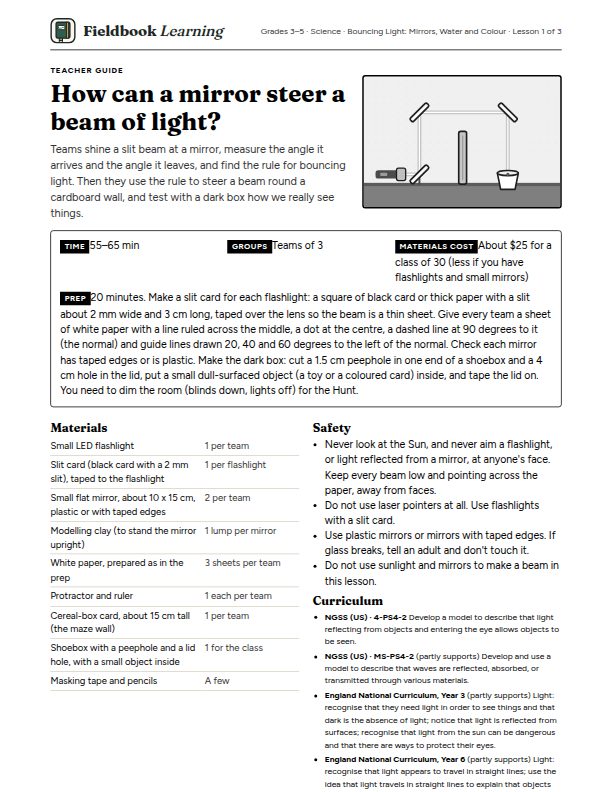 Grades 3–5 · Bouncing Light: Mirrors, Water and Colour · Lesson 1How can a mirror steer a beam of light?Teams shine a slit beam at a mirror, measure the angle it arrives and the angle it leaves, and find the rule for bouncing light. Then they use the rule to steer a beam round a cardboard wall, and test with a dark box how we really see things.55–65 min
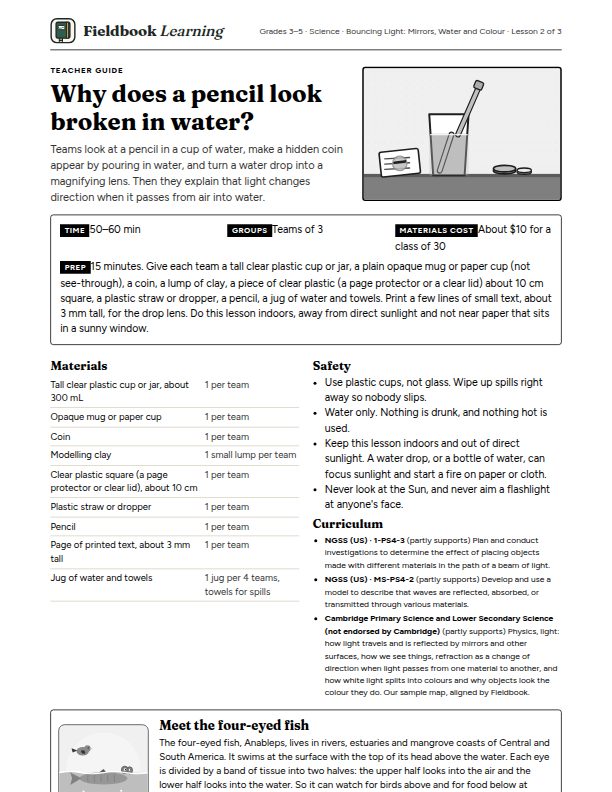 Grades 3–5 · Bouncing Light: Mirrors, Water and Colour · Lesson 2Why does a pencil look broken in water?Teams look at a pencil in a cup of water, make a hidden coin appear by pouring in water, and turn a water drop into a magnifying lens. Then they explain that light changes direction when it passes from air into water.50–60 min
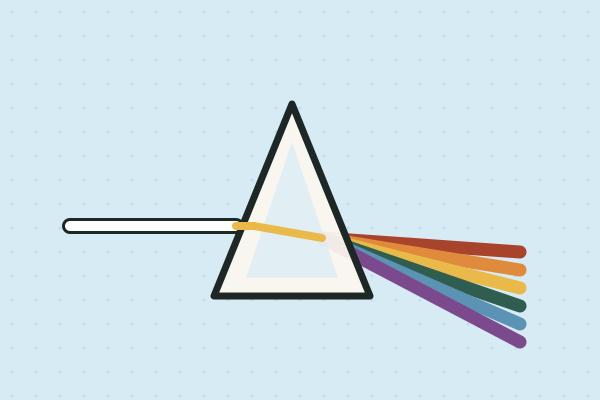
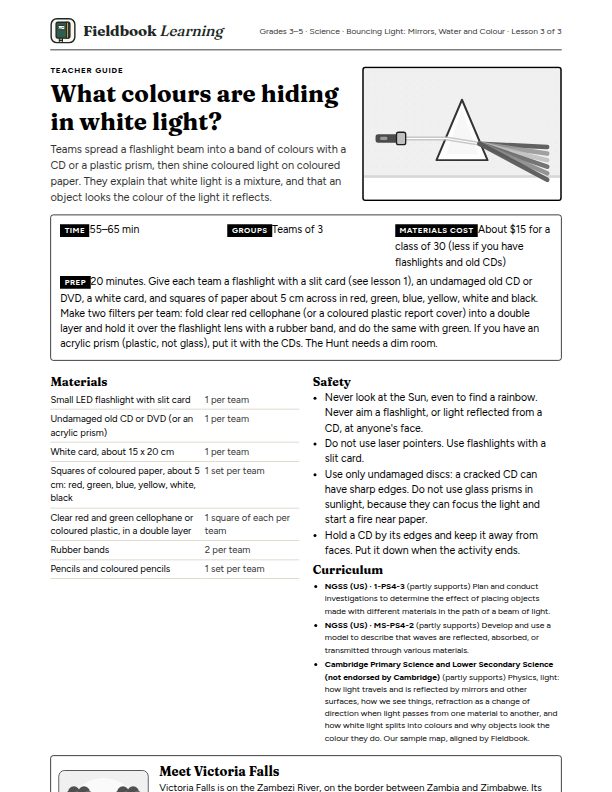 Grades 3–5 · Bouncing Light: Mirrors, Water and Colour · Lesson 3What colours are hiding in white light?Teams spread a flashlight beam into a band of colours with a CD or a plastic prism, then shine coloured light on coloured paper. They explain that white light is a mixture, and that an object looks the colour of the light it reflects.55–65 min
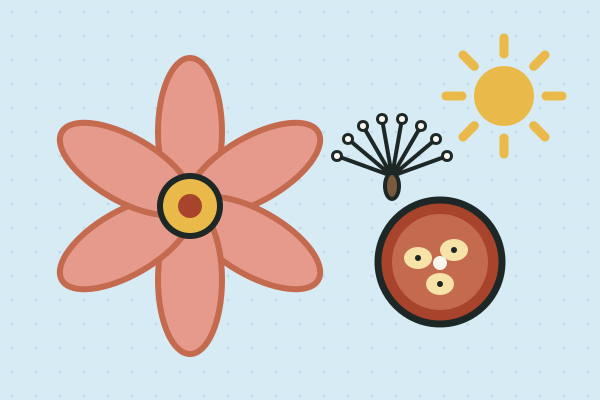
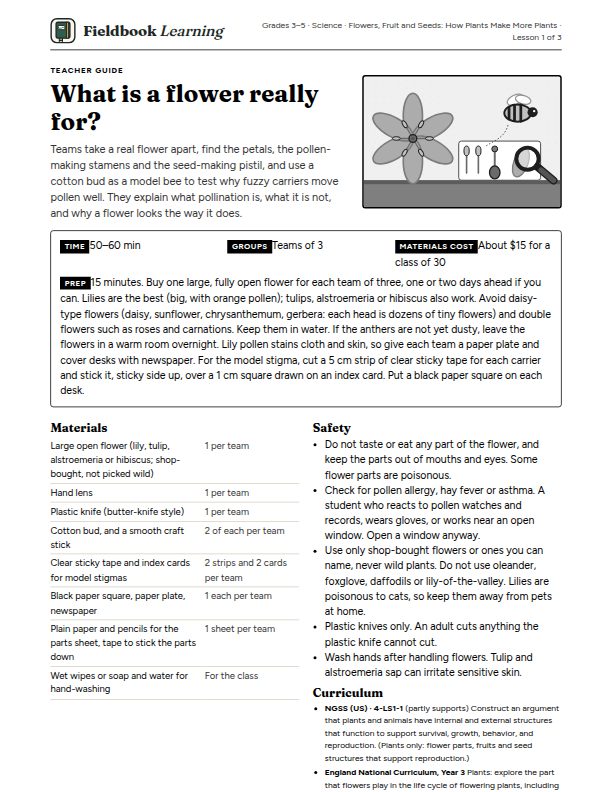 Grades 3–5 · Flowers, Fruit and Seeds: How Plants Make More Plants · Lesson 1What is a flower really for?Teams take a real flower apart, find the petals, the pollen-making stamens and the seed-making pistil, and use a cotton bud as a model bee to test why fuzzy carriers move pollen well. They explain what pollination is, what it is not, and why a flower looks the way it does.50–60 min
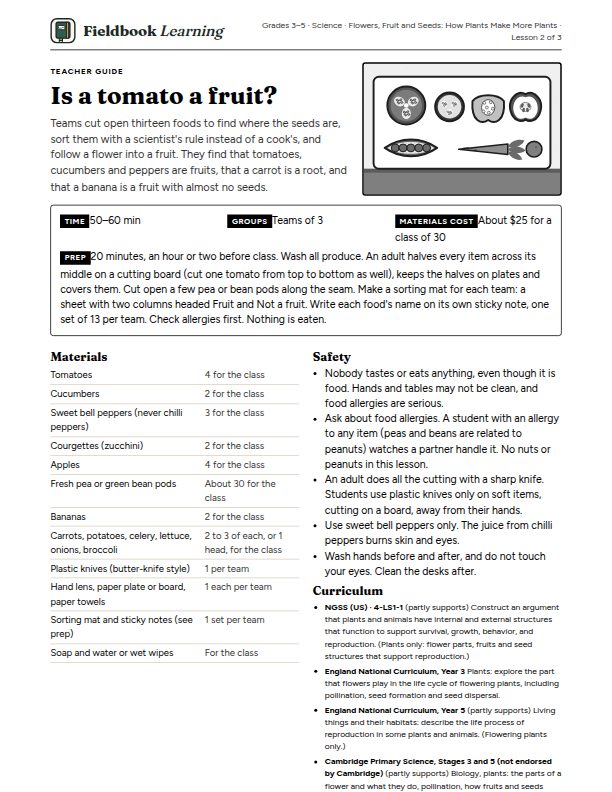 Grades 3–5 · Flowers, Fruit and Seeds: How Plants Make More Plants · Lesson 2Is a tomato a fruit?Teams cut open thirteen foods to find where the seeds are, sort them with a scientist's rule instead of a cook's, and follow a flower into a fruit. They find that tomatoes, cucumbers and peppers are fruits, that a carrot is a root, and that a banana is a fruit with almost no seeds.50–60 min
 Grades 3–5 · Flowers, Fruit and Seeds: How Plants Make More Plants · Lesson 3How can a seed travel without legs?Teams build a model seed for wind, water or animals, carrying the same clay seed, and test every model with a fair drop, fan, float and wool test. They find that no design wins every test, and explain how real seeds are shaped for the way they travel.60–75 min
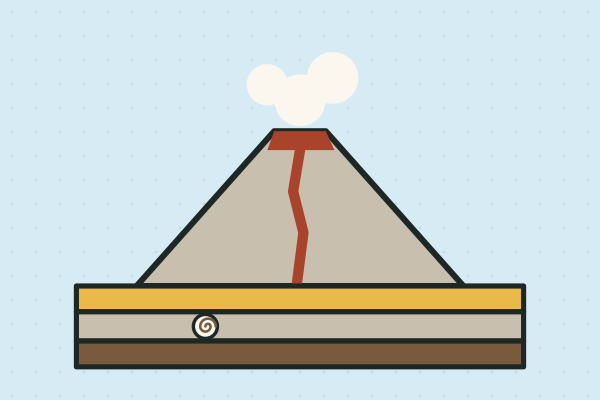
 Grades 4–7 · Restless Earth: Fossils, Soils, Volcanoes and Plates · Lesson 1How do fossils form, and what can they tell us?Teams press shells and leaves into clay to make a mould and a salt-dough cast, build a cliff of coloured layers with a different model fossil in each, and swap cliffs to work out which layer is oldest. They then read a cliff of real fossils and explain that a place once under the sea is now dry land.55–70 min
 Grades 4–7 · Restless Earth: Fossils, Soils, Volcanoes and Plates · Lesson 2What is soil made of?Teams shake a sample of soil in a jar of water, let it settle, and measure the layers of sand, silt and clay with floating plant bits on top. They rub the soil between their fingers to feel the grains, then use their results to choose the best soil for a garden bed.45–55 min, plus two 5-minute checks later
 Grades 4–7 · Restless Earth: Fossils, Soils, Volcanoes and Plates · Lesson 3Where do volcanoes and earthquakes happen?Teams plot twenty-two real volcanoes and earthquakes from a data table onto a world map using latitude and longitude. They join the dots, find the lines and rings they make, and use the pattern to say which of three cities is most likely to feel earthquakes.50–60 min
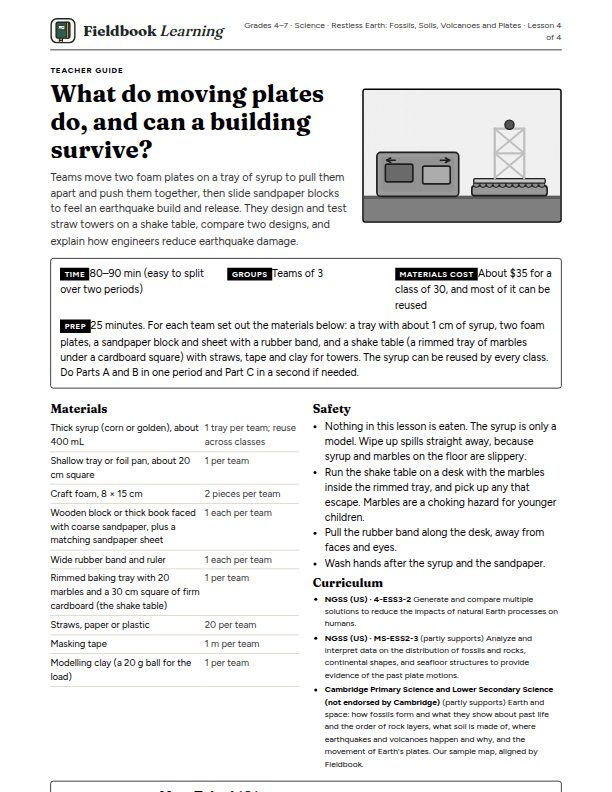 Grades 4–7 · Restless Earth: Fossils, Soils, Volcanoes and Plates · Lesson 4What do moving plates do, and can a building survive?Teams move two foam plates on a tray of syrup to pull them apart and push them together, then slide sandpaper blocks to feel an earthquake build and release. They design and test straw towers on a shake table, compare two designs, and explain how engineers reduce earthquake damage.80–90 min (easy to split over two periods)
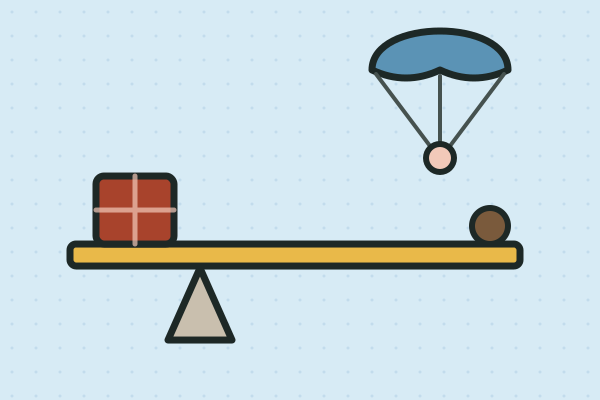
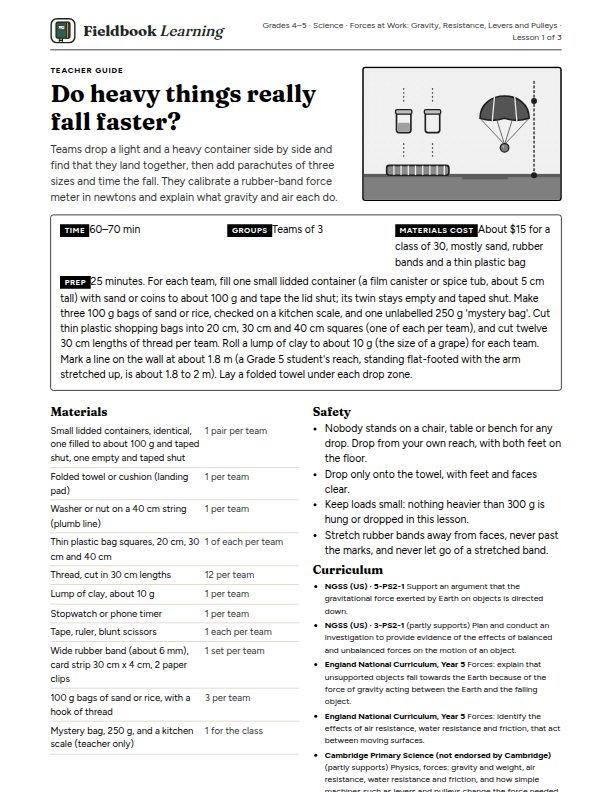 Grades 4–5 · Forces at Work: Gravity, Resistance, Levers and Pulleys · Lesson 1Do heavy things really fall faster?Teams drop a light and a heavy container side by side and find that they land together, then add parachutes of three sizes and time the fall. They calibrate a rubber-band force meter in newtons and explain what gravity and air each do.60–70 min
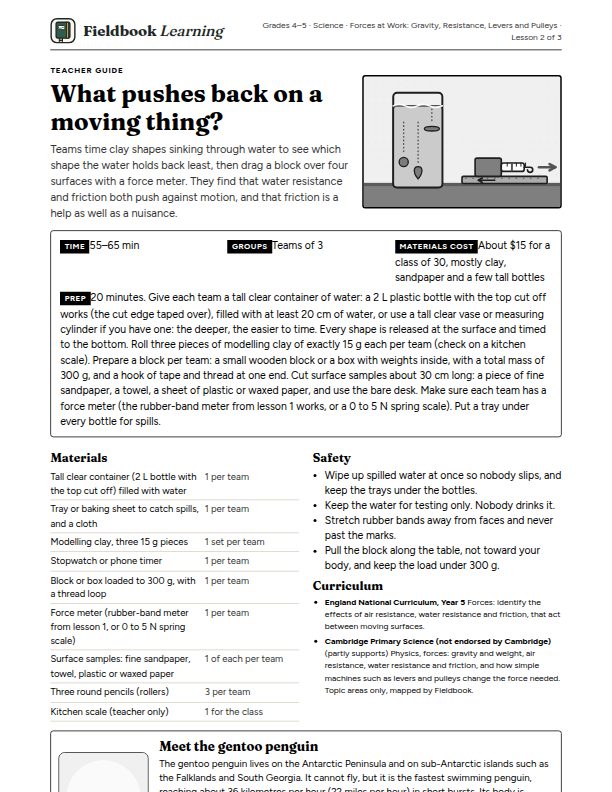 Grades 4–5 · Forces at Work: Gravity, Resistance, Levers and Pulleys · Lesson 2What pushes back on a moving thing?Teams time clay shapes sinking through water to see which shape the water holds back least, then drag a block over four surfaces with a force meter. They find that water resistance and friction both push against motion, and that friction is a help as well as a nuisance.55–65 min
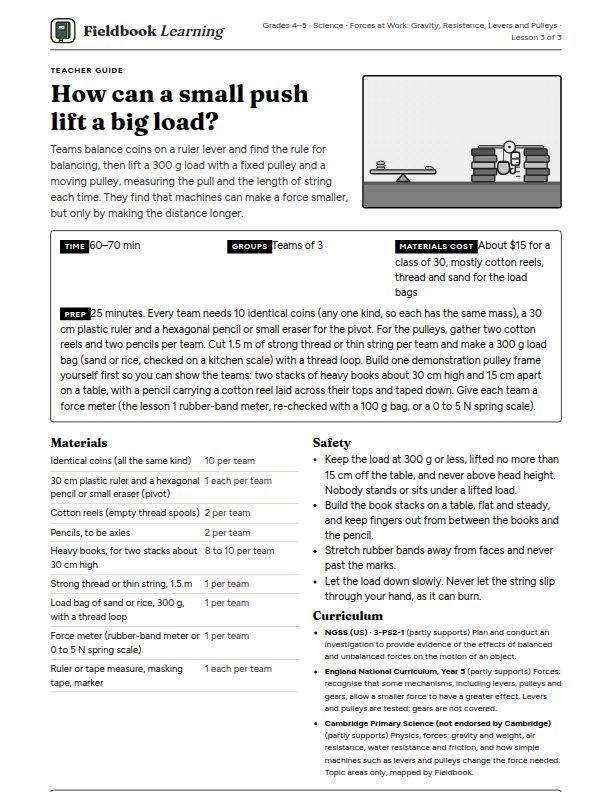 Grades 4–5 · Forces at Work: Gravity, Resistance, Levers and Pulleys · Lesson 3How can a small push lift a big load?Teams balance coins on a ruler lever and find the rule for balancing, then lift a 300 g load with a fixed pulley and a moving pulley, measuring the pull and the length of string each time. They find that machines can make a force smaller, but only by making the distance longer.60–70 min
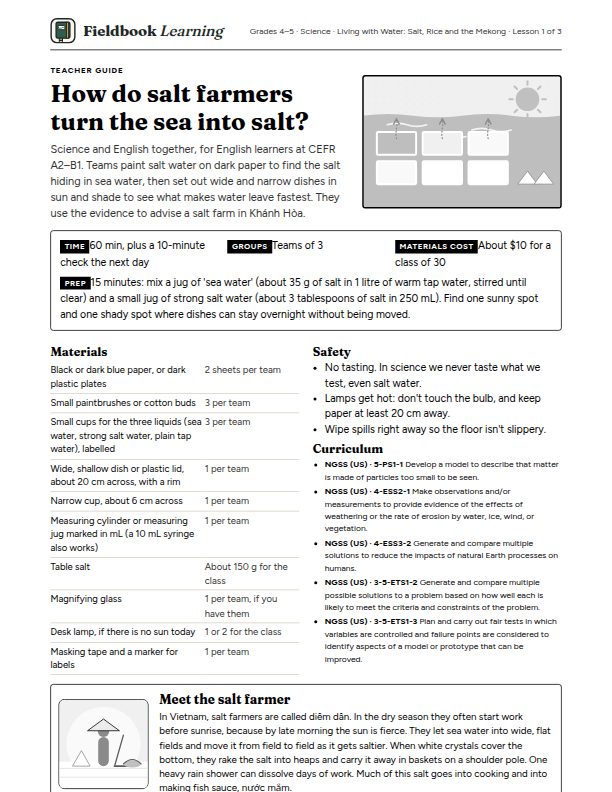 Grades 4–5 · Living with Water: Salt, Rice and the Mekong · Lesson 1How do salt farmers turn the sea into salt?Science and English together, for English learners at CEFR A2–B1. Teams paint salt water on dark paper to find the salt hiding in sea water, then set out wide and narrow dishes in sun and shade to see what makes water leave fastest. They use the evidence to advise a salt farm in Khánh Hòa.60 min, plus a 10-minute check the next day
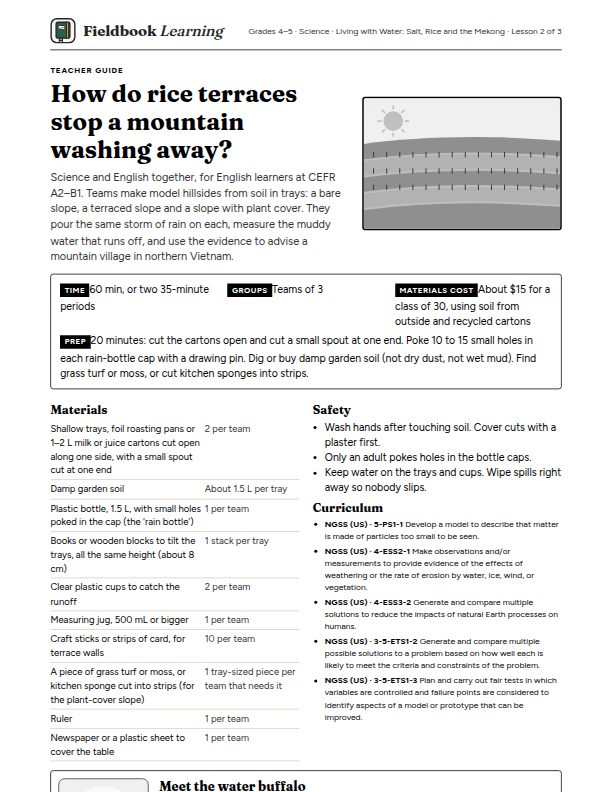 Grades 4–5 · Living with Water: Salt, Rice and the Mekong · Lesson 2How do rice terraces stop a mountain washing away?Science and English together, for English learners at CEFR A2–B1. Teams make model hillsides from soil in trays: a bare slope, a terraced slope and a slope with plant cover. They pour the same storm of rain on each, measure the muddy water that runs off, and use the evidence to advise a mountain village in northern Vietnam.60 min, or two 35-minute periods
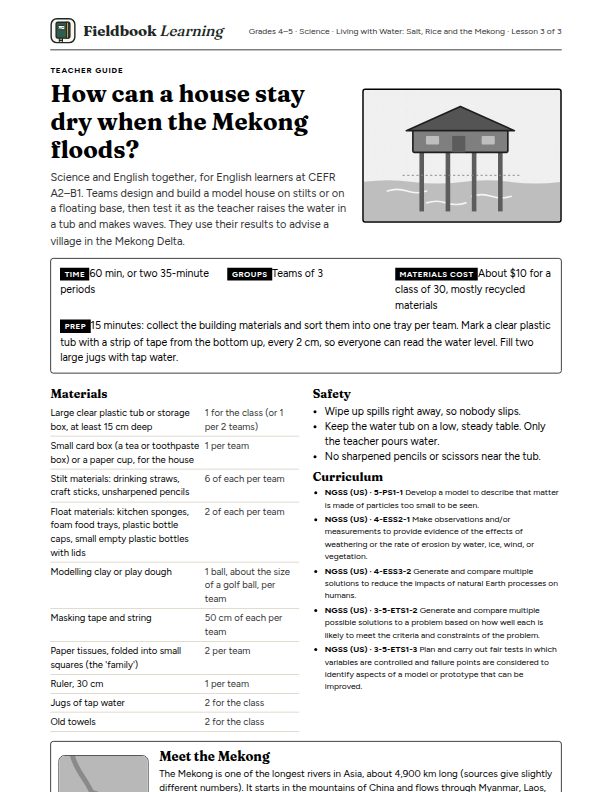 Grades 4–5 · Living with Water: Salt, Rice and the Mekong · Lesson 3How can a house stay dry when the Mekong floods?Science and English together, for English learners at CEFR A2–B1. Teams design and build a model house on stilts or on a floating base, then test it as the teacher raises the water in a tub and makes waves. They use their results to advise a village in the Mekong Delta.60 min, or two 35-minute periods
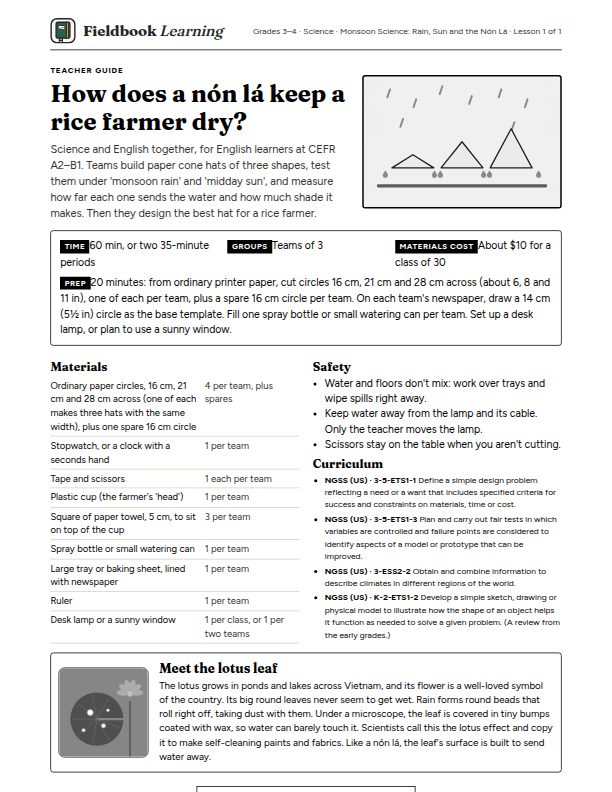 Grades 3–4 · Monsoon Science: Rain, Sun and the Nón Lá · Lesson 1How does a nón lá keep a rice farmer dry?Science and English together, for English learners at CEFR A2–B1. Teams build paper cone hats of three shapes, test them under 'monsoon rain' and 'midday sun', and measure how far each one sends the water and how much shade it makes. Then they design the best hat for a rice farmer.60 min, or two 35-minute periods
 Grade 6 · Hot and Cold: Particles on the Move · Lesson 1Why do bike tires go soft in winter?Students stretch a balloon over a bottle, move it between warm and ice water, and find out what happens to air particles when they cool down. Then they explain a cyclist's 'flat' tire on the first cold morning.45–60 min
 Grade 6 · Hot and Cold: Particles on the Move · Lesson 2Why does food colouring spread faster in hot water?Two cups, two drops, one race. Students drop food colouring into warm and ice-cold water at the same moment, then explain what the moving colour tells us about particles they can't see.45–60 min
 Grade 6 · Hot and Cold: Particles on the Move · Lesson 3How does a thermometer know?Teams build a working thermometer from a bottle of coloured water and a clear straw, then calibrate it against a real thermometer. At the end, they explain how any liquid thermometer 'knows' the temperature.50–60 min
 Grade 6 · Hot and Cold: Particles on the Move · Lesson 4Why do sidewalks have cracks on purpose?Students loosen a stuck jar lid with warm water, then go on a gap hunt around the school to find and measure the joints engineers build into sidewalks, walls and railings. They explain why solid things need room to grow and shrink.50–60 min
 Grade 6 · Hot and Cold: Particles on the Move · Lesson 5Can you keep an ice cube frozen the longest?A design challenge with insulation, a budget and a class leaderboard. Teams build an ice cube keeper, measure how much melted, and explain why the best designs slow down heat moving in.60 min, plus a 40-minute wait (teach something else while the ice sits)
 Grade 6 · Power Up: Where Electricity Comes From · Lesson 1Where does our classroom's electricity come from?Students trace the classroom light switch back to a power plant, then look up the real mix of energy sources for their own province or state and turn it into a 100-square chart. They explain why different places make electricity in different ways.50–60 min
 Grade 6 · Power Up: Where Electricity Comes From · Lesson 2Can the wind power our school?Teams build a paper wind machine that winds up a string and lifts paper clips, then test one change to the blades to see which design does the most work. They use their results to explain what a real wind farm needs.55–65 min
 Grade 6 · Power Up: Where Electricity Comes From · Lesson 3Why don't we use solar power everywhere?Students shine a flashlight onto grid paper at different angles and through 'clouds' to see why sunlight is weaker in winter, then compare day lengths for their own town. They weigh solar power's strengths and limits like an energy planner.50–60 min
 Grade 6 · Climate Clues · Lesson 1Is this winter colder than when your grandparents were kids?Students compare January temperatures from the 1960s with the last ten years, using their own town's records. They find out why memories and single years can mislead, and how averages show the real pattern.50–60 min
 Grade 6 · Climate Clues · Lesson 2What can a tree ring tell us?Students count and measure the rings in a real slice of tree, match ring widths to rainfall, and compare old and new photographs of a glacier. They explain how nature keeps records of past climate long before anyone owned a thermometer.50–60 min
 Grade 6 · Climate Clues · Lesson 3What's the difference between weather and climate?A cold week versus a cold century. Students sort evidence cards into weather and climate, then roll dice to make a month of 'weather' and see how a small shift in climate still allows cold days. They settle the argument with evidence.45–60 min
 Grades 7–8 · Kitchen Chemistry · Lesson 1Is it a new substance?Teams run six quick kitchen changes, from dissolving sugar to curdling milk, and record properties before and after. They sort each change as physical or chemical using evidence, and find out why a single clue like bubbles or a colour change isn't proof on its own.50–60 min
 Grades 7–8 · Kitchen Chemistry · Lesson 2Where does the mass go?Teams weigh baking soda and vinegar reacting in an open cup, then in a capped pop bottle. The open cup gets lighter and the capped bottle doesn't, until they open it. Students use atoms to explain why mass is never lost in a reaction, only let out.50–60 min
 Grades 7–8 · Kitchen Chemistry · Lesson 3Can red cabbage tell acid from base?Students add purple cabbage juice to safe household liquids and watch it turn pink, purple, blue or green. They build a colour scale, sort the liquids into acids and bases, identify two mystery liquids, and watch an acid and a base cancel each other out.50–60 min
 Grade 8 · Forces and Motion: Crash, Push and Stop · Lesson 1Why do you lurch forward when a bus stops?Students flick a card out from under a coin, then crash toy cars carrying loose clay passengers into a barrier and measure how far the passenger flies. They use their data to explain inertia and to design a better seatbelt.50–60 min
 Grade 8 · Forces and Motion: Crash, Push and Stop · Lesson 2How fast is a toy car really going?Teams time a toy car over measured distances from two ramp heights, calculate its speed and draw distance-time graphs. They use the slope of their graphs to argue which run was faster, and convert a toy car's speed to a real car's.50–60 min
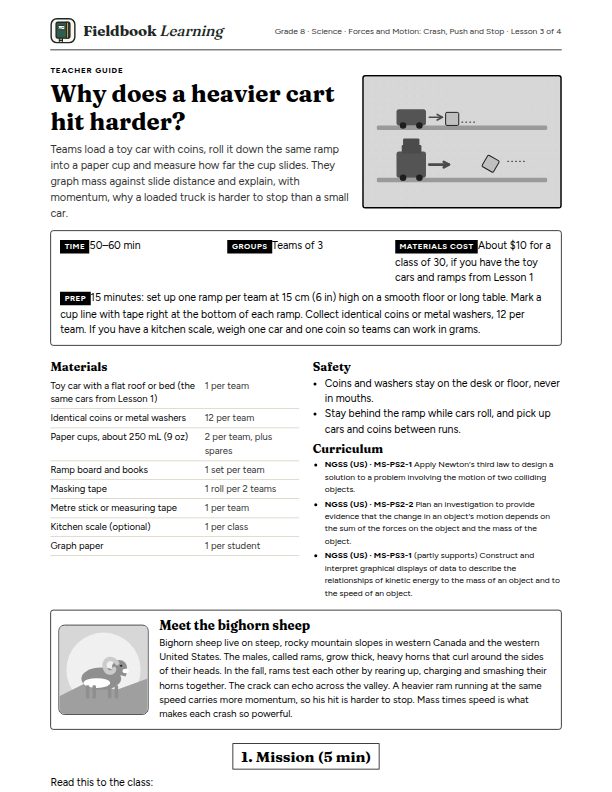 Grade 8 · Forces and Motion: Crash, Push and Stop · Lesson 3Why does a heavier cart hit harder?Teams load a toy car with coins, roll it down the same ramp into a paper cup and measure how far the cup slides. They graph mass against slide distance and explain, with momentum, why a loaded truck is harder to stop than a small car.50–60 min
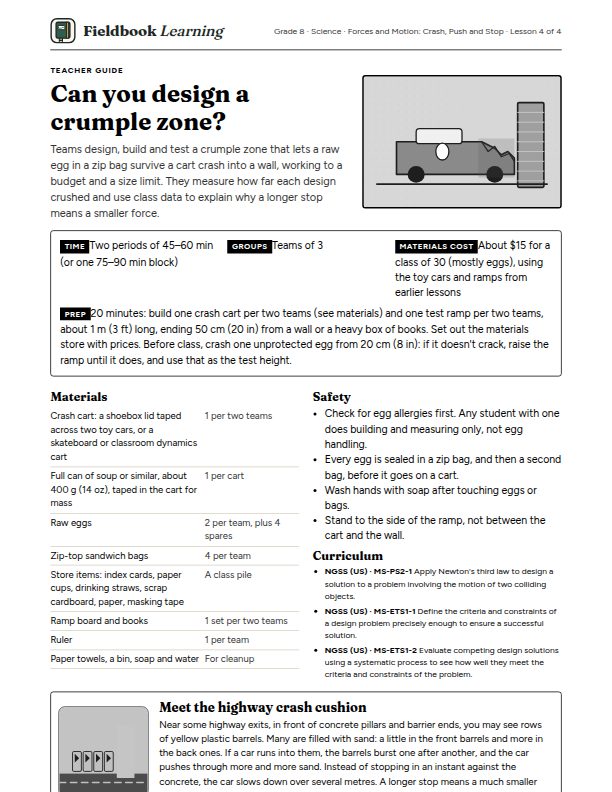 Grade 8 · Forces and Motion: Crash, Push and Stop · Lesson 4Can you design a crumple zone?Teams design, build and test a crumple zone that lets a raw egg in a zip bag survive a cart crash into a wall, working to a budget and a size limit. They measure how far each design crushed and use class data to explain why a longer stop means a smaller force.Two periods of 45–60 min (or one 75–90 min block)
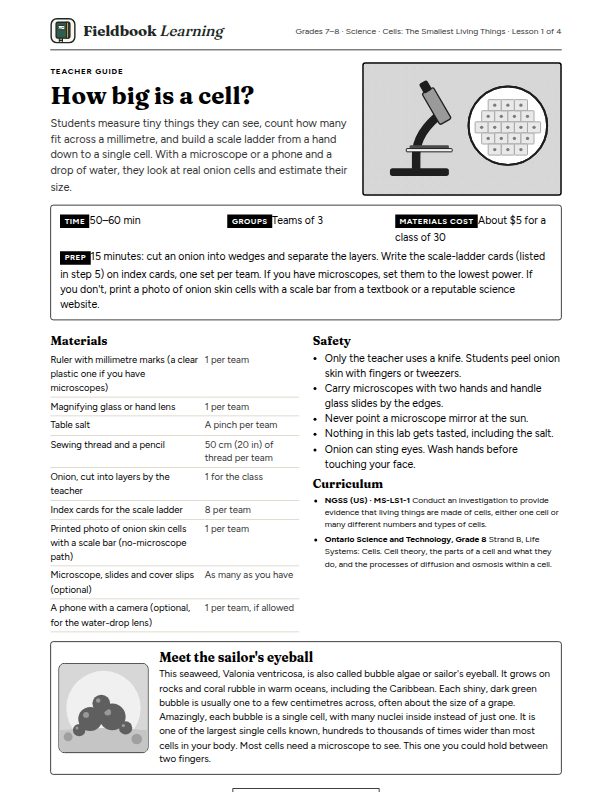 Grades 7–8 · Cells: The Smallest Living Things · Lesson 1How big is a cell?Students measure tiny things they can see, count how many fit across a millimetre, and build a scale ladder from a hand down to a single cell. With a microscope or a phone and a drop of water, they look at real onion cells and estimate their size.50–60 min
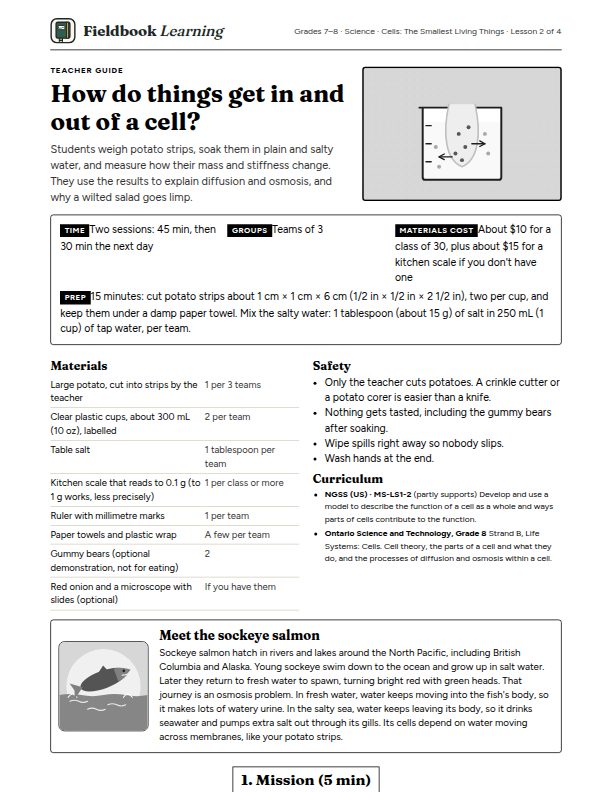 Grades 7–8 · Cells: The Smallest Living Things · Lesson 2How do things get in and out of a cell?Students weigh potato strips, soak them in plain and salty water, and measure how their mass and stiffness change. They use the results to explain diffusion and osmosis, and why a wilted salad goes limp.Two sessions: 45 min, then 30 min the next day
 Grades 7–8 · Cells: The Smallest Living Things · Lesson 3Can you pull DNA out of a strawberry?Students mash strawberries with dish soap and salt, filter the juice, and watch a cloudy white tangle of DNA appear when the teacher layers cold rubbing alcohol on top. They explain what each ingredient did to the cell, and test what happens without soap.50–60 min
 Grades 7–8 · Cells: The Smallest Living Things · Lesson 4Why are you made of many small cells, not one big one?Students soak gelatin cubes of 1, 2 and 3 cm in food colouring, cut them open and measure how far the colour got in. They calculate surface area to volume and explain why cells stay small.50–60 min, with cubes soaking for at least an hour
 Grades 6–7 · Stone, Bamboo and Storms: Building in Vietnam · Lesson 1How did rain carve the islands of Hạ Long Bay?Science and English together, for English learners at CEFR B1. Teams drop limestone and shells into vinegar, water and soda water, watch for bubbles and weigh what is left the next day. Then they use the evidence to explain to a tour boat guide how weak acid in rain carved the towers and caves of Hạ Long Bay.60 min, plus 15 minutes the next day
 Grades 6–7 · Stone, Bamboo and Storms: Building in Vietnam · Lesson 2Why do builders in Vietnam trust bamboo?Science and English together, for English learners at CEFR B1. Teams make four beams from identical sheets of paper (a flat sheet, a solid rod, a hollow tube and a tube with 'nodes'), load each one with water until it bends, and work out strength per gram. Then they use the evidence to explain why bamboo is shaped the way it is, and design a bamboo footbridge.60 min, or two 35-minute periods
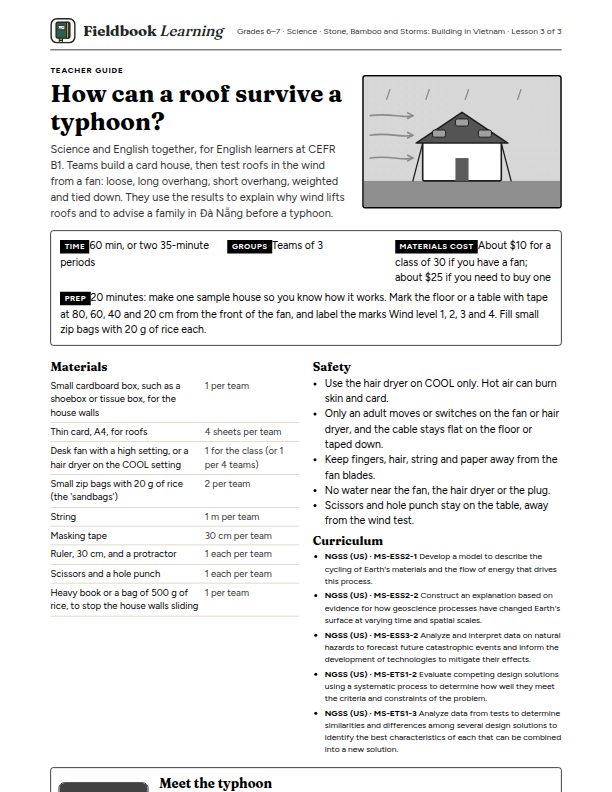 Grades 6–7 · Stone, Bamboo and Storms: Building in Vietnam · Lesson 3How can a roof survive a typhoon?Science and English together, for English learners at CEFR B1. Teams build a card house, then test roofs in the wind from a fan: loose, long overhang, short overhang, weighted and tied down. They use the results to explain why wind lifts roofs and to advise a family in Đà Nẵng before a typhoon.60 min, or two 35-minute periods
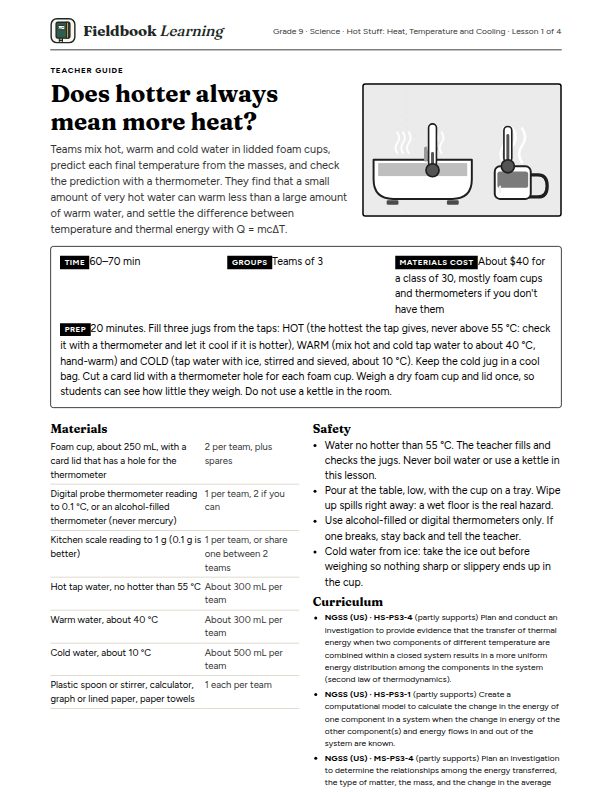 Grade 9 · Hot Stuff: Heat, Temperature and Cooling · Lesson 1Does hotter always mean more heat?Teams mix hot, warm and cold water in lidded foam cups, predict each final temperature from the masses, and check the prediction with a thermometer. They find that a small amount of very hot water can warm less than a large amount of warm water, and settle the difference between temperature and thermal energy with Q = mcΔT.60–70 min
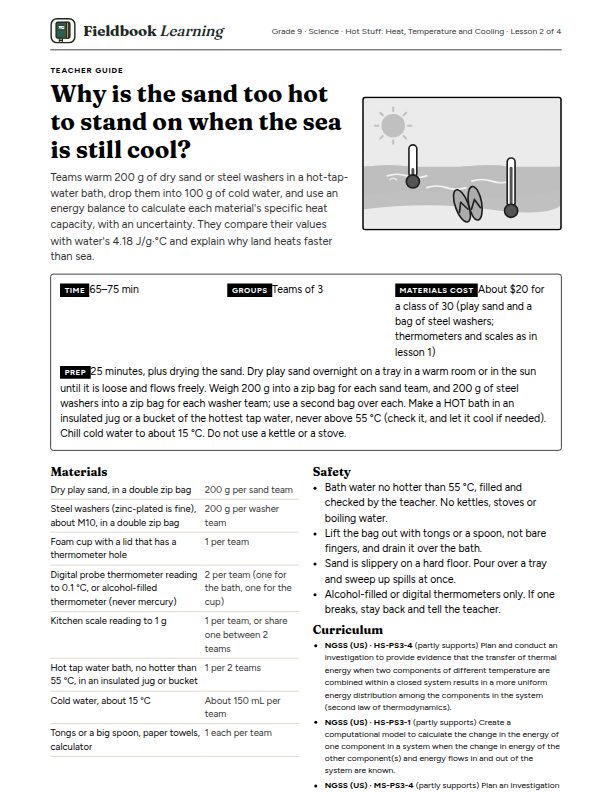 Grade 9 · Hot Stuff: Heat, Temperature and Cooling · Lesson 2Why is the sand too hot to stand on when the sea is still cool?Teams warm 200 g of dry sand or steel washers in a hot-tap-water bath, drop them into 100 g of cold water, and use an energy balance to calculate each material's specific heat capacity, with an uncertainty. They compare their values with water's 4.18 J/g·°C and explain why land heats faster than sea.65–75 min
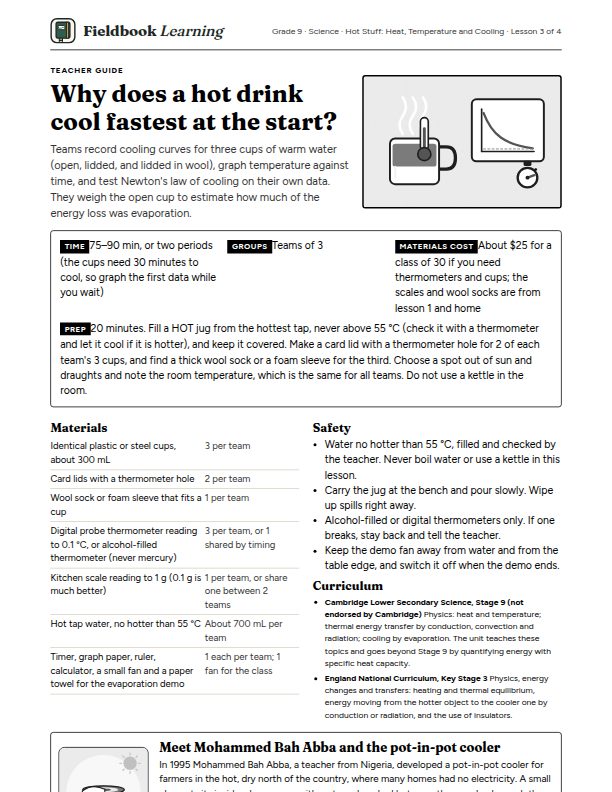 Grade 9 · Hot Stuff: Heat, Temperature and Cooling · Lesson 3Why does a hot drink cool fastest at the start?Teams record cooling curves for three cups of warm water (open, lidded, and lidded in wool), graph temperature against time, and test Newton's law of cooling on their own data. They weigh the open cup to estimate how much of the energy loss was evaporation.75–90 min, or two periods (the cups need 30 minutes to cool, so graph the first data while you wait)
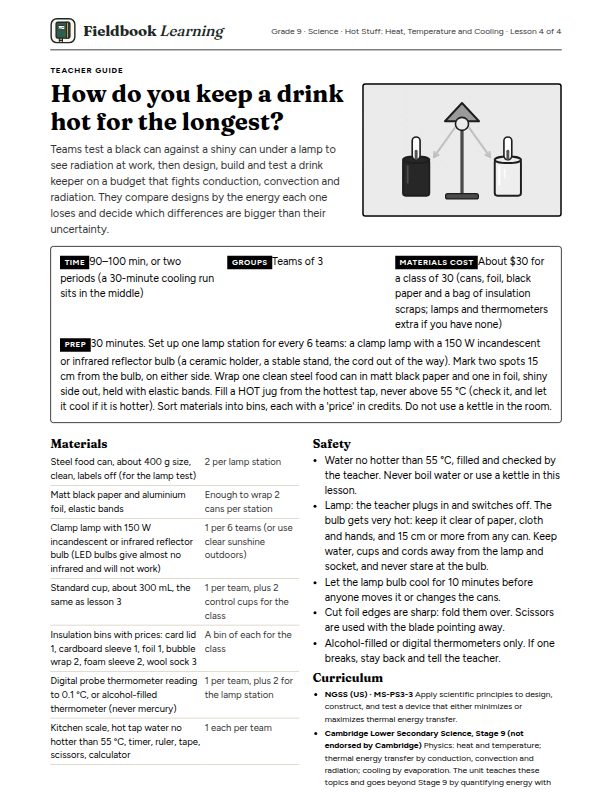 Grade 9 · Hot Stuff: Heat, Temperature and Cooling · Lesson 4How do you keep a drink hot for the longest?Teams test a black can against a shiny can under a lamp to see radiation at work, then design, build and test a drink keeper on a budget that fights conduction, convection and radiation. They compare designs by the energy each one loses and decide which differences are bigger than their uncertainty.90–100 min, or two periods (a 30-minute cooling run sits in the middle)
Nothing matches yet. Try fewer words or a different grade, or . Looking for something we don't have? Tell us what you need next.