Who Lives Here?
A schoolyard survey with string squares and hand lenses, sorting animals by their features, life cycles from caterpillar to butterfly, and who can live in which habitat. Students look, count and sketch but never collect or harm. Works in any climate and any country, in a garden, on pavement or in a desert.
Or try any 3 lessons free with an account.
Already bought it? Download the whole unit as one printable workbook: cover, contents, curriculum connections, every lesson, readings, practice pages, a unit test and an answer key, in black and white.
4 lessons in this unit
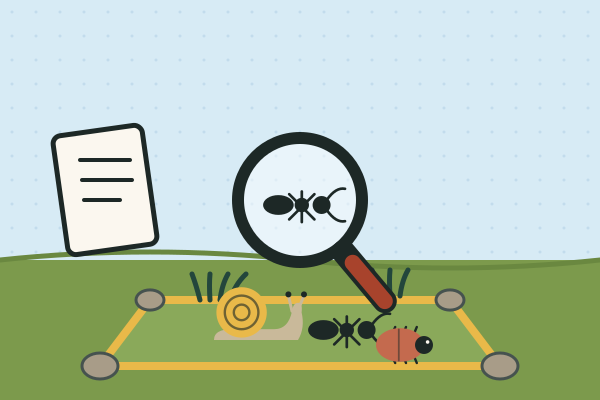 Lesson 1 · 45–60 minWho lives in our schoolyard?Teams lay a 1 m square of string in two different spots in the schoolyard and count every kind of living thing they can find, without touching or taking anything. They sort what they find into living, once living and never alive, and compare the two spots.
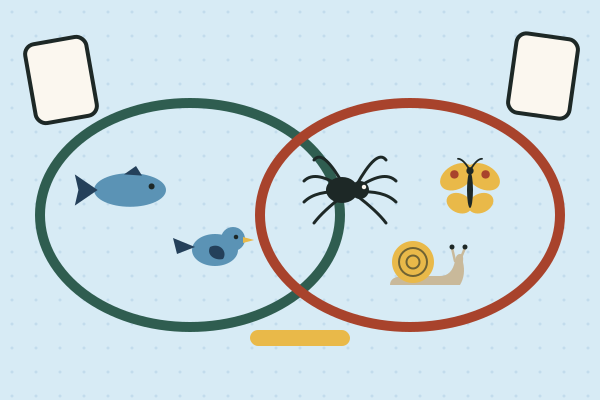 Lesson 2 · 45–60 minIs a spider an insect?Teams sort sixteen animal clue cards into groups using features, not looks: backbone or no backbone, then fish, amphibians, reptiles, birds and mammals, then insects, spiders and others. They test the tricky cards (a bat, a dolphin, a penguin, a platypus) and build a yes-or-no key.
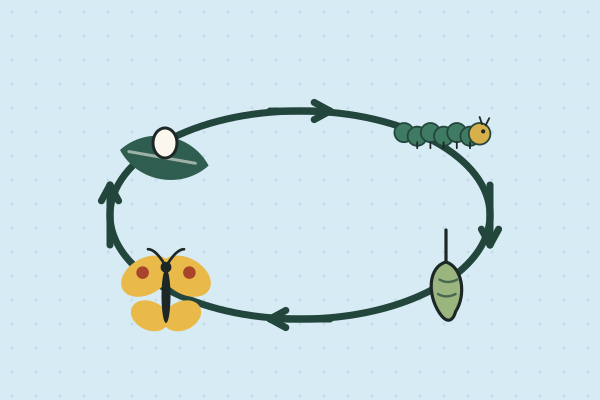 Lesson 3 · 45–60 minDoes every animal grow up the same way?Teams get clues about the life of one animal (a butterfly, a grasshopper, a frog or a bird), order the stages, and draw a life-cycle wheel. They compare the four wheels, find what every life cycle shares and see how a butterfly's cycle differs from a grasshopper's.
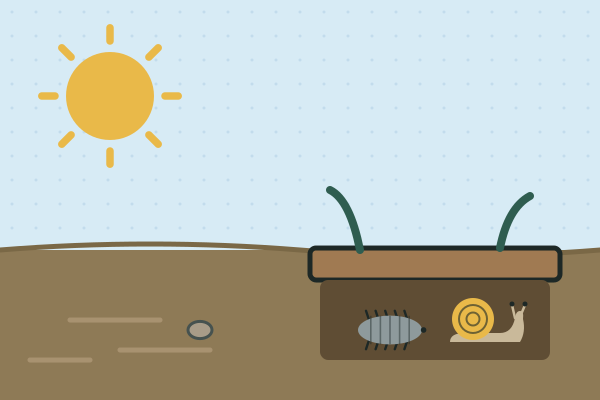 Lesson 4 · 45–60 minWho can live here, and who can't?Teams compare what lives under a board with what lives on the bare ground beside it, and feel which is damper. Then they judge six animals against the schoolyard's food, water and shelter, and argue with evidence which can live here well, which less well and which not at all.
Materials for the whole unit · one list, lesson by lesson
Lesson 1: Who lives in our schoolyard?
- String or garden twine, 4 m (13 ft), tied in a loop with a knot every metre1 loop per team
- Flat stones, sticks or pegs to hold the corners down4 per team
- Hand lens (5× to 10×)1 per team
- Clipboard or hard book, and pencils1 per team, 1 pencil each
- Phone or tablet for photos (optional)1 per team
- A fallen leaf, a stone and a feather or empty snail shell, found on the ground, for the Predict step1 set per class
About $20 for a class of 30
Lesson 2: Is a spider an insect?
- Animal cards (16 per set, copied from the student sheet and cut up)1 set per team
- String loops or A3 sheets of paper for sorting groups2 per team
- Plain paper or sticky notes for group namesA few per team
- Sketches or photos of creatures found in Lesson 1Each team's own
- Hand lens (optional)1 per team (optional)
About $5 for a class of 30 (paper and printing)
Lesson 3: Does every animal grow up the same way?
- Life-cycle clue cards (4 animals)1 per team, with each animal used at least once
- Paper circles or plain paper plates, about 25 cm (10 in) across1 per team
- Coloured pencils or crayons1 set per team
- Scissors and glue stick (optional, for stage pictures)1 per team
- Phone or tablet for photos on the yard walk (optional)1 per team
About $6 for a class of 30
Lesson 4: Who can live here, and who can't?
- Flat board or thick cardboard, about 30 cm (1 ft) square1 per survey spot (2 in all)
- Stones or pegs to mark the bare patch4 per patch
- Hand lens1 per team
- Clipboard and pencils1 per team
- Thermometer, to read the ground in the sun and under the board (optional)1 per team
- Animal need cards (copied from the student sheet)1 set per team
About $8 for a class of 30 (boards can be scrap)
Students lay a 1 m square of string on the ground in two different spots and count every kind of living thing they can find, without touching or taking anything. They sort sixteen animal clue cards by features (not looks) and settle whether a spider is an insect, draw life-cycle wheels for a butterfly, a grasshopper, a frog and a bird, and lift a cover board to compare what lives in the shelter with what lives on the bare ground beside it.
By the end, students can say what makes something living, once living or never alive; tell vertebrates from invertebrates and insects from spiders using features; describe the stages of a complete and an incomplete life cycle and what every life cycle shares; and argue from their own evidence that an animal survives well, less well or not at all in a particular habitat because of its food, water, shelter and temperature. Everything uses string, paper, hand lenses and a few boards, in any climate on any continent.