 Preview · the opening mission
Read this to the class:
The head teacher read your reports about the schoolyard. "Good counting," she said. "But why were there more creatures in the shady spot? And someone has asked if we could keep a goldfish in the yard, or if a frog would move in. Which animals could actually live here?" Your team's job: collect evidence about what lives under a board and on the bare ground, then argue which animals can live in our yard well, which less well and which not at all.
Teams of three, with three jobs that rotate: Spotter (looks and calls out what is there), Recorder (writes the data) and Feeler (touches the soil to check how damp it is and reads the thermometer, if you have one).
Look inside the PDF
Sample pages, stamped “preview”. The download is the clean, full lesson.
In the full lesson PDF
- Predict (5–10 min)
- Hunt (20 min)
- Reveal (10–15 min)
- Act (10 min)
- Background for the teacher
- Assessment
- Student sheet
- Worksheet: Label it
- Worksheet: Try it at home
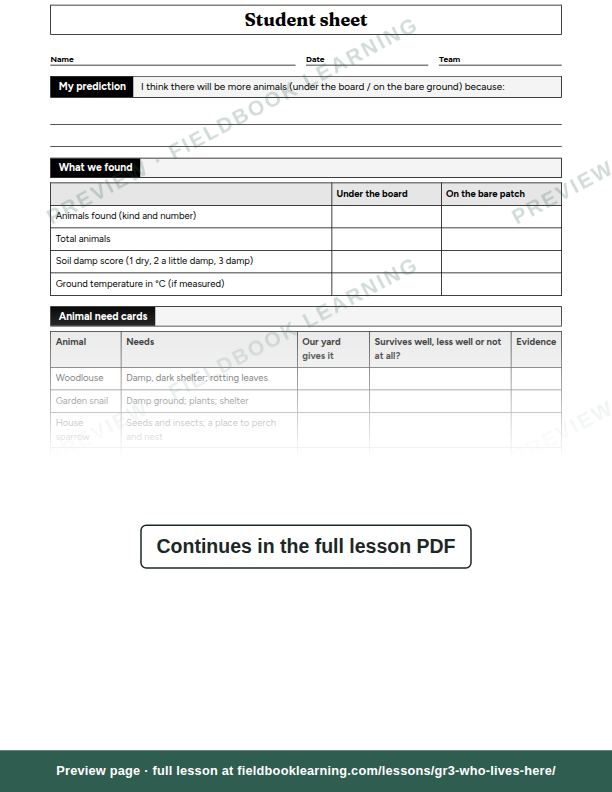
On the student sheet
- My prediction
- What we found
- Animal need cards
- My argument
- A change to help
- Label it
- Try it at home
US Letter, prints cleanly in black and white. The student sheet is on its own page, ready to photocopy.
Free with an account (any 3 lessons), or US$19 / C$25 for all 4 lessons in this unit.
What students show by the end
- Collects fair evidence
- Links needs to habitat
- Argues with evidence
From the lesson’s rubric, which scores each one as not yet, getting there or got it.
Questions teachers ask
How long does “Who can live here, and who can't?” take?
45–60 min. Group size: teams of 3.
How much prep does it need?
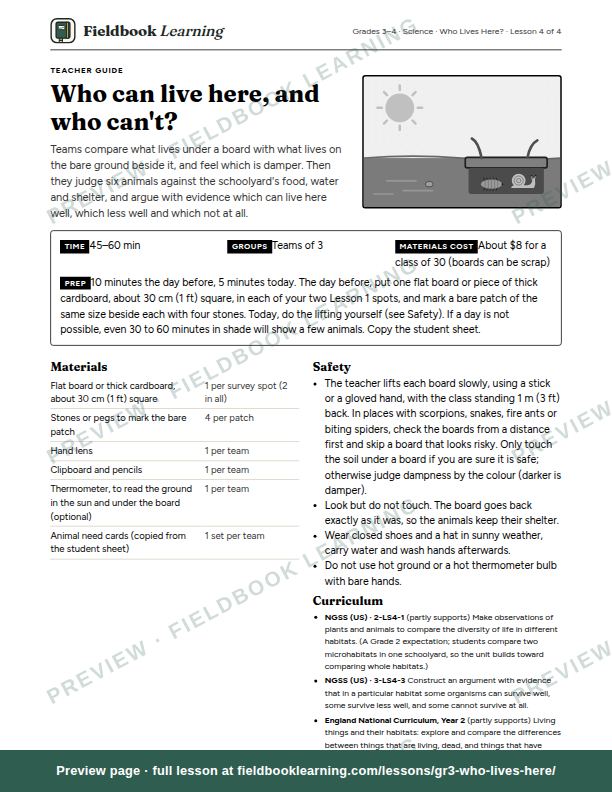
10 minutes the day before, 5 minutes today. The day before, put one flat board or piece of thick cardboard, about 30 cm (1 ft) square, in each of your two Lesson 1 spots, and mark a bare patch of the same size beside each with four stones. Today, do the lifting yourself (see Safety). If a day is not possible, even 30 to 60 minutes in shade will show a few animals. Copy the student sheet.
What materials do I need?
Flat board or thick cardboard, about 30 cm (1 ft) square; stones or pegs to mark the bare patch; hand lens; clipboard and pencils; thermometer, to read the ground in the sun and under the board (optional); animal need cards (copied from the student sheet). Cost: about $8 for a class of 30 (boards can be scrap).
Which curriculum standards does it cover?
NGSS (US): 2-LS4-1 (partly) and 3-LS4-3. It also matches England National Curriculum, Year 2 and Cambridge Primary Science.
What’s in the lesson PDF?
A teacher guide that walks you through predict, hunt, reveal, act, background for the teacher and assessment, then a student sheet (“My prediction”, “What we found”, “Animal need cards”, “My argument”, “A change to help”, “Label it” and “Try it at home”) on its own page, ready to photocopy. It’s US Letter and prints cleanly in black and white.
Can I try it for free?
Yes. A free account includes any 3 full lessons of your choice, and this can be one of them. After that, this unit is US$19 (C$25) for all 4 lessons, yours to keep, or every lesson is US$79 (C$109) a year.